
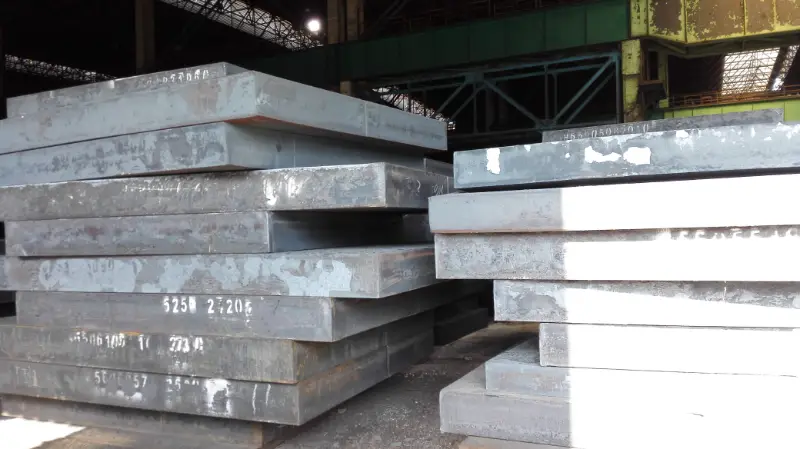
St37-2 Steel Plate: Full Data Sheet per DIN 17100
St37-2 Steel Plate: Full Data Sheet per DIN 17100 - Carbon Structural Steel
Complete technical data for St37-2 carbon structural steel according to DIN 17100, including chemical composition, mechanical properties, physical properties, international equivalents, and application guidance. Equivalent to EN 10025 S235JR.
Hot rolling, normalising rolling (upon agreement), cold forming, gas cutting, welding (all common methods), machining, drilling
- Phone : +8618037372205
- Email : [email protected]
- WhatsApp: Contact via Whtsapp
- WeChat: +8618037372205
St37-2 Steel Plate: Full Data Sheet per DIN 17100 Introduction
St37-2 is a non-alloy structural steel defined in the withdrawn German standard DIN 17100. It offers a minimum yield strength of 235 MPa for thicknesses up to 16 mm and tensile strength in the range of 360–510 MPa. The grade belongs to the basic quality category (Quality 2), meaning no specific impact energy is guaranteed unless separately agreed. St37-2 exhibits excellent weldability, good cold formability, and is suitable for general structural applications. It has been largely superseded by S235JR according to EN 10025-2, yet the designation remains in common use. Typical delivery condition is as-rolled; normalising rolling may be performed when specified. The material is widely used in civil engineering, bridge construction, vehicle manufacturing, and machinery.
St37-2 Steel Plate: Full Data Sheet per DIN 17100 Chemical Composition
The chemical composition of St37-2 is defined in DIN 17100. The limits shown are for ladle analysis. Values apply to standard structural steel without special requirements for impact toughness. Elements not listed are allowed only as residual impurities within the limits of the standard deoxidation practice. The nitrogen content is restricted when no nitrogen‑binding elements are present.
| Element | Standard Value (wt%) | Remarks |
|---|---|---|
| C | ≤ 0.17 | Maximum carbon content |
| Si | ≤ 0.50 | Typically up to 0.50%; may be left as trace in rimming steel |
| Mn | ≤ 1.40 | Manganese contributes to strength and deoxidation |
| P | ≤ 0.045 | Phosphorus maximum; higher limit reflects basic quality |
| S | ≤ 0.045 | Sulphur maximum; similar to P, no special desulphurisation required |
| N | ≤ 0.009 | Applies if no adequate nitrogen-binding elements (e.g. Al) are present |
| Cu | ≤ 0.55 (residual) | Copper is generally not specified but may appear; limit depends on agreement |
| Others | Traces | Cr, Ni, Mo etc. allowed only as unavoidable impurities; no guarantee given |
St37-2 Steel Plate: Full Data Sheet per DIN 17100 Thermal and Electrical Physical Properties
The following physical properties are based on typical data for carbon‑manganese structural steel of similar chemistry to St37-2. Actual values may vary slightly depending on exact composition, processing, and temperature. These data are not part of the mandatory requirements of DIN 17100 and are provided for design guidance.
| Property | Typical Value | Unit | Temperature / Condition |
|---|---|---|---|
| Density (ρ) | 7.85 | g/cm³ | Room temperature |
| Modulus of Elasticity (E) | 210 | GPa | Ambient |
| Shear Modulus (G) | 81 | GPa | Ambient |
| Poisson's Ratio (ν) | 0.3 | – | Ambient |
| Thermal Expansion Coefficient (α) | 11.5 × 10⁻⁶ | K-1 | 20 – 100 °C |
| Thermal Expansion Coefficient (α) | 12.2 × 10⁻⁶ | K-1 | 20 – 200 °C |
| Thermal Expansion Coefficient (α) | 13.0 × 10⁻⁶ | K-1 | 20 – 300 °C |
| Thermal Conductivity (λ) | 50 | W/(m·K) | Room temperature |
| Thermal Conductivity (λ) | 45 | W/(m·K) | 200 °C |
| Specific Heat Capacity (cp) | 460 | J/(kg·K) | Room temperature |
| Electrical Resistivity (ρe) | 0.18 – 0.22 | Ω·mm²/m | Room temperature |
St37-2 Steel Plate: Full Data Sheet per DIN 17100 Mechanical Properties
Mechanical properties are guaranteed for the as‑rolled condition according to DIN 17100. The yield strength ReH decreases with increasing product thickness. Tensile strength Rm is specified as a range. Elongation A is measured on a gauge length of 5.65√S₀ (A5) for sheet/plate and proportional test pieces for sections. Bending test at 180° is required; no impact energy is mandatory unless Grade St37‑2 is ordered with a supplementary impact requirement (e.g. +20 °C, KV ≥ 27 J, longitudinal).
| Property | Standard Value | Unit | Thickness / Condition |
|---|---|---|---|
| Yield Strength ReH | ≥ 235 | MPa | t ≤ 16 mm |
| Yield Strength ReH | ≥ 225 | MPa | 16 < t ≤ 40 mm |
| Yield Strength ReH | ≥ 215 | MPa | 40 < t ≤ 100 mm |
| Yield Strength ReH | ≥ 195 | MPa | 100 < t ≤ 150 mm |
| Yield Strength ReH | ≥ 185 | MPa | 150 < t ≤ 200 mm |
| Tensile Strength Rm | 360 – 510 | MPa | t ≤ 40 mm |
| Tensile Strength Rm | 340 – 510 | MPa | 40 < t ≤ 100 mm |
| Tensile Strength Rm | 330 – 510 | MPa | 100 < t ≤ 200 mm |
| Elongation A (longitudinal) | ≥ 26 | % | t ≤ 40 mm |
| Elongation A (longitudinal) | ≥ 25 | % | 40 < t ≤ 63 mm |
| Elongation A (longitudinal) | ≥ 24 | % | 63 < t ≤ 100 mm |
| Elongation A (longitudinal) | ≥ 22 | % | 100 < t ≤ 200 mm |
| Bend Test (180°) | mandrel dia. = 0.5 × t | – | t ≤ 16 mm |
| Bend Test (180°) | mandrel dia. = 1.0 × t | – | 16 < t ≤ 100 mm |
| Bend Test (180°) | mandrel dia. = 2.0 × t | – | 100 < t ≤ 200 mm |
St37-2 Steel Plate: Full Data Sheet per DIN 17100 Full Equivalents – Standards and Grades That Match St37-2 Requirements
| Country / Region | Standard | Grade / Designation | Remarks |
|---|---|---|---|
| Germany | DIN 17100 | St37-2 | Original standard, now withdrawn; basic structural quality |
| Europe | EN 10025-2 | S235JR | Direct successor; guaranteed impact at +20°C (min. 27J) |
| International | ISO 630-2 | E235A | Strength ranges overlap; elongation limits comparable |
| USA | ASTM A283/A283M | Grade C | Similar yield and tensile; weldable structural carbon steel |
| Japan | JIS G3101 | SS400 | Tensile 400–510 MPa, yield ≥ 245 MPa (t≤16 mm); often used interchangeably |
| China | GB/T 700 | Q235B | Yield ≥ 235 MPa, tensile 370–500 MPa; +20°C impact 27J typically guaranteed |
St37-2 Steel Plate: Full Data Sheet per DIN 17100 Application Introduction
St37-2 is a versatile carbon structural steel suitable for a wide range of general engineering and construction applications. Its combination of adequate strength, excellent weldability, and good cold formability makes it a preferred choice for statically and dynamically loaded structures where no special low‑temperature toughness is required. When impact properties are needed, the user should specify St37‑3 or S235J0/J2 equivalents.
Product Applications: Steel frameworks (columns, beams, trusses), Bridge girders and deck plates, Truck chassis and trailer parts, Farm equipment (plough frames, harrows), Low‑pressure storage tanks and silos, Pipelines for water and non‑hazardous fluids, Fencing, handrails, and grating
Processed into products: Base plates and footings, Gusset plates and connecting brackets, Flanges and stiffeners, Welded brackets and cleats, Machined bushes and spacers (when hardness is less critical), Shear studs and connectors, Lifting lugs and padeyes, Structural hollow sections and rolled angles for bracing
Application industries: Civil Engineering and Construction, Bridge Building, Vehicle and Trailer Manufacturing, Agricultural Machinery, Storage Tanks and Silos, General Mechanical Engineering, Structural Steelwork for Buildings and Roofs
St37-2 Steel Plate: Full Data Sheet per DIN 17100 Similar / Closely Related Materials for Potential Substitution
| Country / Region | Standard | Grade / Designation | Remarks |
|---|---|---|---|
| Germany | DIN 17100 | St37-3 | Fully killed, guaranteed impact at +20°C, more uniform toughness |
| Europe | EN 10025-2 | S235J0 | Impact guaranteed at 0°C, slightly higher quality requirement |
| Europe | EN 10025-2 | S235J2 | Impact guaranteed at -20°C, fine grain practice |
| USA | ASTM A283/A283M | Grade D | Higher manganese, similar strength, sometimes used in place of St37-2 |
| Japan | JIS G3101 | SS330 | Lower tensile (330–430 MPa), used for less demanding structures |
| China | GB/T 700 | Q235A | No impact guarantee; otherwise very similar chemistry and strength |
| China | GB/T 700 | Q235C | 0°C impact guaranteed, more suitable for cold environment substitutes |
Notes:
Welding: St37-2 is readily weldable using all common arc welding processes (SMAW, GMAW, FCAW, SAW). No preheating is generally required for thicknesses below 30 mm; thicker sections may need a preheat of ~100–150 °C depending on joint restraint and hydrogen control. Cold forming: The steel can be bent, flanged, and rolled to tight radii, especially in material up to 16 mm. The bend test guarantees formability parallel and perpendicular to the rolling direction. Surface treatment: The material accepts hot‑dip galvanising, painting, and powder coating after appropriate surface preparation. Replaced standard: Although DIN 17100 was officially withdrawn in 2004 and replaced by EN 10025, the designation St37-2 is still widely used in inquiries and stock lists. When ordering to an active standard, EN 10025‑2 S235JR should be specified.
- Share



