
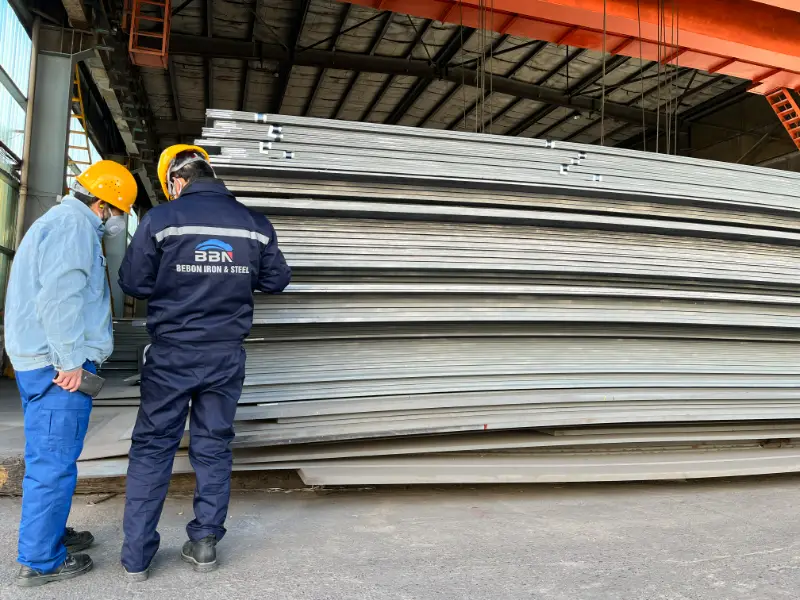
DIN17100 USt37-2 Carbon Structural Steel Plate
DIN17100 USt37-2 Carbon Structural Steel Plate - Composition, Properties & International Equivalents
Complete material data for DIN17100 USt37-2 steel including chemical composition, mechanical and physical properties, exact equivalent grades, and application guidance.
Welding, oxy-fuel cutting, plasma cutting, bending, roll forming, deep drawing, machining
- Phone : +8618037372205
- Email : [email protected]
- WhatsApp: Contact via Whtsapp
- WeChat: +8618037372205
DIN17100 USt37-2 Carbon Structural Steel Plate Introduction
USt37-2 is a non-alloy structural steel specified under the withdrawn German standard DIN 17100. It belongs to the St37-2 family, with the prefix U designating unkilled (rimmed) steel. This steelmaking practice limits the maximum product thickness to 25 mm and results in a surface that is particularly suitable for cold forming and bending. USt37-2 exhibits a minimum tensile strength of 360 MPa and, in the as-rolled condition, is widely used for general welded structures, machinery parts, and building components that do not require guaranteed low-temperature toughness. Its good weldability and formability have made it a popular choice in European manufacturing, although modern standards now prefer fully killed alternatives such as S235JR.
DIN17100 USt37-2 Carbon Structural Steel Plate Chemical Composition
The chemical composition limits for USt37-2 according to DIN 17100 are shown below. Silicon is not intentionally added because of the rimmed steel practice, and nitrogen content is tightly controlled to ensure good weldability. The values apply to product thicknesses up to 100 mm; for greater thicknesses slightly higher nitrogen may be permitted.
| Chemical Element | Standard Value (max %) | Remarks |
|---|---|---|
| Carbon (C) | 0.17 | ≤ 0.17% |
| Silicon (Si) | Trace | Not added intentionally (rimmed); typical residual < 0.03% |
| Manganese (Mn) | 1.40 | ≤ 1.40% |
| Phosphorus (P) | 0.045 | ≤ 0.045% |
| Sulfur (S) | 0.045 | ≤ 0.045% |
| Nitrogen (N) | 0.009 | ≤ 0.009% (for thickness ≤ 100 mm) |
DIN17100 USt37-2 Carbon Structural Steel Plate Thermal and Electrical Physical Properties
These physical property values are representative for carbon structural steels and can be applied to USt37-2. Variations may occur due to slight differences in chemical composition and manufacturing route, but the data are suitable for most engineering calculations.
| Property | Typical Value | Unit | Test Condition / Temperature |
|---|---|---|---|
| Density (ρ) | 7.85 | kg/dm³ | Room temperature |
| Modulus of elasticity (E) | 210 | GPa | Room temperature |
| Shear modulus (G) | 81 | GPa | Room temperature |
| Poisson's ratio (ν) | 0.3 | — | Room temperature |
| Thermal expansion coefficient (α) | 11.1 | 10⁻⁶/K | 20–100 °C |
| Thermal expansion coefficient (α) | 12.5 | 10⁻⁶/K | 20–200 °C |
| Thermal conductivity (λ) | 53 | W/(m·K) | Room temperature |
| Specific heat capacity | 460 | J/(kg·K) | Room temperature |
| Electrical resistivity (ρₑ) | 0.15 | µΩ·m | Room temperature |
DIN17100 USt37-2 Carbon Structural Steel Plate Mechanical Properties
The following mechanical property requirements are extracted from DIN 17100 for USt37-2. Because the steel is rimmed, the maximum guaranteed thickness is normally 25 mm. Values are given for longitudinal test pieces at room temperature. The impact energy requirement applies to quality grade 2 at +20°C.
| Property | Standard Requirement Value | Unit | Test Condition |
|---|---|---|---|
| Yield strength (ReH) | ≥ 235 | MPa | Nominal thickness t ≤ 16 mm |
| Yield strength (ReH) | ≥ 225 | MPa | Nominal thickness 16 < t ≤ 25 mm |
| Tensile strength (Rm) | 360 – 510 | MPa | Nominal thickness t ≤ 25 mm |
| Elongation after fracture (A) | ≥ 25 | % | Longitudinal, gauge length L₀ = 5.65√S₀, t ≤ 16 mm |
| Elongation after fracture (A) | ≥ 24 | % | Longitudinal, gauge length L₀ = 5.65√S₀, 16 < t ≤ 25 mm |
| Impact energy (KV) | ≥ 27 | J | Longitudinal, at +20 °C, Charpy V-notch 10×10 mm |
DIN17100 USt37-2 Carbon Structural Steel Plate Exact Equivalent Materials
| Country/Region | Standard | Grade | Remark |
|---|---|---|---|
| Germany | DIN 17100 (obsolete) | RSt37-2 | Killed version with identical mechanical properties; direct replacement within thickness limits. |
| Europe | EN 10025-2:2004 | S235JR | Modern killed steel; JR guarantees 27 J at +20 °C. Slightly different Si limits. Equivalent for t ≤ 25 mm. |
| International | ISO 630-2:2011 | E235B | Fe 360 B under older notations. Similar strength and impact requirement. |
| USA | ASTM A283/A283M | Grade C | Tensile 380–515 MPa, yield ≥ 205 MPa; chemical limits differ. Suitable for structural use. |
| Japan | JIS G3101 | SS400 | General structural steel; tensile 400–510 MPa. Not guaranteed impact. Substitution requires design review. |
| China | GB/T 700 | Q235B | Impact ≥ 27 J at +20 °C; yield ≥ 235 MPa. Contains Si, need to consider welding compatibility. |
DIN17100 USt37-2 Carbon Structural Steel Plate Application Introduction
USt37-2 is a classic general-purpose structural steel that has been extensively used in European engineering. Due to its rimmed steel surface quality, it is particularly well suited for cold forming, deep drawing, and bending of thin-walled components. The steel can be welded with all conventional methods, although precautions to avoid lamellar tearing are recommended when welding thick sections subjected to through-thickness loads. Modern designs often replace it with killed grades like S235JR to improve consistency and guarantee properties in thicker sections. Typical uses span from simple brackets to complex welded frameworks.
Product Applications: Structural steel frames and portals, Light-duty crane runways and walkways, Metal enclosure panels and cabinets, Ducting and ventilation components, Handrails, ladders, and platforms, Formwork and scaffolding parts, Small storage tanks and hoppers
Processed into products: Base plates and mounting brackets, Gusset plates, stiffeners, and ribs, Simple bent profiles and channels, Cut-and-welded assemblies for machinery frames, Pipe clamps and U-bolts, Guard plates and protective covers, Hinges, latches, and other general hardware
Application industries: Building and construction (frames, purlins, secondary members), General machinery manufacturing (housings, supports, machine bases), Agricultural equipment (trailers, seeders, harrows), Transportation and automotive (chassis parts, cross members), Storage and material handling (racks, shelving, silos), Energy and piping (pipe clamps, cable trays, small pressure vessels – with limitations)
DIN17100 USt37-2 Carbon Structural Steel Plate Similar / Alternative Material Recommendations
| Country/Region | Standard | Grade | Remark |
|---|---|---|---|
| Germany | DIN 17100 | USt37-2 (RSt37-2) | RSt37-2 is the killed equivalent offering the same mechanical properties with better through-thickness properties. |
| Europe | EN 10025-2 | S235J0 / S235J2 | For improved toughness at 0 °C or -20 °C. Slightly higher strength reliability. |
| USA | ASTM A36/A36M | A36 | Tensile 400–550 MPa, yield ≥ 250 MPa; widely available structural steel. Can replace USt37-2 in many applications. |
| China | GB/T 700 | Q235A/Q235C | Q235A without impact requirement; Q235C with 0 °C impact. Choose according to service temperature. |
| Russia | GOST 380 | St3sp/St3ps | Similar carbon structural steels; mechanical properties comparable to USt37-2 (killed/semi-killed). |
Notes:
USt37-2 is withdrawn from the current suite of European standards. The rimmed steel practice has been largely phased out because of quality scatter and thickness limitations. When designing new equipment or performing repairs, it is recommended to use S235JR, S235J0, or S235J2 according to EN 10025-2. These killed steels offer more predictable mechanical properties and better weldability. In substitution, note that the Si content of killed grades may slightly affect surface quality in cold-forming operations and may require adjustment of welding consumables. For critical fatigue or impact-loaded structures, a thorough review of material certificates and quality plans is advised.
- Share



