
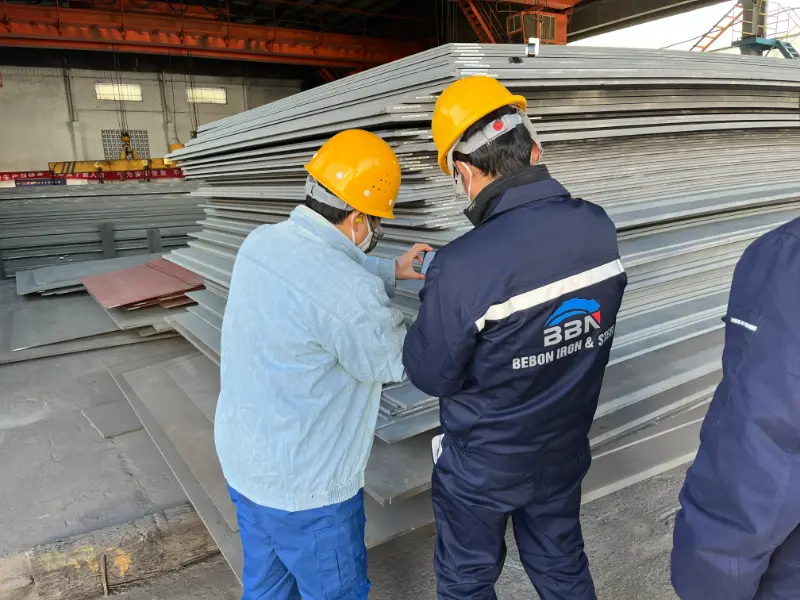
DIN 17100 RSt37-2 Structural Steel
DIN 17100 RSt37-2 Structural Steel: Comprehensive Material Properties & Equivalent Grades Analysis
In-depth technical data sheet for RSt37-2 steel under DIN 17100. Includes chemical composition, mechanical & physical properties, international equivalents, and application guide for carbon structural steel.
Hot rolling, Cold forming, Welding, Machining, Stamping, Bending
- Phone : +8618037372205
- Email : [email protected]
- WhatsApp: Contact via Whtsapp
- WeChat: +8618037372205
DIN 17100 RSt37-2 Structural Steel Introduction
RSt37-2 is a carbon structural steel grade defined under the withdrawn German standard DIN 17100. It is classified as a rimming steel (RSt) with a minimum tensile strength of 340-470 MPa. Known for its good weldability, good toughness, and excellent cold-forming properties, it is suitable for general structural applications. The '37' designation indicates the minimum tensile strength in kg/mm². This grade is often specified in delivery condition +N (normalized) or +AR (as-rolled). It has been largely superseded by S235JR under the modern European standard EN 10025-2, though it remains referenced in legacy designs.
DIN 17100 RSt37-2 Structural Steel Chemical Composition
The chemical composition for RSt37-2 is specified according to DIN 17100. This grade is characterized by a rimming steel process (RSt) which results in a relatively inhomogeneous core compared to killed steels. The phosphorus and sulfur contents are limited to ensure good toughness and weldability. Nitrogen is allowed up to 0.009% if total aluminum content is present, otherwise a higher limit may apply depending on thickness.
| Element | Standard Value (Max or Range) | Remarks |
|---|---|---|
| C (Carbon) | ≤ 0.17% | Max based on heat analysis for thickness ≤ 16mm |
| Si (Silicon) | ≤ 0.50% | Max value; trace amounts allowed |
| Mn (Manganese) | ≥ 0.20% | Minimum value; typical max 1.40% depends on thickness |
| P (Phosphorus) | ≤ 0.050% | Max for heat analysis |
| S (Sulfur) | ≤ 0.050% | Max for heat analysis |
| N (Nitrogen) | ≤ 0.009% | Max for heat analysis (if sufficient Al present) |
| Fe (Iron) | Balance | Remainder |
DIN 17100 RSt37-2 Structural Steel Thermal and Electrical Physical Properties
Physical properties for RSt37-2 are approximate reference values for low-carbon structural steels at room temperature unless otherwise noted. These properties are suitable for engineering calculations involving thermal expansion, heat transfer, and structural stiffness. Variability depends on the exact metallurgical condition.
| Property Item | Standard Required Value | Unit | Test Condition |
|---|---|---|---|
| Density (ρ) | 7.85 | g/cm³ | At 20°C |
| Modulus of Elasticity (E) | 210 | GPa | At 20°C |
| Shear Modulus (G) | 80 | GPa | At 20°C |
| Poisson's Ratio (ν) | 0.30 | - | At 20°C |
| Thermal Expansion Coefficient (α) | 1.2 x 10⁻⁵ | K⁻¹ | 20°C to 100°C |
| Thermal Expansion Coefficient (α) | 1.35 x 10⁻⁵ | K⁻¹ | 20°C to 300°C |
| Thermal Conductivity (λ) | 54 | W/(m·K) | At 20°C |
| Specific Heat Capacity | 0.46 | J/(g·K) | At 20°C to 100°C |
| Electrical Resistivity (ρ_e) | 0.15 - 0.26 | Ω·mm²/m | At 20°C |
DIN 17100 RSt37-2 Structural Steel Mechanical Properties
Mechanical properties of RSt37-2 are dependent on product thickness. The values below reflect standard requirements for flat and long products in the normalized or as-rolled condition. The impact energy is guaranteed only for the killed steel variant, but for RSt (rimming steel), the impact properties were not strictly defined in the base standard except by agreement.
| Property Item | Standard Required Value | Unit | Test Condition |
|---|---|---|---|
| Upper Yield Strength (ReH) | ≥ 235 | MPa | Thickness ≤ 16mm |
| Upper Yield Strength (ReH) | ≥ 225 | MPa | 16mm < Thickness ≤ 40mm |
| Upper Yield Strength (ReH) | ≥ 215 | MPa | 40mm < Thickness ≤ 63mm |
| Upper Yield Strength (ReH) | ≥ 205 | MPa | 63mm < Thickness ≤ 80mm |
| Upper Yield Strength (ReH) | ≥ 195 | MPa | 80mm < Thickness ≤ 100mm |
| Tensile Strength (Rm) | 340 - 470 | MPa | Thickness ≤ 100mm |
| Elongation after fracture (A) | ≥ 26 | % | Longitudinal, Thickness ≤ 16mm, Lo=80mm |
| Elongation after fracture (A) | ≥ 25 | % | Longitudinal, 16mm < Thickness ≤ 40mm, Lo=80mm |
| Elongation after fracture (A) | ≥ 24 | % | Longitudinal, 40mm < Thickness ≤ 63mm, Lo=80mm |
| Elongation after fracture (A) | ≥ 23 | % | Longitudinal, 63mm < Thickness ≤ 100mm, Lo=80mm |
| Bend Test (Mandrel Diameter) | No cracks | - | 180° bend, a = specimen thickness; d = 0.5a (transverse) |
DIN 17100 RSt37-2 Structural Steel Equivalent Material Standards and Substitutable Grade Designations
| Country / Region | Standard | Grade Designation | Remarks |
|---|---|---|---|
| European Union | EN 10025-2:2019 | S235JR (1.0038) | Direct replacement. Killed steel. RSt37-2 is rimmed. S235JR has better homogeneity. |
| China | GB/T 700-2006 | Q235B | Similar strength and usage. Q235B has guaranteed impact properties at 20°C. |
| USA | ASTM A283/A283M-18 | Gr.C | Tensile 380-515 MPa. Slightly higher strength range. Used in structural applications. |
| Japan | JIS G3101:2015 | SS400 | Tensile 400-510 MPa. Structural general purpose. Not strictly identical to RSt37-2. |
| International | ISO 630-2:2011 | S235B | Part of international structural steel framework, closely aligned with EN S235JR. |
DIN 17100 RSt37-2 Structural Steel Application Introduction
RSt37-2 is a versatile general structural steel. Its excellent cold formability and reliable weldability make it suitable for a wide range of applications.
- Welding: Suitable for arc welding, gas welding, and resistance welding. Preheating generally not required for thicknesses below 30mm.
- Forming: Excellent for folding, bending, and pressing operations at room temperature.
- Machining: Fair machinability in normalized condition. Not recommended for high-speed cutting of complex shapes without proper cooling.
Product Applications: Steel structural frames, Bridge girders and sections, Freight wagon components, Ship hulls and decks, Storage tanks and pressure vessels (ambient temp), Transmission line towers, Scaffolding systems, Container corners and fittings
Processed into products: Flanges and gusset plates, Angle brackets and shelf supports, Cold-formed channels and Z-purlins, Welded I-beams and H-piles, Base plates and stiffeners, Manhole covers and grating, Piping supports and clamps, Agricultural tiller blades
Application industries: Building and Construction, Bridge Engineering, Railway Vehicle Manufacturing, Shipbuilding, Tank and Silo Fabrication, Agricultural Machinery, General Machine Building
DIN 17100 RSt37-2 Structural Steel Similar or Comparable Alternative Materials
| Country / Region | Standard | Grade Designation | Remarks |
|---|---|---|---|
| European Union | EN 10025-2:2019 | S235J0 (1.0114) | Higher quality level than JR. Guaranteed impact energy at 0°C. |
| European Union | EN 10025-2:2019 | S235J2 (1.0117) | Guaranteed impact energy at -20°C. Suitable for more demanding structures. |
| USA | ASTM A36/A36M-19 | A36 | Tensile 400-550 MPa. Very common structural steel, slightly higher strength. |
| China | GB/T 700-2006 | Q235C / Q235D | Higher toughness grades than Q235B. Suitable for lower service temperatures. |
| Russia | GOST 380-2005 | St3sp / St3ps | Similar carbon structural steel with equivalent application range. |
Notes:
Note on Rimming Steel (RSt): The 'RSt' designation signifies rimming steel, which has a pure outer rim but a core with higher segregation compared to killed steels. For critical welded structures subject to dynamic loads or low-temperature service (below 0°C), modern standards mandate the use of killed steel grades like EN S235J0/J2 instead of RSt37-2.
Supplementary Requirements: Options for normalized rolling, improved surface condition, or specific copper content for increased atmospheric corrosion resistance could be agreed upon under the old DIN standard. In modern procurement, S235JR (Options 1-6) covers many of these supplementary requirements under EN 10025-2.
- Share



