
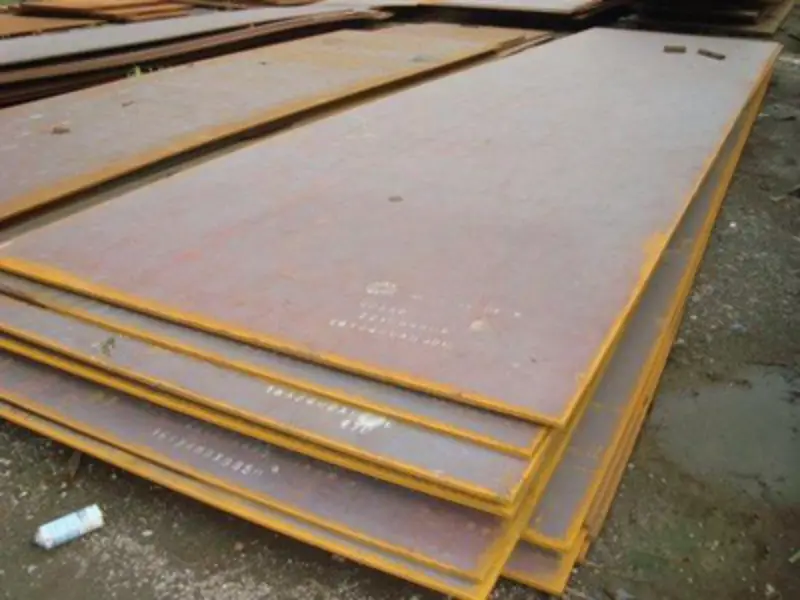
DIN 17100 St37-3 Structural Steel Plate
DIN 17100 St37-3 Structural Steel Plate: Properties, Equivalents & Global Standards
Complete data sheet for St37-3 carbon steel plate according to DIN 17100: chemistry, mechanical & thermal properties, international equivalents (EN S235J0, ISO E235B), and application guidance.
Hot rolling, normalizing, welding, bending, bolting, machining
- Phone : +8618037372205
- Email : [email protected]
- WhatsApp: Contact via Whtsapp
- WeChat: +8618037372205
DIN 17100 St37-3 Structural Steel Plate Introduction
DIN 17100 St37-3 is a general structural steel grade designed for hot-rolled products such as plates, sheets, strips, wide flats, sections, and bars. It is a carbon and low-alloy high-strength steel with a minimum yield strength of 235 MPa for thicknesses up to 16 mm. The '-3' suffix denotes a killed steel with guaranteed impact toughness of at least 27 J at +20 °C (longitudinal Charpy V-notch). Typical applications include welded, bolted, and riveted structures in civil engineering, bridge building, vehicle manufacturing, and machinery. With good weldability and formability, St37-3 is an economical choice for general fabrication. The standard DIN 17100 is now withdrawn and replaced by EN 10025-2, where the closest equivalent is S235J0 (1.0114) or S235J2 (1.0117) for higher toughness requirements.
DIN 17100 St37-3 Structural Steel Plate Chemical Composition
The chemical composition of St37-3 is governed by DIN 17100. For killed steel, silicon shall be 0.17–0.40%. Manganese limits depend on the product thickness, with maximum values rising as thickness increases. Phosphorus and sulfur are controlled for weldability and toughness, and nitrogen is limited to ensure good cold formability. No deliberate additions of alloying elements are required.
| Element | Standard Value (wt%) | Remarks |
|---|---|---|
| Carbon (C) | max 0.17 | Ladle analysis |
| Silicon (Si) | 0.17 – 0.40 | Required if killed steel is specified; otherwise only report if requested |
| Manganese (Mn) | max 1.40 | For product thickness ≤ 40 mm |
| Manganese (Mn) | max 1.50 | For product thickness > 40 mm and ≤ 63 mm |
| Manganese (Mn) | max 1.60 | For product thickness > 63 mm and ≤ 100 mm |
| Phosphorus (P) | max 0.045 | Ladle analysis |
| Sulfur (S) | max 0.045 | Ladle analysis |
| Nitrogen (N) | max 0.009 | Applicable if specified, e.g. for cold formability requirements |
DIN 17100 St37-3 Structural Steel Plate Thermal and Electrical Properties
The values below are typical for carbon structural steels at room temperature and serve as reference. Exact properties may vary with composition and manufacturing process. Thermal conductivity decreases slightly with rising temperature, and electrical resistivity increases. These data are not part of the DIN 17100 standard but are widely accepted for steel grades like St37-3.
| Property | Typical Value | Unit | Test Condition / Remarks |
|---|---|---|---|
| Density (ρ) | 7.85 | g/cm³ | At 20 °C |
| Modulus of Elasticity (E) | 210 | GPa | At 20 °C, tension |
| Shear Modulus (G) | 81 | GPa | At 20 °C, calculated |
| Poisson's Ratio (ν) | 0.3 | — | Elastic range |
| Thermal Expansion Coefficient (α) | 12 × 10⁻⁶ | K⁻¹ | Between 20 °C and 100 °C |
| Thermal Conductivity (λ) | 53 | W/(m·K) | At 20 °C |
| Specific Heat Capacity (c) | 460 | J/(kg·K) | At 20 °C |
| Electrical Resistivity (ρe) | 0.15 – 0.20 | Ω·mm²/m | At 20 °C, typical for carbon steel |
DIN 17100 St37-3 Structural Steel Plate Mechanical Properties
The mechanical properties of St37-3 are thickness-dependent. The guaranteed minimum yield strength decreases with increasing product thickness, while the tensile strength range remains constant. Elongation is measured on a gauge length of Lo = 5.65√So for flat products. Impact toughness is verified at +20 °C on longitudinal Charpy V-notch specimens. These values are based on DIN 17100:1980 and represent the delivery condition 'U' (untreated) or 'N' (normalized) as agreed.
| Property | Standard Requirement | Unit | Test Condition / Remarks |
|---|---|---|---|
| Yield Strength (ReH) | ≥ 235 | MPa | Thickness ≤ 16 mm |
| Yield Strength (ReH) | ≥ 225 | MPa | 16 mm < thickness ≤ 40 mm |
| Yield Strength (ReH) | ≥ 215 | MPa | 40 mm < thickness ≤ 63 mm |
| Yield Strength (ReH) | ≥ 205 | MPa | 63 mm < thickness ≤ 80 mm |
| Yield Strength (ReH) | ≥ 195 | MPa | 80 mm < thickness ≤ 100 mm |
| Tensile Strength (Rm) | 360 – 510 | MPa | All thicknesses up to 100 mm |
| Elongation at fracture (A) | ≥ 25 | % | Thickness ≤ 40 mm, Lo=5.65√So |
| Elongation at fracture (A) | ≥ 24 | % | 40 mm < thickness ≤ 63 mm, Lo=5.65√So |
| Elongation at fracture (A) | ≥ 23 | % | 63 mm < thickness ≤ 100 mm, Lo=5.65√So |
| Charpy Impact Energy (KV) | ≥ 27 | J | At +20 °C, longitudinal, V-notch specimen |
DIN 17100 St37-3 Structural Steel Plate Exactly Equivalent Material Standards and Substitute Grades
| Country / Region | Standard | Designation | Remarks |
|---|---|---|---|
| Europe | EN 10025-2 | S235J0 (1.0114) | Closest equivalent; impact test at 0 °C (27 J longitudinal). S235J2 (1.0117) for -20 °C toughness. St37-3 originally required +20 °C, thus S235J0 is widely accepted. |
| International | ISO 630-2 | E235B | Structural steel Fe360C; impact energy 27 J at +20 °C, directly comparable. |
| Italy | UNI 7070 | Fe 360 C | Obsolete, same concept as St37-3 with +20 °C impact. |
| Spain | UNE 36080 | AE 235 C | Equivalent grade, withdrawn. |
| France | NF A35-501 | E 24-3 | Obsolete standard; E 24-3 corresponds to St37-3. |
DIN 17100 St37-3 Structural Steel Plate Application Introduction
St37-3 is a versatile structural steel suitable for welded, bolted, and riveted constructions. Its guaranteed impact toughness at ambient temperature makes it reliable for dynamically loaded components when a certain notch toughness is required. The material is easily formed, machined, and welded using all common techniques. As the standard is obsolete, current projects often specify EN S235J0 as a direct replacement.
Product Applications: Structural frames and girders, Welded beams and columns, Bridge decks and supports, Railway wagon underframes, Offshore platform secondary structures, Industrial flooring and grating, General fabrication of steel parts
Processed into products: Load-bearing columns and beams, Stiffeners and gusset plates, Machinery bases, Vehicle chassis rails and cross members, Brackets and mounting plates, Tank shell plates (non–cryogenic), Welded pipe flanges (non–high–temperature)
Application industries: Construction and civil engineering (buildings, halls, bridges), Automotive and heavy vehicle chassis, Shipbuilding and marine structures (limited by classification societies), Mechanical engineering and machinery frames, Pressure vessel and storage tank manufacturing (for low–pressure, non–critical service), Steel structures for power plants, conveyors, and cranes
DIN 17100 St37-3 Structural Steel Plate Similar / Alternative Materials
| Country / Region | Standard | Designation | Remarks |
|---|---|---|---|
| Europe | EN 10025-2 | S235JR (1.0038) | Similar strength, but no impact test requirement. Suitable for static applications. |
| USA | ASTM A36/A36M | A36 | Comparable yield (250 MPa for thin plates) and tensile strength; impact not mandatory unless ordered. |
| Japan | JIS G 3101 | SS400 | General structural steel; no impact requirement; similar strength range. |
| China | GB/T 700 | Q235C | Requires 0 °C impact 27 J, slightly higher toughness than St37-3; for +20 °C Q235B can be used but impact optional. |
| India | IS 2062 | E250 B | Fe 410 W B with 27 J at +20 °C; closely comparable. |
Notes:
Important: DIN 17100 has been officially withdrawn and superseded by EN 10025-2:2004 (now EN 10025-2:2019). For new designs, S235J0 or S235J2 should be specified. When ordering St37-3 from old stock or for maintenance jobs, confirm the impact test temperature (+20 °C) with the supplier. The chemical composition and mechanical properties provided are from DIN 17100:1980 and may differ slightly in other national implementations. Always verify the material certificate for compliance with the required specification.
- Share



