
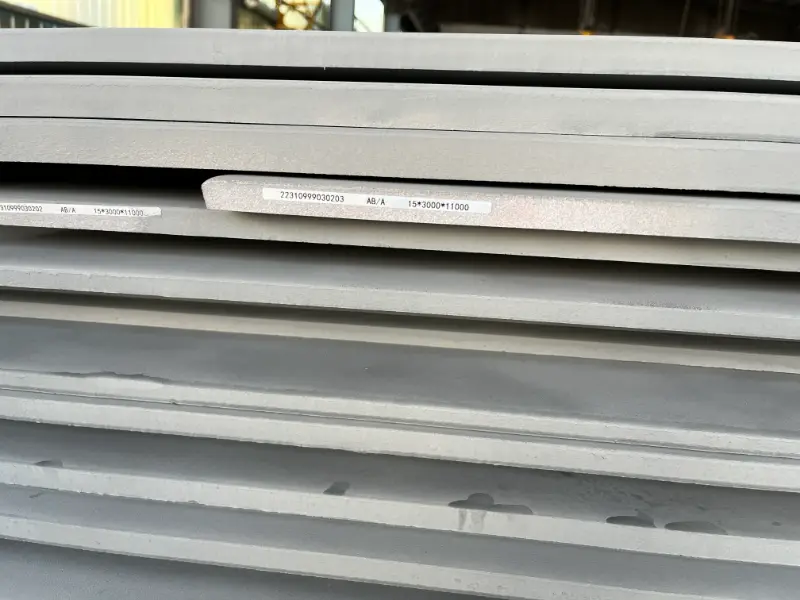
St52-3 / DIN 17100 High-Strength Structural Steel Plate
St52-3 / DIN 17100 High-Strength Structural Steel Plate & Its Equivalents
Explore the complete material datasheet of St52-3 carbon and low-alloy high-strength steel plate under DIN 17100, including chemical composition, mechanical and physical properties, international equivalents, and application guidelines.
Hot rolling, normalizing, cold forming, welding, cutting, machining
- Phone : +8618037372205
- Email : [email protected]
- WhatsApp: Contact via Whtsapp
- WeChat: +8618037372205
St52-3 / DIN 17100 High-Strength Structural Steel Plate Introduction
St52-3, specified in the withdrawn German standard DIN 17100, is a widely used carbon and low-alloy high-strength structural steel. It provides a minimum yield strength of 355 MPa for thicknesses up to 16 mm and offers good weldability and formability. The steel is primarily delivered in the hot-rolled or normalized condition and is suitable for general structural applications. Although the standard is obsolete, St52-3 remains a common reference grade and is functionally replaced by grades such as EN 10025-2 S355J2. Its balanced composition with low carbon and micro-alloying elements ensures reliable mechanical performance across plate, sheet, and section products. This datasheet gathers official property data based on DIN 17100 and typical physical values.
St52-3 / DIN 17100 High-Strength Structural Steel Plate Chemical Composition
The following table lists the main alloying and impurity elements according to DIN 17100 for St52-3. The steel is typically fully killed with addition of grain-refining elements such as aluminium and, optionally, niobium, vanadium or titanium. These micro-alloying elements are not individually limited but contribute to the overall mechanical properties. Single values are maximum unless a range is indicated.
| Element | Standard Value | Remarks |
|---|---|---|
| Carbon (C) | ≤0.20 | For thickness ≤100 mm |
| Silicon (Si) | ≤0.55 | Killed steel practice |
| Manganese (Mn) | ≤1.60 | Higher Mn may be present in thicker products |
| Phosphorus (P) | ≤0.040 | Higher than modern EN standards |
| Sulfur (S) | ≤0.040 | Higher than modern EN standards |
| Nitrogen (N) | ≤0.009 | If sufficient Al present; otherwise ≤0.012 |
| Aluminium (total, Al) | ≥0.020 | For fine grain practice, soluble Al typical |
| Niobium (Nb) | ≤0.05 | Optional micro-alloy addition |
| Vanadium (V) | ≤0.12 | Optional micro-alloy addition |
| Titanium (Ti) | ≤0.05 | Optional micro-alloy addition |
St52-3 / DIN 17100 High-Strength Structural Steel Plate Thermal & Electrical Physical Properties
The physical properties given are representative for low-carbon structural steels similar to St52-3 and are not explicitly regulated in DIN 17100. Values may slightly vary depending on exact composition and heat treatment condition. Thermal conductivity and specific heat capacity are provided for reference in thermal analysis.
| Property | Typical Value | Unit | Test Condition |
|---|---|---|---|
| Density (ρ) | 7850 | kg/m³ | 20 °C |
| Modulus of elasticity (E) | 210 | GPa | 20 °C, tension |
| Shear modulus (G) | 80 | GPa | 20 °C, typical for carbon steel |
| Poisson's ratio (ν) | 0.3 | — | 20 °C, elastic range |
| Thermal expansion coefficient (α) | 11.1 × 10⁻⁶ | 1/K | 20–100 °C |
| Thermal expansion coefficient (α) | 12.5 × 10⁻⁶ | 1/K | 20–200 °C |
| Thermal conductivity (λ) | 51.9 | W/(m·K) | 20 °C |
| Specific heat capacity (cp) | 486 | J/(kg·K) | 50–100 °C |
| Electrical resistivity (ρe) | 0.16 × 10⁻⁶ | Ω·m | 20 °C |
St52-3 / DIN 17100 High-Strength Structural Steel Plate Mechanical Properties
Mechanical properties are based on DIN 17100 for St52-3, measured on longitudinal test pieces taken from the product in the delivery condition. Yield and tensile requirements vary with nominal thickness (t). Impact values are guaranteed at +20 °C for thicknesses ≥6 mm.
| Property | Required Value | Unit | Test Condition |
|---|---|---|---|
| Yield strength (ReH) | ≥355 | MPa | t ≤ 16 mm |
| Yield strength (ReH) | ≥345 | MPa | 16 < t ≤ 40 mm |
| Yield strength (ReH) | ≥335 | MPa | 40 < t ≤ 63 mm |
| Yield strength (ReH) | ≥325 | MPa | 63 < t ≤ 80 mm |
| Yield strength (ReH) | ≥315 | MPa | 80 < t ≤ 100 mm |
| Tensile strength (Rm) | 490–630 | MPa | t ≤ 100 mm |
| Elongation after fracture (A) | ≥22 | % | Lo = 5.65√So, t ≤ 40 mm, longitudinal |
| Elongation after fracture (A) | ≥21 | % | Lo = 5.65√So, 40 < t ≤ 63 mm |
| Elongation after fracture (A) | ≥20 | % | Lo = 5.65√So, 63 < t ≤ 100 mm |
| Bend test – mandrel diameter | 2 t (180°) | — | t ≤ 16 mm |
| Bend test – mandrel diameter | 3 t (180°) | — | 16 < t ≤ 100 mm |
| Charpy impact energy (KV) | ≥27 | J | Longitudinal, +20 °C, t ≥ 6 mm |
St52-3 / DIN 17100 High-Strength Structural Steel Plate Full Equivalent Materials
| Country/Region | Standard | Grade | Remarks |
|---|---|---|---|
| Europe | EN 10025-2:2019 | S355J2 | Replaces St52-3; improved P & S limits, -20 °C impact |
| China | GB/T 1591-2018 | Q355D | Comparable strength and -20 °C impact requirement |
| USA | ASTM A572/A572M | Grade 50 [345] | Similar strength, standard CVN at 21 °C for certain constructions |
| Japan | JIS G 3106:2020 | SM490A | Tensile class 490 MPa, comparable weldability |
| International | ISO 630-2:2021 | E355DD | Fine grain steel, yield 355 MPa, guaranteed impact properties |
St52-3 / DIN 17100 High-Strength Structural Steel Plate Application Introduction
St52-3 steel is extensively employed in welded, bolted and riveted structures requiring high strength-to-weight ratios. Its good formability and reliable mechanical properties make it suitable for a wide spectrum of engineering constructions. Typical end-use sectors include:
Product Applications: Structural steel plates and sheets for bridge girders and column-plate assemblies, Hot-rolled sections such as IPE, HEA, UPN, angle bars, Welded hollow sections (square, rectangular, circular) for architectural trusses, Pressure vessel shells and heads operating at moderate temperatures, Heavy-vehicle chassis and trailer frames, Pipes and tubular piling for foundation and marine construction
Processed into products: Flanges and webs of welded beams, Gusset plates and stiffeners for connections, Machined parts like bearing housings, pivots, and bushings, Crane runway beams and lifting lugs, Formwork and scaffolding components, Machine bed plates and support frames
Application industries: Building and civil infrastructure (steel frames, bridges, towers), Shipbuilding and offshore engineering (decks, hull stiffeners, platforms), Transportation and railway (vehicle chassis, rail car bodies, highway guardrails), Heavy machinery and crane manufacturing (booms, jibs, slew rings), Power generation and pressure vessel manufacture (wind turbine towers, storage tanks), Mining and earth-moving equipment (dump truck bodies, excavator arms)
St52-3 / DIN 17100 High-Strength Structural Steel Plate Similar / Closely Matching Substitution Materials
| Country/Region | Standard | Grade | Comparison Notes |
|---|---|---|---|
| Europe | EN 10025-2 | S355J0 / S355JR | Softer impact requirements (0 °C / +20 °C); suitable for less demanding toughness |
| China | GB/T 1591 | Q345B / Q345C | Q345C with 0 °C impact; slightly lower P/S limits in newer Q355 grades |
| USA | ASTM A36/A36M | — | Lower strength (250 MPa); often upgraded by A572 Gr.50 for St52-3 substitution |
| Russia | GOST 19281 | 17G1S | Russian equivalent for welded structures, yield ~345 MPa |
| India | IS 2062:2011 | E350 BR / E350 C | E350 with comparable tensile and impact classes for structural use |
Notes:
DIN 17100 has been withdrawn. For new designs, EN 10025-2 S355J2 should be specified. When using St52-3 according to the old standard, additional verification of toughness and cast analysis may be required. Marking often includes the heat number and steel grade for full traceability. The steel is fully killed and can be supplied with normalized or as-rolled conditions depending on thickness and end-use requirements.
- Share



