
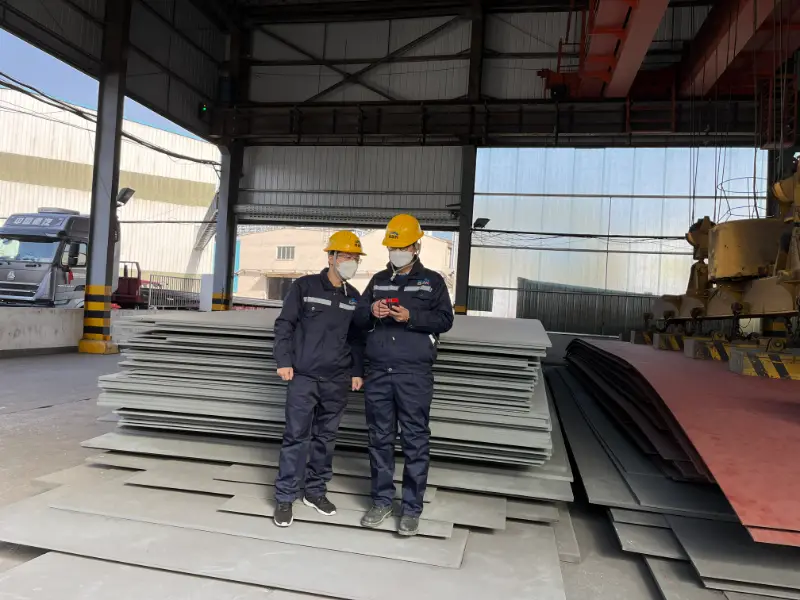
DIN 17102 StE255 Carbon and Low-alloy High-strength Steel Plate
DIN 17102 StE255 Carbon and Low-alloy High-strength Steel Plate - Specifications, Properties & Applications
Detailed material analysis of StE255 steel according to DIN 17102, covering its chemical composition, mechanical and physical properties, international equivalents, and typical applications in welded structures.
Hot rolling, normalizing, welding, cutting, forming, machining
- Phone : +8618037372205
- Email : [email protected]
- WhatsApp: Contact via Whtsapp
- WeChat: +8618037372205
DIN 17102 StE255 Carbon and Low-alloy High-strength Steel Plate Introduction
DIN 17102 StE255 is a weldable, normalized fine-grain structural steel with a minimum yield strength of 255 MPa. It belongs to the carbon and low-alloy high-strength steel category, specifically designed for demanding welded constructions where good toughness and reliable mechanical properties are essential. The fine-grain microstructure, achieved through controlled rolling and normalizing, ensures superior notch toughness and uniform strength across plate thicknesses. Typical delivery condition is normalized. This steel is widely used in building frames, bridges, pressure vessels, and heavy machinery, offering excellent weldability and formability. Its standardized chemical composition, with controlled carbon equivalent and micro-alloying elements (Al, optionally Nb, V, Ti), guarantees consistent performance. The DIN 17102 standard has been superseded by EN 10025-3, where the closest equivalent is S275N.
DIN 17102 StE255 Carbon and Low-alloy High-strength Steel Plate Chemical Composition
The chemical composition of StE255 as specified in DIN 17102 ensures good weldability and mechanical properties. Fine grain practice is mandatory, typically guaranteed by a minimum total aluminium content. Micro-alloying elements such as niobium, vanadium and titanium may be added singly or in combination to enhance strength and toughness. Maximum carbon equivalent values may be agreed for thicker plates to avoid cold cracking after welding.
| Element | Standard Value (max, unless range) | Remarks |
|---|---|---|
| Carbon (C) | 0.22 % | max. |
| Silicon (Si) | 0.50 % | max. |
| Manganese (Mn) | 0.50 – 1.50 % | Ladle analysis |
| Phosphorus (P) | 0.035 % | max. |
| Sulfur (S) | 0.035 % | max. |
| Aluminium (Altot) | ≥ 0.020 % | Minimum total aluminium for fine grain |
| Nitrogen (N) | 0.012 % | max. |
| Niobium (Nb) | ≤ 0.05 % | Optional; if added alone or in combination |
| Vanadium (V) | ≤ 0.12 % | Optional; if added alone or in combination |
| Titanium (Ti) | ≤ 0.03 % | Optional; if added alone or in combination |
DIN 17102 StE255 Carbon and Low-alloy High-strength Steel Plate Thermal and Electrical Physical Properties
The following physical properties are typical for normalized fine‑grain carbon‑manganese structural steels like StE255. Actual values may vary slightly depending on exact composition and processing conditions. These properties are essential for design calculations involving thermal loads, electrical resistance, and dynamic analysis.
| Property | Typical Value | Unit | Test Condition / Remarks |
|---|---|---|---|
| Density (ρ) | 7.85 | g/cm³ | Room temperature |
| Elastic modulus (E) | 210 | GPa | Room temperature |
| Shear modulus (G) | 81 | GPa | Calculated from E and ν |
| Poisson's ratio (ν) | 0.30 | dimensionless | Room temperature |
| Thermal expansion coefficient (α) | 12.0 | 10⁻⁶/K | 20 – 100 °C |
| Thermal expansion coefficient (α) | 13.0 | 10⁻⁶/K | 20 – 200 °C |
| Thermal expansion coefficient (α) | 13.8 | 10⁻⁶/K | 20 – 300 °C |
| Thermal conductivity (λ) | 50 | W/(m·K) | Room temperature |
| Specific heat capacity (cp) | 460 | J/(kg·K) | Room temperature |
| Electrical resistivity (ρe) | 0.20 – 0.25 | µΩ·m | Room temperature |
DIN 17102 StE255 Carbon and Low-alloy High-strength Steel Plate Mechanical Properties
Mechanical properties according to DIN 17102 for StE255 in the normalized condition. The tensile test is conducted at room temperature using standard specimens with gauge length L0 = 5.65√S0. Impact energy (Charpy-V) is guaranteed for longitudinal specimens at +20 °C for the basic StE255 grade. For low‑temperature requirements (e.g., -20 °C or -50 °C), the suffix grades StE255‑20 or StE255‑50 should be selected. Values vary with product thickness.
| Property | Standard Requirement Value | Unit | Test Condition |
|---|---|---|---|
| Yield strength (ReH) | ≥ 255 | MPa | Thickness ≤ 16 mm |
| Yield strength (ReH) | ≥ 245 | MPa | Thickness > 16 mm ≤ 40 mm |
| Yield strength (ReH) | ≥ 235 | MPa | Thickness > 40 mm ≤ 63 mm |
| Yield strength (ReH) | ≥ 225 | MPa | Thickness > 63 mm ≤ 80 mm |
| Tensile strength (Rm) | 360 – 480 | MPa | Thickness ≤ 100 mm |
| Elongation (A) | ≥ 24 | % | Thickness ≤ 40 mm, L0 = 5.65√S0 |
| Elongation (A) | ≥ 23 | % | Thickness > 40 mm ≤ 63 mm |
| Elongation (A) | ≥ 22 | % | Thickness > 63 mm ≤ 100 mm |
| Impact energy (KV) | ≥ 27 | J | Longitudinal, +20 °C, thickness ≤ 60 mm |
DIN 17102 StE255 Carbon and Low-alloy High-strength Steel Plate Completely Equivalent Material Standards & Substitutable Grades
| Country/Region | Standard | Grade | Remarks |
|---|---|---|---|
| Europe | EN 10025-3 | S275N (1.0490) | Direct successor; normalized fine‑grain structural steel, identical application |
| International | ISO 4951-2 | S275N | Harmonised international standard, same chemical and mechanical requirements |
| Germany (withdrawn) | DIN 17102 | StE255 (1.0486) | Original specification, now replaced by EN S275N |
DIN 17102 StE255 Carbon and Low-alloy High-strength Steel Plate Application Introduction
StE255 is engineered for applications where reliable mechanical properties and good weldability are mandatory under static and moderate dynamic loads. Its normalized fine‑grain structure provides superior resistance to brittle fracture, making it suitable for welded components subjected to low temperatures when appropriate impact toughness grades are selected. Typical service temperatures for the basic grade range from -10 °C to +400 °C, depending on design codes.
Product Applications: Welded girders and box columns for multi‑storey buildings, Bridge decks and orthotropic plates, Bottom plates for storage tanks and silos, Flanges and webs of heavy crane beams, Support structures for boilers and heat exchangers, Bogie frames for railway rolling stock
Processed into products: Built‑up H‑beams and I‑sections, Welded box sections for column bases, Stiffeners and gusset plates, Base plates and anchor boxes for wind turbine towers, Frame members for hydraulic presses and lifts, Transverse and longitudinal stiffening ribs in ship hulls, Bolted connections and splice plates
Application industries: Civil engineering and infrastructure (bridges, stadiums, high‑rise building frames), Offshore and onshore heavy‑duty machinery, Shipbuilding and transport equipment (truck frames, railcars), Energy sector (wind turbine towers, pressure vessel support structures), Industrial plant construction (crane runways, storage tanks, conveying systems)
DIN 17102 StE255 Carbon and Low-alloy High-strength Steel Plate Similar / Alternative Grades for Reference
| Country/Region | Standard | Grade | Remarks |
|---|---|---|---|
| Europe | EN 10025-2 | S275J2 (+N) | Non‑fine‑grain structural steel; slightly lower all‑around toughness; cost‑effective alternative when fine grain not required |
| Europe | EN 10025-3 | S355N | Higher yield strength (355 MPa) normalized fine‑grain steel; suitable when higher static loads are present |
| Europe | EN 10025-4 | S275M / S275ML | Thermomechanically rolled fine‑grain steel; equivalent strength but may offer better weldability for thick plates |
| Japan | JIS G 3106 | SM400B | Weldable structural steel with min. tensile 400–510 MPa and guaranteed impact at 0 °C; similar strength level |
| USA | ASTM A572 | Grade 42 (290) | High‑strength low‑alloy structural steel with min. yield 290 MPa; covers similar applications but not identical in chemistry |
Notes:
Welding: StE255 exhibits excellent weldability under all common arc welding processes (SMAW, GMAW, FCAW, SAW). Preheating is generally not required for plate thicknesses up to 30 mm, but controlled heat input and interpass temperature should be observed to preserve fine‑grain structure.
Forming: Hot and cold forming processes are applicable. For cold forming with large deformation, a subsequent stress‑relief anneal may be considered to restore toughness.
Inspection: Ultrasonic testing (UT) to a specified acceptance class (e.g., EN 10160 class S1/E1) can be ordered for critical applications.
Certification: Mill test certificates according to EN 10204 type 3.1 or 3.2 are typically provided.
Note on standards status: DIN 17102 is obsolete; for new designs EN 10025‑3 S275N is the valid specification. StE255 may still appear in maintenance and repair projects of older constructions.
- Share



