
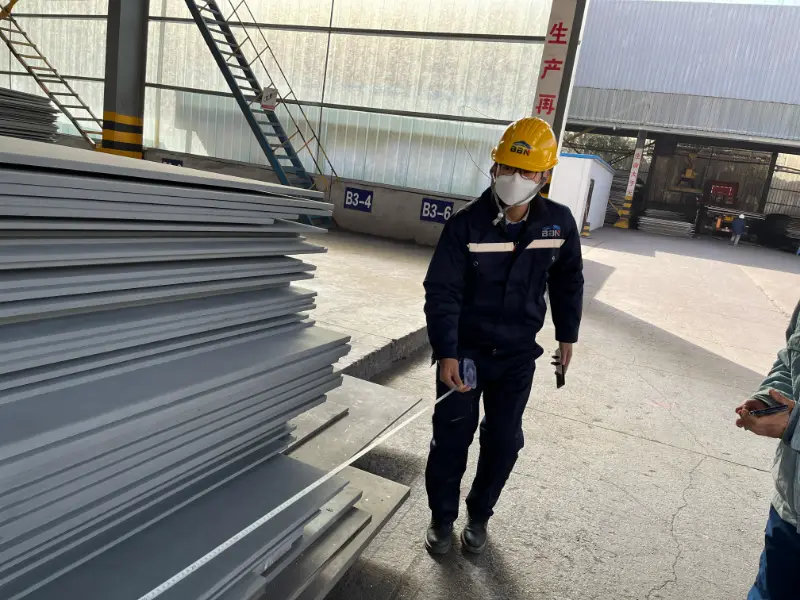
DIN 17102 WStE255 Steel Plate
WStE255 Steel Plate: DIN 17102 Weldable Fine Grain Structural Steel Properties & Equivalents
In-depth analysis of DIN 17102 WStE255 carbon and low-alloy high-strength steel plate, including chemical composition, mechanical and physical properties, international equivalents, and typical applications in welded structures.
Hot rolling, normalizing, thermomechanical rolling, cold forming, welding, machining
- Phone : +8618037372205
- Email : [email protected]
- WhatsApp: Contact via Whtsapp
- WeChat: +8618037372205
DIN 17102 WStE255 Steel Plate Introduction
WStE255 is a weldable fine grain structural steel grade defined in the historical German standard DIN 17102. It is a low-carbon, low-alloy high-strength steel designed for superior weldability and notch toughness in welded constructions. Typical delivery conditions are normalized (+N) or thermomechanically rolled (+M). The steel exhibits a minimum yield strength of 255 MPa for thicknesses up to 16 mm and good elongation, making it suitable for dynamically loaded structures. Its fine grain structure, achieved through microalloying elements like Al, Nb, or V, ensures excellent toughness at low temperatures (typically impact tested at -20°C). This material is widely used in
- bridge building
- structural engineering
- pressure vessel manufacturing
- offshore and shipbuilding
and has been largely superseded by EN 10025-3 S255N or EN 10025-4 S255M grades.
DIN 17102 WStE255 Steel Plate Chemical Composition
Typical chemical composition according to DIN 17102 for WStE255. Values are based on heat analysis and apply to product thicknesses ≤ 100 mm.
- Carbon equivalent (CEV) is typically ≤ 0.40% to ensure good weldability.
- Fine grain practice requires a minimum aluminum content or addition of other grain-refining elements.
| Chemical Element | Standard Value (max unless range given) | Remarks |
|---|---|---|
| C (Carbon) | 0.18 % | |
| Si (Silicon) | 0.50 % | |
| Mn (Manganese) | 0.50 - 1.50 % | For thickness > 30 mm, max Mn may be 1.60 % |
| P (Phosphorus) | 0.030 % | |
| S (Sulfur) | 0.025 % | |
| Al (Aluminum, total) | min 0.020 % | Typically 0.020-0.060 %; fine grain requirement |
| Nb (Niobium) | 0.05 % | Optional grain refiner, singly or in combination |
| V (Vanadium) | 0.10 % | Optional grain refiner, singly or in combination |
| Ti (Titanium) | 0.05 % | Optional grain refiner, singly or in combination |
| Cr (Chromium) | 0.30 % | Residual element; not intentionally added |
| Ni (Nickel) | 0.30 % | Residual element; not intentionally added |
| Cu (Copper) | 0.30 % | Residual element; not intentionally added |
| Mo (Molybdenum) | 0.08 % | Residual element |
| N (Nitrogen) | 0.012 % | Typically bound by Al |
DIN 17102 WStE255 Steel Plate Thermal and Electrical Physical Properties
Typical physical properties for low-carbon fine grain structural steel at room temperature, applicable to WStE255. Properties are not mandated by DIN 17102 but are provided for engineering reference.
- Thermal conductivity decreases slightly with increasing temperature.
- Specific heat capacity increases with temperature.
| Property | Standard Requirement Value | Unit | Test Condition |
|---|---|---|---|
| Density (ρ) | 7.85 | g/cm³ | 20°C |
| Elastic Modulus (E) | 210 | GPa | 20°C |
| Shear Modulus (G) | 81 | GPa | 20°C |
| Poisson's Ratio (ν) | 0.3 | dimensionless | 20°C |
| Thermal Expansion Coefficient (α) | 12.0 × 10⁻⁶ | K⁻¹ | 20-100°C |
| Thermal Expansion Coefficient (α) | 12.5 × 10⁻⁶ | K⁻¹ | 20-200°C |
| Thermal Conductivity (λ) | 51 | W/(m·K) | 20°C |
| Thermal Conductivity (λ) | 48 | W/(m·K) | 200°C |
| Specific Heat Capacity (cp) | 460 | J/(kg·K) | 20°C |
| Electrical Resistivity (ρₑ) | 0.22 × 10⁻⁶ | Ω·m | 20°C |
DIN 17102 WStE255 Steel Plate Mechanical Properties
Mechanical properties at room temperature as per DIN 17102 for normalized or thermomechanically rolled condition. Yield strength and tensile strength vary with product thickness.
- Impact energy (KV) is guaranteed for longitudinal test pieces at -20°C; transverse values may be specified separately.
- Elongation (A5) based on gauge length L0=5.65√S0.
| Property | Standard Requirement Value | Unit | Test Condition |
|---|---|---|---|
| Yield Strength (ReH) min | 255 | MPa | Thickness t ≤ 16 mm |
| Yield Strength (ReH) min | 245 | MPa | 16 < t ≤ 35 mm |
| Yield Strength (ReH) min | 235 | MPa | 35 < t ≤ 50 mm |
| Yield Strength (ReH) min | 225 | MPa | 50 < t ≤ 70 mm |
| Tensile Strength (Rm) | 360 - 480 | MPa | All thicknesses ≤ 70 mm |
| Elongation (A5) min | 24 | % | Longitudinal, t ≤ 70 mm |
| Elongation (A5) min | 22 | % | Transverse, t ≤ 70 mm (for info) |
| Impact Energy (KV) min | 27 | J | Longitudinal, -20°C |
| Cold Bending (bend diameter) | D = 3a (t ≤ 16 mm) | 180° bend, mandrel diameter, a = sample thickness | |
| Cold Bending (bend diameter) | D = 4a (16 < t ≤ 35 mm) | 180° bend |
DIN 17102 WStE255 Steel Plate Completely Equivalent Material Standards and Replaceable Grades
| Country/Region | Standard | Grade | Remarks |
|---|---|---|---|
| European Union | EN 10025-3 | S255N | Normalized; same yield strength class, fine grain |
| European Union | EN 10025-4 | S255M | Thermomechanically rolled; same yield strength class |
| International | ISO 630-3 | S255N / S255M | Identical properties; normalized or TMCP |
| Germany (old) | DIN 17102 | WStE255 | Original designation; superseded by EN grades |
| United Kingdom (old) | BS 4360 | 50D | Comparable; fine grain structural steel |
| France (old) | NFA 36-201 | E255R | Similar normalized grade |
| Italy (old) | UNI 7382 | FeE255KG | Comparable fine grain structural steel |
DIN 17102 WStE255 Steel Plate Application Introduction
WStE255 is primarily used in welded load-bearing structures where a combination of good weldability, sufficient toughness at low ambient temperatures, and moderate strength is required. Typical applications include:
- Structural frameworks and columns
- Bridges and flyovers
- Offshore platform components
- Penstocks and spiral casings
- Pressure vessels and storage tanks
- Ship hulls and marine structures
- Cranes, earthmoving equipment, and heavy machinery
Product Applications: Welded bridge girders, Storage tanks and silos, Penstock pipes, Ship deck plates and hull stiffeners, Crane booms and frames, Offshore jacket legs and braces, Heavy equipment chassis
Processed into products: Welded built-up beams and columns, Flanges and web plates, Cylindrical shells and pressure parts, Stiffeners and brackets, Base plates and anchor plates, Machined pins and bushings (where welding is needed)
Application industries: Civil Engineering and Construction, Bridge Building, Shipbuilding and Marine Engineering, Pressure Vessel and Tank Fabrication, Offshore and Wind Energy Structures, Heavy Machinery and Crane Manufacturing
DIN 17102 WStE255 Steel Plate Similar/Alternative Material Recommendations
| Country/Region | Standard | Grade | Remarks |
|---|---|---|---|
| USA | ASTM A572 / A572M | Grade 50 [345 MPa] | Higher strength; low-alloy structural; similar weldability, need to verify toughness at low temp |
| Japan | JIS G3106 | SM490A | Yield strength 325 MPa min; good weldability; commonly used in welded structures |
| China | GB/T 1591 | Q345D | Yield 345 MPa; fine grain; impact at -20°C; widely used equivalent |
| India | IS 2062 | E250 B / E250 C | Yield 250 MPa; close but may lack full fine grain guarantee for some grades |
| Russia | GOST 19281 | 16GS | Low-alloy structural steel; similar yield class; often used for pressure vessels |
Notes:
The DIN 17102 standard has been officially withdrawn and replaced by EN 10025-3 and EN 10025-4. For new designs, S255N or S255M should be specified. However, existing structures and spares may still reference the WStE255 designation. Welding consumables should be selected to match the strength and toughness requirements, typically using basic-coated electrodes or wires of AWS E7018 or equivalent. Preheating may be required for thick sections to avoid cold cracking. The steel can be galvanized or painted for corrosion protection. All values are for information; refer to latest applicable standards for exact requirements.
- Share



