
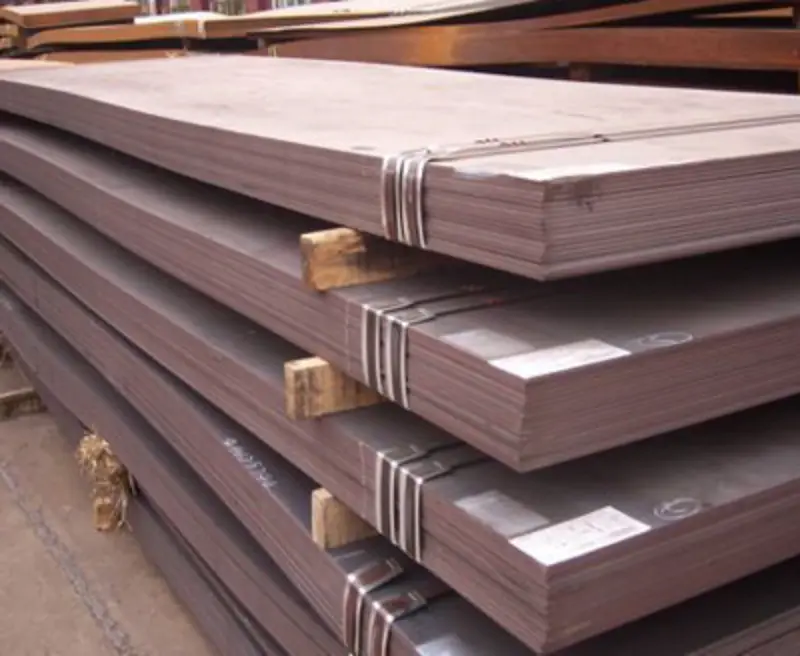
JIS G3106 SM400B Steel Plate
SM400B Steel Plate: Reliable Carbon Structural Steel for Welded Applications
Complete datasheet for JIS G3106 SM400B carbon and low-alloy high-strength steel plate including chemical composition, mechanical properties, thermal and electrical physical properties, equivalent grades, and application recommendations.
Welding, hot bending, cold bending, flame cutting, machining, drilling
- Phone : +8618037372205
- Email : [email protected]
- WhatsApp: Contact via Whtsapp
- WeChat: +8618037372205
JIS G3106 SM400B Steel Plate Introduction
JIS G3106 SM400B is a hot-rolled carbon steel plate designed for welded structures. It offers good weldability, moderate tensile strength in the range of 400–510 MPa, and reliable toughness at 0 °C. The steel is widely used in bridges, buildings, shipbuilding, industrial machinery, and container fabrication. Its balanced chemistry with controlled carbon and manganese ensures excellent formability and suitability for conventional welding processes. Key features:
- Minimum yield strength 245 MPa for thickness ≤16 mm
- Guaranteed Charpy impact energy 27 J at 0 °C
- Available in as-rolled or normalized condition
- Cost-effective solution for general structural applications
JIS G3106 SM400B Steel Plate Chemical Composition
The chemical composition of SM400B is controlled to ensure good weldability and sufficient strength. For thicknesses ≤50 mm, the maximum carbon content is 0.20%, while thicker plates allow slightly higher carbon up to 0.24%. Manganese range is specified to improve toughness and strength. Residual elements such as copper, nickel, and chromium are not intentionally added but may be present; their limits are not specified unless agreed upon.
| Chemical Element | Standard Value (wt%) | Remarks |
|---|---|---|
| Carbon (C) | ≤0.20 | For product thickness ≤50 mm (>50–100 mm: ≤0.22; >100–200 mm: ≤0.24) |
| Silicon (Si) | ≤0.35 | Typical residual content |
| Manganese (Mn) | 0.60–1.40 | Required range for all thicknesses |
| Phosphorus (P) | ≤0.035 | Maximum limit |
| Sulfur (S) | ≤0.035 | Maximum limit |
JIS G3106 SM400B Steel Plate Thermal and Electrical Physical Properties
The following physical properties are typical for SM400B carbon steel and may vary slightly depending on exact composition and heat treatment condition. These values are not mandatory requirements but are useful for engineering calculations and design. Density is often taken as 7850 kg/m³. Thermal expansion and conductivity values are given for ambient to moderate temperatures.
| Property | Typical Value | Unit | Test Condition |
|---|---|---|---|
| Density (ρ) | 7.85 | g/cm³ | At 20 °C |
| Elastic Modulus (E) | 210 | GPa | At room temperature |
| Shear Modulus (G) | 80 | GPa | At room temperature |
| Poisson's Ratio (ν) | 0.3 | - | At room temperature |
| Thermal Expansion Coefficient (α) | 11.5 | 10⁻⁶/K | 20–100 °C |
| Thermal Expansion Coefficient (α) | 12.2 | 10⁻⁶/K | 20–200 °C |
| Thermal Expansion Coefficient (α) | 12.9 | 10⁻⁶/K | 20–300 °C |
| Thermal Conductivity (λ) | 50 | W/(m·K) | At 20 °C |
| Thermal Conductivity (λ) | 45 | W/(m·K) | At 200 °C |
| Specific Heat Capacity | 460 | J/(kg·K) | 20–100 °C |
| Electrical Resistivity (ρₑ) | 0.16 | 10⁻⁶ Ω·m | At 20 °C |
JIS G3106 SM400B Steel Plate Mechanical Properties
Mechanical properties are determined on test specimens taken from the plate in the transverse direction. The yield strength decreases with increasing thickness, while tensile strength remains within a fixed range. Elongation values depend on the test piece type and plate thickness. Charpy impact tests are performed at 0 °C on longitudinal V-notch specimens. Note: Values are minimum requirements unless a range is given.
| Property | Standard Requirement | Unit | Test Condition |
|---|---|---|---|
| Yield Strength (ReH) | ≥245 | MPa | Plate thickness ≤16 mm |
| Yield Strength (ReH) | ≥235 | MPa | 16 mm < t ≤ 40 mm |
| Yield Strength (ReH) | ≥215 | MPa | 40 mm < t ≤ 100 mm |
| Yield Strength (ReH) | ≥205 | MPa | 100 mm < t ≤ 160 mm |
| Yield Strength (ReH) | ≥195 | MPa | 160 mm < t ≤ 200 mm |
| Tensile Strength (Rm) | 400–510 | MPa | All thicknesses |
| Elongation (A) | ≥21 | % | Thickness ≤5 mm, JIS No.5 test piece |
| Elongation (A) | ≥17 | % | 5 mm < t ≤ 16 mm, JIS No.1A test piece |
| Elongation (A) | ≥21 | % | 16 mm < t ≤ 50 mm, JIS No.1A test piece |
| Elongation (A) | ≥23 | % | 50 mm < t ≤ 100 mm, JIS No.1A test piece |
| Elongation (A) | ≥23 | % | 100 mm < t ≤ 200 mm, JIS No.10 test piece |
| Charpy Impact Energy (KV₂) | ≥27 (average), 27 (individual) | J | Longitudinal, 0 °C, 2 mm V-notch |
JIS G3106 SM400B Steel Plate Completely Equivalent Material Standards and Recommended Substitutes
| Country/Region | Standard | Grade | Remarks |
|---|---|---|---|
| Europe | EN 10025-2 | S235JR (1.0038) | Approximate equivalent; yield and tensile properties nearly identical; suitable for substitution with verification of impact requirements. |
| USA | ASTM A36/A36M | A36 | Approximate equivalent; slightly higher yield point but not defined. Widely used as alternative. |
| China | GB/T 700 | Q235B | Approximate equivalent; comparable strength and similar 20 °C impact energy (27 J). Good substitute. |
| International | ISO 630-2 | S235B | Approximate equivalent; matching lower strength range and weldability. |
JIS G3106 SM400B Steel Plate Application Introduction
SM400B is a versatile structural steel plate primarily used in welded constructions. Its balance of strength, ductility, and weldability makes it suitable for numerous engineering sectors. The product can be formed, cut, and machined with conventional tools. Typical usage includes:
- Primary and secondary structural members in buildings and bridges
- Framing for heavy machinery and transportation equipment
- Ship hull plates and offshore platform decks (non-critical fatigue areas)
- Storage tanks and pressure vessel shells where low-temperature toughness is not the main concern
- General fabrication of brackets, stiffeners, and base plates
Product Applications: Welded structural beams and columns, Bridge girders and deck plates, Offshore platform components (secondary structures), Storage tanks and silos, Pressure vessel shells (non-longitudinal stress), Vehicle chassis and dump truck bodies
Processed into products: Gusset plates and connecting brackets, Flanges and web plates for built-up girders, Stiffeners and diaphragms in box girders, Base plates and anchor bolt sleeves, Bracket supports for mechanical equipment, Cut and machined parts for machinery frames
Application industries: Bridge and infrastructure construction, Shipbuilding and marine structures, Industrial machinery and equipment, Building and civil engineering, Container and storage tank fabrication, Vehicle and trailer manufacturing
JIS G3106 SM400B Steel Plate Similar or Closely Related Material Recommendations
| Country/Region | Standard | Grade | Remarks |
|---|---|---|---|
| Japan | JIS G3106 | SM400A | Same strength level but without mandatory 0 °C impact test; not suitable for dynamic loading at low temperature. |
| Japan | JIS G3106 | SM400C | Same strength, guaranteed 0 °C impact; fine grain practice ensures better toughness than SM400B. |
| USA | ASTM A572/A572M | Grade 42 | Higher yield strength (290 MPa) but similar tensile range and weldability; requires careful evaluation. |
| Europe | EN 10025-2 | S235J0 | Very close in properties; guaranteed impact energy 27 J at 0 °C. Excellent substitute for dynamic structures. |
Notes:
Additional Information:
- SM400B is usually delivered in the as-rolled condition. Normalizing may be applied to refine grain structure for thicker sections (>50 mm) or when enhanced toughness is required.
- Preheating is recommended for thicknesses above 30 mm to avoid hydrogen-induced cracking, with typical preheat temperatures of 50–100 °C.
- Welding consumables should match the strength level (e.g., E70XX series electrodes). Low-hydrogen processes (SMAW, GMAW, SAW) are preferred.
- For cold forming, a minimum bending radius of 2t (where t is plate thickness) is advised; hot forming permitted if the temperature does not degrade mechanical properties.
- The steel is not intended for prolonged service at temperatures below -10 °C without specific impact testing validation.
- Ultrasonic testing and other NDE requirements may be specified at the time of order.
- Share



