
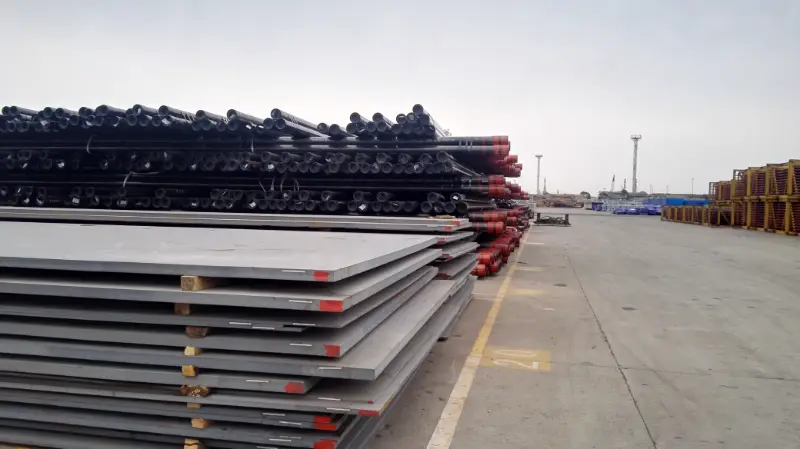
JIS G3106 SM400C Carbon Steel Plate
JIS G3106 SM400C Carbon Steel Plate - Composition, Properties, Equivalents & Application Guide
Detailed data sheet for JIS G3106 SM400C carbon and low-alloy high-strength steel plate. Includes chemical composition, mechanical and thermal properties, equivalent international grades, and typical applications.
Hot rolling, normalizing, thermo-mechanical control process (TMCP), welding, cutting, forming, machining
- Phone : +8618037372205
- Email : [email protected]
- WhatsApp: Contact via Whtsapp
- WeChat: +8618037372205
JIS G3106 SM400C Carbon Steel Plate Introduction
JIS G3106 SM400C is a hot-rolled carbon steel plate for welded structures, supplied in accordance with Japanese Industrial Standard JIS G3106. It offers a minimum tensile strength of 400 MPa, good weldability, and guaranteed low-temperature impact toughness at 0 °C (charpy V-notch ≥ 27 J). This grade belongs to the SM (Structural Marine) series and is widely employed in bridges, shipbuilding, building construction, and general engineering.
- Excellent balance of strength and ductility
- Reliable notch toughness for service in moderate climate conditions
- Available in a wide range of thicknesses from 6 mm up to 200 mm
SM400C is typically delivered in as-rolled or normalized condition, with optional thermo-mechanical rolling or controlled rolling upon agreement.
JIS G3106 SM400C Carbon Steel Plate Chemical Composition
The table below lists the mandatory chemical elements for SM400C steel according to JIS G3106. Values are based on ladle analysis and apply to all product thicknesses unless otherwise noted. Key features:
- Low carbon content ensures good weldability.
- Moderate manganese provides solid solution strengthening without compromising toughness.
- Tight phosphorus and sulfur limits enhance cleanliness and impact performance.
| Chemical Element | Standard Value (wt%) | Remarks |
|---|---|---|
| Carbon (C) | ≤ 0.20 | Ladle analysis; same requirement for all thicknesses up to 200 mm |
| Silicon (Si) | ≤ 0.35 | Deoxidation element |
| Manganese (Mn) | 0.60 – 1.40 | For thickness >100 mm, upper limit may be 1.50 upon agreement; consult standard |
| Phosphorus (P) | ≤ 0.035 | Essential for avoiding embrittlement |
| Sulfur (S) | ≤ 0.035 | Low S for improved through-thickness properties |
JIS G3106 SM400C Carbon Steel Plate Thermal and Electrical Physical Properties
These properties are typical for carbon-manganese structural steels and are provided as engineering references. Actual values may vary slightly depending on exact composition and processing route.
- Thermal expansion and conductivity are essential for design involving temperature changes.
- Electrical resistivity is indicative for cathodic protection or grounding applications.
| Property | Typical Value | Unit | Test Condition / Remarks |
|---|---|---|---|
| Density (ρ) | 7.85 | g/cm³ | At room temperature |
| Elastic Modulus (E) | 205 – 210 | GPa | Ambient temperature |
| Shear Modulus (G) | 80 | GPa | Calculated from E and Poisson's ratio |
| Poisson's Ratio (ν) | 0.29 – 0.30 | — | Linear elastic range |
| Coefficient of Thermal Expansion (α) | 11.5 – 12.1 | 10⁻⁶/K | 20 °C to 100 °C |
| Thermal Conductivity (λ) | 50 – 52 | W/(m·K) | At 100 °C |
| Specific Heat Capacity (cp) | 460 – 490 | J/(kg·K) | Room temperature to 100 °C |
| Electrical Resistivity (ρe) | 0.15 – 0.18 | µΩ·m | At 20 °C |
JIS G3106 SM400C Carbon Steel Plate Mechanical Properties
Mechanical properties are obtained on test pieces taken in the transverse direction (for plates) and according to JIS Z 2241, JIS Z 2242.
- Yield strength values depend on product thickness.
- Elongation is measured using different specimen geometries specified in JIS G3106.
- Charpy impact tests apply to products thicker than 12 mm; specimen orientation is longitudinal.
| Property | Standard Requirement | Unit | Test Condition / Thickness |
|---|---|---|---|
| Yield Strength (ReH) | ≥ 245 | MPa | Thickness ≤ 16 mm |
| Yield Strength (ReH) | ≥ 235 | MPa | 16 mm < thickness ≤ 40 mm |
| Yield Strength (ReH) | ≥ 215 | MPa | 40 mm < thickness ≤ 75 mm |
| Yield Strength (ReH) | ≥ 215 | MPa | 75 mm < thickness ≤ 100 mm |
| Yield Strength (ReH) | ≥ 205 | MPa | 100 mm < thickness ≤ 160 mm |
| Yield Strength (ReH) | ≥ 195 | MPa | 160 mm < thickness ≤ 200 mm |
| Tensile Strength (Rm) | 400 – 510 | MPa | All thicknesses, room temperature |
| Elongation (A) | ≥ 23 | % | Thickness ≤ 5 mm; JIS No. 5 test piece (gauge length 50 mm) |
| Elongation (A) | ≥ 18 | % | 5 mm < thickness ≤ 16 mm; JIS No. 1A test piece (gauge length 200 mm) |
| Elongation (A) | ≥ 22 | % | 16 mm < thickness ≤ 50 mm; No. 1A test piece |
| Elongation (A) | ≥ 24 | % | 50 mm < thickness ≤ 100 mm; No. 1A test piece |
| Elongation (A) | ≥ 24 | % | 100 mm < thickness ≤ 200 mm; No. 1A test piece (use of No. 10 specimen with appropriate conversion allowed) |
| Charpy Impact Absorbed Energy (KV2) | ≥ 27 | J | Test temperature 0 °C; 2 mm V-notch; longitudinal specimen; applies for thickness >12 mm |
JIS G3106 SM400C Carbon Steel Plate Fully Equivalent Material Standards & Recommended Replacement Grades
| Country / Region | Standard | Grade | Remarks |
|---|---|---|---|
| Japan | JIS G3106 | SM400C | Original grade; mandatory 0°C impact test |
| Europe | EN 10025-2 | S275J0 | Similar yield strength (275 MPa min) and impact temperature 0°C; tensile range 410–560 MPa slightly higher; subject to agreement for direct substitution |
| USA | ASTM A36 / A36M | A36 | Comparable tensile 400–550 MPa; not always accompanied by 0°C impact requirement; additional impact verification needed |
| China | GB/T 700 | Q235C | Same 0°C impact category; yield ≥235 MPa (≤16 mm), tensile 370–500 MPa; similar construction steel |
JIS G3106 SM400C Carbon Steel Plate Application Introduction
JIS G3106 SM400C steel plate is designed for load‑bearing welded components that require guaranteed toughness at 0 °C. It is extensively used in heavy civil infrastructure, shipbuilding, and industrial machinery. Its good formability and weldability allow the manufacture of complex components. Key application sectors:
- Bridge girders, diaphragms, and stiffeners
- Hull plates, decks, and superstructures in mild‑water vessels
- Pressure vessels and storage tanks for non‑aggressive media
- Offshore platform substructures (above water level)
- Building columns, beams, and base plates
Typical products include:
- Welded structural shapes and box sections
- Cut‑to‑size blanks for cranes and heavy machinery
- Flanges, stiffener rings, and gusset plates
Processing capabilities: The material can be flame‑cut, plasma‑cut, sheared, bent, rolled, and machined into precision parts such as bearing plates, connecting brackets, and machinery frames.
Product Applications: Welded bridge girders and bracing members, Hull plates and deck structures for ships and barges, Storage tanks and silos, Support structures for conveyor systems and silo hoppers, Column‑beam connections and baseplates in high‑rise structures, Fabricated machinery frames and excavator components
Processed into products: Stiffeners, gussets, and connection plates, Flanges for pipe supports and equipment mounts, Bearing plates and sole plates for bridges and cranes, Cut and drilled parts for bolted assemblies, Rolled shells and curved segments for pressure vessels, Machinery bases and heavy‑duty brackets
Application industries: Civil engineering and bridge construction, Shipbuilding and marine engineering, Structural steelwork for buildings and industrial halls, Pressure vessel and tank manufacturing, Heavy machinery and crane manufacturing, Offshore and port infrastructure
JIS G3106 SM400C Carbon Steel Plate Similar or Alternative Material Recommendations
| Country / Region | Standard | Grade | Remarks |
|---|---|---|---|
| Japan | JIS G3106 | SM400B | Lower impact toughness (0°C vs 20°C for B); SM400C is preferred for more demanding low‑temperature service |
| Europe | EN 10025-2 | S275JR / S275J0 | S275J0 is closer; S275JR provides room‑temperature impact only, suitable for less severe conditions |
| Europe | EN 10025-2 | S355J0 | Higher strength (yield ≥355 MPa); may be over‑qualifying for SM400C applications but offers better load‑bearing capacity |
| USA | ASTM A572 / A572M | Grade 50 [345] | Yield 345 MPa min; higher strength level; still suitable for welded structures with proper welding practices |
| China | GB/T 700 | Q235B | Room‑temperature impact (20°C); can be used when 0°C toughness is not mandatory |
Notes:
Additional information:
- Carbon equivalent (CE) is not specified in JIS G3106 for SM400C, but typical CE for thickness >50 mm is below 0.40% to ensure weldability without preheat in moderate conditions.
- Ultrasonic testing and through‑thickness tensile requirements can be agreed upon at the time of order (e.g., Z‑quality per EN 10164).
- For service at temperatures below 0 °C, consider upgrading to SM490C or JIS G3106 SM400D (impact temperature –20 °C).
- Delivery conditions other than as‑rolled (normalized, TMCP) must be clearly specified in the purchase order.
- Data provided here are for general guidance; always refer to the latest official JIS standard and mill certificates for exact values.
- Share



