
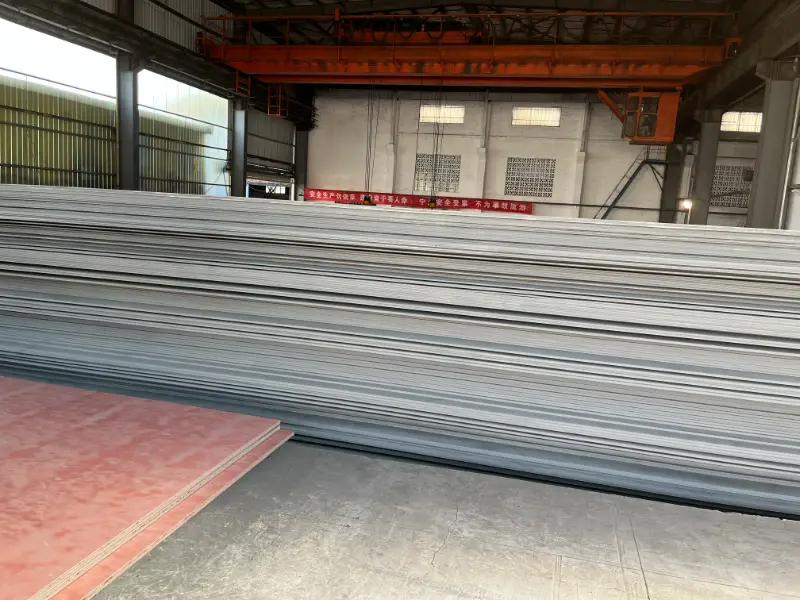
JIS G3106 SM490A Carbon and Low-Alloy High-Strength Steel Plate
JIS G3106 SM490A Carbon and Low-Alloy High-Strength Steel Plate - Complete Technical Data
Detailed material analysis of SM490A steel plate according to JIS G3106: chemistry, mechanical properties, physical data, equivalent grades, and application guidance for welded structures.
Cutting, welding, bending, forming, machining, drilling, hot rolling, normalizing, thermomechanical rolling
- Phone : +8618037372205
- Email : [email protected]
- WhatsApp: Contact via Whtsapp
- WeChat: +8618037372205
JIS G3106 SM490A Carbon and Low-Alloy High-Strength Steel Plate Introduction
SM490A is a hot-rolled carbon and low-alloy high-strength steel plate specified in Japanese Industrial Standard JIS G3106 for welded structures. It offers a minimum yield strength of 325 MPa for thicknesses up to 16 mm and a tensile strength range of 490–610 MPa. Designed for general structural and welded applications, SM490A provides good weldability, formability, and toughness at ambient temperature. It is typically supplied in the as-rolled or normalized condition and is widely used in bridges, buildings, ship hulls, and industrial machinery. The steel is fully killed and may contain microalloying elements such as niobium, vanadium, or titanium to refine grain size. Its carbon equivalent is controlled to ensure adequate weldability, and it meets specific bend test requirements depending on thickness.
JIS G3106 SM490A Carbon and Low-Alloy High-Strength Steel Plate Chemical Composition
The chemical requirements for SM490A are defined in JIS G3106. The steel shall be fully killed. Microalloying elements (Nb, V, Ti) may be added singly or in combination. The carbon equivalent (CE) is controlled to ensure weldability: CE ≤0.38% for thickness ≤50 mm, ≤0.40% for 50
- Elements not listed are incidental or not specified.
| Element | Content (%) | Remarks |
|---|---|---|
| C (Carbon) | ≤0.20 | For thickness ≤200 mm |
| Si (Silicon) | ≤0.55 | Killed steel; higher Si content may be agreed |
| Mn (Manganese) | ≤1.60 | Provides strength and hardenability |
| P (Phosphorus) | ≤0.035 | Max 0.030% may be required by agreement for thick plates |
| S (Sulfur) | ≤0.035 | Low sulfur for improved toughness and weldability |
| Others (Nb, V, Ti) | Optional | May be added singly or combined to refine grain; exact limits by agreement |
JIS G3106 SM490A Carbon and Low-Alloy High-Strength Steel Plate Thermal and Electrical Physical Properties
These physical properties are indicative and not part of the JIS G3106 standard; they represent typical values for unalloyed and low-alloy carbon structural steels at room temperature unless otherwise noted. They are important for design calculations involving heat transfer or electromagnetic effects.
- Density may vary slightly with alloy content.
- Thermal expansion coefficient is given for the 20–100°C range.
| Property | Value | Unit | Condition |
|---|---|---|---|
| Density (ρ) | 7.85 | g/cm³ | 20°C |
| Elastic Modulus (E) | 205 | GPa | 20°C |
| Shear Modulus (G) | 80 | GPa | 20°C |
| Poisson's Ratio (ν) | 0.29 | – | 20°C |
| Thermal Expansion Coefficient (α) | 12.0 | 10⁻⁶/K | 20–100°C |
| Thermal Conductivity (λ) | 50 | W/(m·K) | 20°C |
| Specific Heat Capacity (cp) | 460 | J/(kg·K) | 20°C |
| Electrical Resistivity (ρe) | 0.20 | µΩ·m | 20°C |
JIS G3106 SM490A Carbon and Low-Alloy High-Strength Steel Plate Mechanical Properties
Mechanical properties are determined in accordance with JIS Z 2241. The yield strength and tensile strength values vary with plate thickness. Elongation is measured on JIS No. 5 specimens for thickness ≤5 mm and on JIS No. 1A/No. 4 for greater thicknesses. SM490A does not require impact testing; it is intended for ambient-temperature service. The bend test is carried out with 180° bending over specified mandrel diameters.
- Values shown are minimum unless otherwise stated.
- 1 N/mm² = 1 MPa.
| Property | Value | Unit | Condition / Thickness |
|---|---|---|---|
| Yield Strength (ReH) | 325 | MPa | t ≤ 16 mm |
| Yield Strength (ReH) | 315 | MPa | 16 mm < t ≤ 40 mm |
| Yield Strength (ReH) | 295 | MPa | 40 mm < t ≤ 75 mm |
| Yield Strength (ReH) | 295 | MPa | 75 mm < t ≤ 100 mm |
| Yield Strength (ReH) | 285 | MPa | 100 mm < t ≤ 160 mm |
| Yield Strength (ReH) | 275 | MPa | 160 mm < t ≤ 200 mm |
| Tensile Strength (Rm) | 490–610 | MPa | t ≤ 100 mm |
| Tensile Strength (Rm) | 490–610 | MPa | 100 mm < t ≤ 200 mm |
| Elongation (A) in 200 mm (No. 5 specimen) | ≥17 | % | t ≤ 5 mm |
| Elongation (A) in 200 mm (No. 1A/No. 4) | ≥21 | % | 5 mm < t ≤ 16 mm |
| Elongation (A) in 200 mm (No. 1A/No. 4) | ≥19 | % | 16 mm < t ≤ 50 mm |
| Elongation (A) in 200 mm (No. 1A/No. 4) | ≥19 | % | 50 mm < t ≤ 100 mm |
| Elongation (A) in 200 mm (No. 1A/No. 4) | ≥17 | % | 100 mm < t ≤ 200 mm |
| Bend Test (180°) – mandrel diameter | 1.0t | – | t ≤ 16 mm |
| Bend Test (180°) – mandrel diameter | 1.5t | – | 16 mm < t ≤ 100 mm |
| Bend Test (180°) – mandrel diameter | 2.0t | – | 100 mm < t ≤ 200 mm |
JIS G3106 SM490A Carbon and Low-Alloy High-Strength Steel Plate Fully Equivalent Material Standards and Substitutable Grades
| Country/Region | Standard | Grade | Remarks |
|---|---|---|---|
| EU | EN 10025-2 | S355J0 (+N or +AR) | Yield 355 MPa, tensile 470–630 MPa; similar weldability; impact 0°C min 27 J |
| USA | ASTM A572/A572M | Grade 50 (Type 1) | Yield 345 MPa, tensile 450 MPa min; no impact; widely used structural steel |
| China | GB/T 1591 | Q355B (formerly Q345B) | Yield 355 MPa, tensile 470–630 MPa; 20°C impact 34 J; equivalent in many applications |
| International | ISO 630 | Fe490B | Yield 310–355 MPa (thickness dependent), tensile 490–620 MPa; no impact required |
| Korea | KS D 3515 | SM490A | Identical to JIS G3106; same chemistry and properties |
| India | IS 2062 | E350 BR (Fe 490) | Yield ~350 MPa, tensile 490 MPa min; comparable structural steel |
JIS G3106 SM490A Carbon and Low-Alloy High-Strength Steel Plate Application Introduction
SM490A is a versatile structural steel that balances strength, weldability, and cost, making it suitable for a broad range of welded fabrications. It is commonly employed in static and quasi-static applications at ambient temperatures. The steel can be cut by flame, plasma, or laser, and formed by bending or pressing. Preheating is recommended for thicker sections to avoid hydrogen cracking. Post-weld heat treatment is normally not required but can be applied to relieve residual stresses.
- Note: SM490A is not intended for low-temperature service (below 0°C) where impact toughness is critical.
Product Applications: Welded H-beams and box columns, Bridge girders and orthotropic decks, Ship hull plates and stiffeners, Storage tanks and silos, Offshore platform topside modules, Drilling rig substructures, Crane and lifting equipment booms, Earthmoving equipment frames and attachments
Processed into products: Web plates and flange plates for welded beams and columns, Stiffened panels and diaphragms, Welded tubular nodes and connections, Base plates and splice plates, Brackets, gussets, and reinforcement pads, Cut-outs for manholes and access openings, Bucket bodies and loader arms, Railcar side frames and bolsters
Application industries: Civil engineering and construction (building frames, bridges, towers), Shipbuilding and marine structures (hulls, decks, bulkheads), Industrial machinery and heavy equipment (crane booms, excavator arms, bulldozer blades), Transportation (railway wagons, truck chassis), Energy sector (wind turbine towers, support platforms, pressure vessel shells when impact not required), Mining and material handling
JIS G3106 SM490A Carbon and Low-Alloy High-Strength Steel Plate Similar or Closely Related Substitutable Grades
| Country/Region | Standard | Grade | Remarks |
|---|---|---|---|
| Japan | JIS G3106 | SM490B | Impact test at 0°C (min 27 J); otherwise identical chemical and strength properties |
| Japan | JIS G3106 | SM490C | Impact test at -10°C; suitable for lower temperature service |
| Japan | JIS G3106 | SM520A | Higher strength: yield 365 MPa (t≤16), tensile 520–640 MPa; no impact requirement |
| Japan | JIS G3101 | SS490 | General structural rolled steel; looser chemistry, no microalloying, no CE limit; not for welded structures unless agreed |
| Europe | EN 10025-2 | S355J2 (+N) | Impact at -20°C; better toughness; often interchangeable with SM490A if lower temperature toughness is needed |
| USA | ASTM A36 | – | Yield 250 MPa; lower strength but widely available; may be used in less demanding applications |
Notes:
Important considerations when ordering SM490A:
- Thickness limitations: JIS G3106 covers plates up to 200 mm thick.
- Edge preparation: Mill edge sheared or gas-cut edges may be specified.
- Internal soundness: Ultrasonic testing can be agreed upon for critical applications.
- Weldability: Carbon equivalent values are guaranteed; for thicknesses above 50 mm, consider preheat and welding procedure qualification.
- Surface condition: Hot-rolled as-delivered; oiled or primed upon request.
- Certification: Inspection certificates 3.1 or 3.2 according to EN 10204 are commonly required.
- Share



