
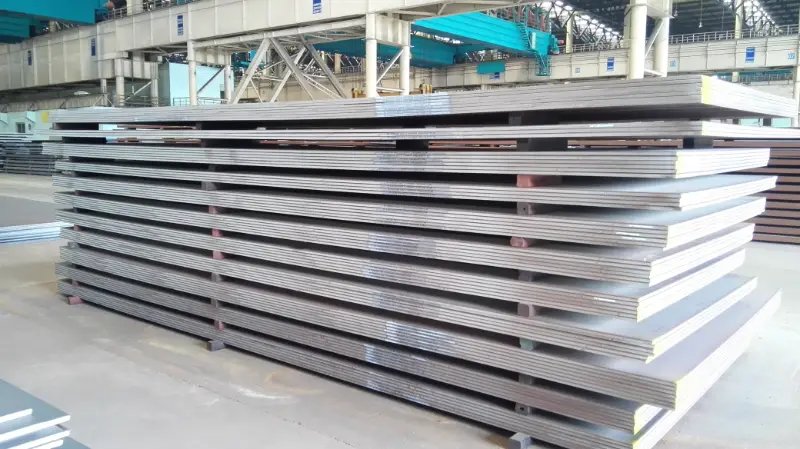
S890Q High-Strength Steel Plate
EN10025-6 S890Q Quenched and Tempered High Yield Strength Structural Steel Plate
Explore S890Q steel plate according to EN10025-6 standard: chemical composition, mechanical properties, thermal and electrical properties, equivalent grades, and application guide for heavy-duty structural engineering.
Thermal cutting, welding (with preheating and controlled heat input), cold forming (limited), machining
- Phone : +8618037372205
- Email : [email protected]
- WhatsApp: Contact via Whtsapp
- WeChat: +8618037372205
S890Q High-Strength Steel Plate Introduction
S890Q is a high-strength quenched and tempered fine-grain structural steel defined in EN 10025-6. With a minimum yield strength of 890 MPa and excellent toughness at -20 °C, it offers outstanding strength-to-weight ratio. This grade is designed for demanding heavy-duty applications in cranes, bridges, offshore structures, and earth-moving equipment. It combines high resistance to static and dynamic loads with good weldability when proper procedures are followed. The alloying concept with microalloying elements (Nb, V, Ti) and a controlled quenching and tempering process ensures uniform mechanical properties across thicknesses up to 150 mm.
S890Q High-Strength Steel Plate Chemical Composition
The chemical composition of S890Q is as per EN 10025-6. Maximum limits are specified for elements that influence hardenability and toughness. The steel is typically low in carbon to maintain weldability, with additions of Mn, Cr, Mo, Ni, and microalloying elements for strength and grain refinement.
| Element | Standard Value (max %) | Remarks |
|---|---|---|
| C (Carbon) | 0.20 | Ladle analysis; thickness ≤50 mm. For thickness >50 to 100 mm max 0.22; >100 to 150 mm max 0.24 |
| Si (Silicon) | 0.80 | Typically 0.10-0.50 |
| Mn (Manganese) | 1.70 | Higher Mn contributes to strength and hardenability |
| P (Phosphorus) | 0.020 | Maximum; for improved toughness lower is preferred |
| S (Sulfur) | 0.010 | Maximum; for Z-quality even lower |
| N (Nitrogen) | 0.015 | Maximum; bound by Ti or Al |
| B (Boron) | 0.0050 | Maximum |
| Cr (Chromium) | 1.50 | Maximum; enhances hardenability |
| Cu (Copper) | 0.50 | Maximum; may be limited for hot forming |
| Mo (Molybdenum) | 0.70 | Maximum; improves tempering resistance |
| Nb (Niobium) | 0.06 | Maximum; grain refiner |
| Ni (Nickel) | 2.0 | Maximum; up to 2.0 for toughness |
| Ti (Titanium) | 0.05 | Maximum; microalloying, nitrogen binding |
| V (Vanadium) | 0.12 | Maximum; precipitation strengthening |
| Zr (Zirconium) | 0.15 | Maximum |
| Al (Aluminium) total | ≥0.015 | Minimum when used for grain refinement and nitrogen binding; normally 0.020-0.080 |
S890Q High-Strength Steel Plate Thermal and Electrical Physical Properties
The physical properties represent typical values for quenched and tempered high-strength low-alloy steel at room temperature. They may vary slightly with actual chemical composition and heat treatment condition. Data derived from industrial references and not to be used for design without verification.
| Property | Typical Value | Unit | Test Condition / Notes |
|---|---|---|---|
| Density (ρ) | 7.85 | g/cm³ | At 20 °C |
| Modulus of elasticity (E) | 210 | GPa | At 20 °C, static loading |
| Shear modulus (G) | 81 | GPa | Calculated using ν=0.3 |
| Poisson's ratio (ν) | 0.30 | - | Elastic range |
| Thermal expansion coefficient (α) | 11.5 | 10⁻⁶/K | Between 20 °C and 100 °C |
| Thermal expansion coefficient (α) | 12.5 | 10⁻⁶/K | Between 20 °C and 200 °C |
| Thermal expansion coefficient (α) | 13.5 | 10⁻⁶/K | Between 20 °C and 400 °C |
| Thermal conductivity (λ) | 42 | W/(m·K) | At 20 °C |
| Thermal conductivity (λ) | 40 | W/(m·K) | At 100 °C |
| Specific heat capacity (cp) | 460 | J/(kg·K) | At 20-100 °C |
| Electrical resistivity (ρe) | 0.25 | µΩ·m | At 20 °C |
S890Q High-Strength Steel Plate Mechanical Properties
Mechanical properties are valid for quenched and tempered condition according to EN 10025-6. Tensile test specimens are taken transverse to rolling direction. Impact test at -20 °C (KCV min 27J) for quality Q. For thicknesses >100 mm, slightly reduced strength may apply.
| Property | Standard Requirement | Unit | Test Condition / Notes |
|---|---|---|---|
| Yield Strength (ReH) | ≥ 890 | MPa | Thickness ≤ 50 mm |
| Yield Strength (ReH) | ≥ 870 | MPa | Thickness > 50 to ≤ 100 mm |
| Yield Strength (ReH) | ≥ 840 | MPa | Thickness > 100 to ≤ 150 mm |
| Tensile Strength (Rm) | 940 – 1180 | MPa | Thickness ≤ 50 mm |
| Tensile Strength (Rm) | 920 – 1160 | MPa | Thickness > 50 to ≤ 100 mm |
| Tensile Strength (Rm) | 900 – 1140 | MPa | Thickness > 100 to ≤ 150 mm |
| Elongation (A5) | ≥ 12 | % | Gauge length 5.65√S0, transverse; thickness ≤ 50 mm |
| Elongation (A5) | ≥ 11 | % | Thickness > 50 to ≤ 100 mm |
| Elongation (A5) | ≥ 10 | % | Thickness > 100 to ≤ 150 mm |
| Impact Energy (KV, -20°C) | ≥ 27 (min single value 19) | J | Charpy V-notch, transverse; quality Q |
| Bend test (bend angle 180°) | No cracks or defects | - | Mandrel diameter 4t (t=thickness) for t≤12.5mm; for t>12.5mm: 5t |
S890Q High-Strength Steel Plate Full Equivalent Material Standards and Replaceable Grades
| Country/Region | Standard | Grade | Remarks |
|---|---|---|---|
| European Union | EN 10025-6 | S890Q | Original grade |
| Germany | DIN EN 10025-6 | S890Q | Identical to EN |
| International | ISO 4950-2 | S890Q | Same designation, refers to EN grade |
| Italy | UNI EN 10025-6 | S890Q | Identical |
| United Kingdom | BS EN 10025-6 | S890Q | Identical |
| France | NF EN 10025-6 | S890Q | Identical |
| China | GB/T 16270 | Q890D | Comparable; impact temperature -20°C; check full equivalence |
S890Q High-Strength Steel Plate Application Introduction
S890Q steel plate is engineered for applications requiring extremely high strength while allowing weight reduction. It is commonly used in welded structures subjected to heavy static and dynamic loads at ambient and low temperatures. Key industry sectors:
Product Applications: Welded box sections for crane booms, Heavy-duty chassis and subframes, Offshore platform structural nodes and bracing, Bridge structural members (flanges, webs), Armour plates and ballistic protection, High-pressure hydraulic cylinders
Processed into products: Cut and bent flanges for crane booms, Welded stiffeners and brackets, Milled and drilled connector plates, Rolled conical sections for tower connections, Gear rings and slewing rings (base material), Die-formed structural supports
Application industries: Mobile crane manufacturing (lattice boom cranes, telescopic booms), Offshore and marine engineering (jack-up rig legs, heavy lift vessels), Bridge construction (long-span box girders, orthotropic decks), Mining and earth-moving equipment (dump truck frames, excavator booms), Pressure vessels and water pipes (where high strength allows thinner walls), Wind energy (tower sections for high-strength tubular towers)
S890Q High-Strength Steel Plate Similar / Alternative Materials Recommendation
| Country/Region | Standard | Grade | Remarks |
|---|---|---|---|
| European Union | EN 10025-6 | S890QL | Low temperature toughness variant; impact at -40°C (27J); slight differences in composition possible |
| European Union | EN 10025-6 | S890QL1 | Very low temperature variant; impact at -60°C |
| European Union | EN 10025-6 | S960Q | Higher yield strength (≥960 MPa); lower elongation and greater sensitivity to welding |
| USA | ASTM A514/A517 | Grade Q | Similar strength (minimum yield 890-1035 MPa); chemistry and delivery condition differ; verify direct substitution |
| USA | ASTM A514 | Grade F | Minimum yield 100 ksi (690 MPa); lower strength, may be used with higher thickness if 890 MPa not required |
| Japan | JIS G 3128 | SHY 685 NS | Yield 685 MPa class; significantly lower strength, use only when redesign possible |
| China | GB/T 16270 | Q890C | Impact at 0°C; Q890D matches -20°C; detailed comparison needed for chemistry |
Notes:
Welding of S890Q requires strict adherence to heat input and interpass temperature limits. Preheating is recommended (typically 150-200°C depending on thickness). Matching yield strength welding consumables (e.g., EN ISO 16834-A G 89 6 M21) should be used. Post-weld heat treatment (PWHT) may reduce strength and is generally avoided unless necessary. For bending, minimum bending radii must be observed to prevent cracking. As with all high-strength steels, stress corrosion cracking in susceptible environments should be evaluated.
- Share



