
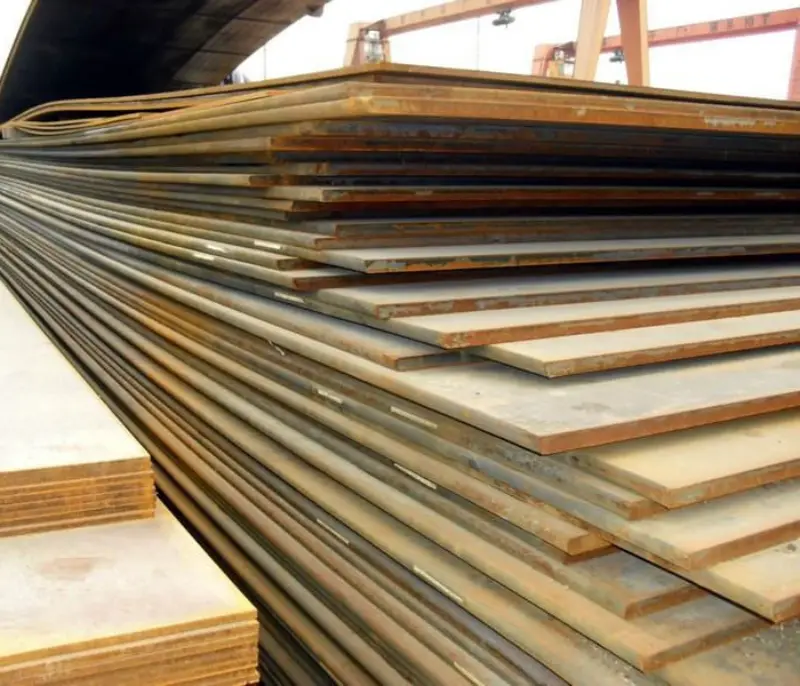
EN 10025-6 S690QL1 Quenched & Tempered High-Strength Structural Steel Plate
EN 10025-6 S690QL1 Quenched & Tempered High-Strength Structural Steel Plate - Expert Datasheet
Complete material data for S690QL1 steel plate according to EN 10025-6: chemical composition, mechanical properties, physical data, international equivalents, and application guidance for welded structures.
Hot rolling + quenching and tempering; suitable for cold forming (within limitation), thermal cutting, welding (with preheat and control), machining
- Phone : +8618037372205
- Email : [email protected]
- WhatsApp: Contact via Whtsapp
- WeChat: +8618037372205
EN 10025-6 S690QL1 Quenched & Tempered High-Strength Structural Steel Plate Introduction
S690QL1 is a quenched and tempered, weldable fine-grain structural steel with a minimum yield strength of 690 MPa, specified in EN 10025-6:2019. It belongs to the high-strength low-alloy (HSLA) category and is designed for heavy-duty structural applications where weight savings, high load-bearing capacity, and reliable low-temperature toughness are required.
- The steel offers an excellent combination of high strength, good ductility, and guaranteed impact energy at -40 °C (designated by "L1").
- It is produced via a carefully controlled quenching and tempering process, resulting in a fine-grained martensitic/bainitic microstructure.
- Thanks to its low carbon equivalent (CEV), the grade exhibits satisfactory weldability when proper procedures are followed, enabling fabrication of complex welded components without immediate post-weld heat treatment in many cases.
- S690QL1 is predominantly supplied as heavy plate and is extensively used in mobile cranes, offshore structures, pressure vessels, and heavy-duty machinery.
EN 10025-6 S690QL1 Quenched & Tempered High-Strength Structural Steel Plate Chemical Composition
The table lists the maximum allowable contents for most elements unless a range or minimum is specified. All values are in weight percent. The steel is fully killed and fine-grain treated. Nitrogen-binding elements such as Al, Nb, Ti, or V are added. The carbon equivalent value (CEV) is limited to ensure weldability, with typical CEV ≤ 0.52% for S690QL1 depending on product thickness.
| Chemical Element | Standard Value (max, unless noted) | Remarks |
|---|---|---|
| C (Carbon) | 0.20 | Max. |
| Si (Silicon) | 0.80 | Max. |
| Mn (Manganese) | 1.70 | Max. |
| P (Phosphorus) | 0.020 | Max. |
| S (Sulfur) | 0.010 | Max. |
| N (Nitrogen) | 0.015 | Max. If sufficient N-binding elements present, higher N permitted |
| B (Boron) | 0.005 | Max. |
| Cr (Chromium) | 1.50 | Max. |
| Cu (Copper) | 0.50 | Max. |
| Mo (Molybdenum) | 0.70 | Max. |
| Nb (Niobium) | 0.060 | Max. |
| Ni (Nickel) | 2.00 | Max. |
| Ti (Titanium) | 0.05 | Max. |
| V (Vanadium) | 0.12 | Max. |
| Zr (Zirconium) | 0.15 | Max. |
| Al (Aluminium, total) | ≥ 0.015 | Min. for fine-grain practice; if other N-binders used, lower Al allowed |
EN 10025-6 S690QL1 Quenched & Tempered High-Strength Structural Steel Plate Physical Properties
The values below represent typical engineering reference data for quenched and tempered steels of this strength class. They are not part of the delivery specification and may vary slightly depending on exact tempering temperature and microstructural condition. Use these values for design calculations and simulations.
| Property | Typical Value | Unit | Test Condition |
|---|---|---|---|
| Density (ρ) | 7850 | kg/m³ | At 20 °C |
| Elastic modulus (E) | 210 | GPa | At 20 °C, static |
| Shear modulus (G) | ~80 | GPa | Estimated from E and ν = 0.3 |
| Poisson's ratio (ν) | 0.3 | – | Elastic range, ambient temperature |
| Thermal expansion coefficient (α) | 11.7 × 10⁻⁶ | K⁻¹ | Between 20 °C and 100 °C |
| Thermal conductivity (λ) | 42 – 48 | W/(m·K) | At 20 °C (typical range for QT steels) |
| Specific heat capacity (Cp) | 460 | J/(kg·K) | At 20 °C |
| Electrical resistivity (ρe) | ~0.20 – 0.25 | μΩ·m | At 20 °C |
EN 10025-6 S690QL1 Quenched & Tempered High-Strength Structural Steel Plate Mechanical Properties
Properties apply to quenched and tempered condition. Values are minimum unless a range is given. Tensile test specimens are transverse to the rolling direction (unless longitudinal is specified). Impact properties are verified on longitudinal V-notch Charpy specimens at -40 °C. The steel fulfills the requirements for L1 (-40 °C) low-temperature toughness class.
| Property | Standard Required Value | Unit | Test Condition / Product Thickness (t) |
|---|---|---|---|
| Yield strength (ReH) | ≥ 690 | MPa | t ≤ 50 mm |
| Yield strength (ReH) | ≥ 650 | MPa | 50 mm < t ≤ 100 mm |
| Yield strength (ReH) | ≥ 630 | MPa | 100 mm < t ≤ 150 mm |
| Tensile strength (Rm) | 770 – 940 | MPa | t ≤ 50 mm |
| Tensile strength (Rm) | 760 – 930 | MPa | 50 mm < t ≤ 100 mm |
| Tensile strength (Rm) | 710 – 900 | MPa | 100 mm < t ≤ 150 mm |
| Elongation after fracture (A5) | ≥ 14 | % | t ≤ 50 mm, gauge Lo = 5.65√So (proportional test piece) |
| Elongation after fracture (A5) | ≥ 14 | % | 50 mm < t ≤ 100 mm |
| Elongation after fracture (A5) | ≥ 14 | % | 100 mm < t ≤ 150 mm |
| Charpy V-notch impact energy (KV) | ≥ 27 (longitudinal) | J | Test temperature -40 °C, t ≤ 150 mm (L1 class) |
| Bend test (if agreed) | No cracks | – | Bend angle 180°, former diameter per specification; not mandatory for all thicknesses in standard |
EN 10025-6 S690QL1 Quenched & Tempered High-Strength Structural Steel Plate Completely Equivalent / Identical Materials
The following standards define the same or technically identical steel grade, ensuring full interchangeability in terms of chemical composition and mechanical requirements.
| Country/Region | Standard | Grade Designation | Remarks |
|---|---|---|---|
| International (ISO) | ISO 4950-2 | S690QL1 | Identical designation, same requirements |
| United Kingdom | BS EN 10025-6 | S690QL1 | Direct adoption of European standard |
| Germany | DIN EN 10025-6 | S690QL1 | National adoption |
| France | NF EN 10025-6 | S690QL1 | National adoption |
| Italy | UNI EN 10025-6 | S690QL1 | National adoption |
EN 10025-6 S690QL1 Quenched & Tempered High-Strength Structural Steel Plate Application Introduction
S690QL1 is designed for demanding welded structures where high strength and low-temperature toughness are critical. Its use enables weight reduction, increased payload capacity, and extended service life. The steel is usually delivered as quenched and tempered plate, which can be further fabricated by cutting, welding, and limited cold forming. All welding must follow qualified procedures, typically with controlled preheat and interpass temperatures, and using low-hydrogen consumables. Post-weld heat treatment is generally not required for thicknesses below 50 mm, but thicker sections may need tempering to avoid cold cracking.
Product Applications: All-terrain and crawler crane telescopic booms and outriggers, Jack-up rig legs and spud cans, Bulky welded box girders and truss bridges, Hydroelectric penstocks and spiral cases, Heavy-duty chassis for off-road vehicles, Foundation piles and retaining structures requiring high bending strength
Processed into products: Boom segments (top, middle, bottom) with welded longitudinal stiffeners, Pivot pins, bearing housings, and thick gusset plates, Flanges and webs for plate girders (thicknesses 20–100 mm), Cut and drilled link plates for lattice booms, Welded lifting lugs and pad-eyes for offshore lifting sets, Transition joints between different thicknesses (tapered plates)
Application industries: Mobile crane and heavy-lift equipment manufacturing, Offshore and marine engineering (platform structures, crane pedestals), Construction and civil engineering (long-span bridges, high-rise columns), Pressure vessel and penstock fabrication, Mining and earth-moving machinery (dump truck bodies, excavator booms), Railway vehicle manufacturing (bogies, structural frames)
EN 10025-6 S690QL1 Quenched & Tempered High-Strength Structural Steel Plate Similar / Nearest Equivalent Grades
The following grades possess comparable minimum yield strength and may be considered for substitution after careful analysis of CEV, toughness requirements, and welding performance. Direct substitution without engineering review is not advised.
| Country/Region | Standard | Grade | Remarks on Similarity |
|---|---|---|---|
| USA | ASTM A514/A514M | Grade S (690 MPa) | Similar yield strength (~690 MPa), but different chemistry and stricter CEV in EN steel; requires re-qualification of welding |
| USA | ASTM A709/A709M | Grade 100 Type Q (690 MPa) | Structural steel for bridges; requires check of toughness class (may need additional CVN tests) |
| Japan | JIS G 3128 | SHY685 (or SHY685N) | High strength steel for welded structures; yield 685 MPa; check L1 (-40 °C) impact requirement |
| China | GB/T 16270 | Q690D | Quenched and tempered high strength steel, delivery condition D guarantees -20 °C impact; not fully equivalent to -40 °C L1 class |
| China | GB/T 16270 | Q690E | Impact at -40 °C; closer to S690QL1 but still verify fine-grain practice and CEV |
| Europe | EN 10025-6 | S690Q (without L1) | Same strength but only basic toughness (0 °C or -20 °C); not suitable for low-temperature applications requiring L1 |
Notes:
Weldability: S690QL1 has a controlled carbon equivalent (typically CEV ≤ 0.52 %) to ensure good weldability. Preheating (min. 100–175 °C depending on plate thickness and hydrogen scale) and slow cooling are recommended. Stress relief: In most cases, post-weld stress relieving is avoided to maintain temper properties, but if mandated, a temperature below the original tempering temperature must be used (typically around 550–580 °C). Surface condition: Plates are supplied as-rolled, descaled, or blast-cleaned according to EN 10163. Tolerances: Dimensional and shape tolerances comply with EN 10029 for plates sheared or cut from hot-rolled plate. Certification: The steel is typically delivered with inspection certificate 3.1 according to EN 10204, stating the results of heat analysis, mechanical tests, and impact tests.
- Share



