
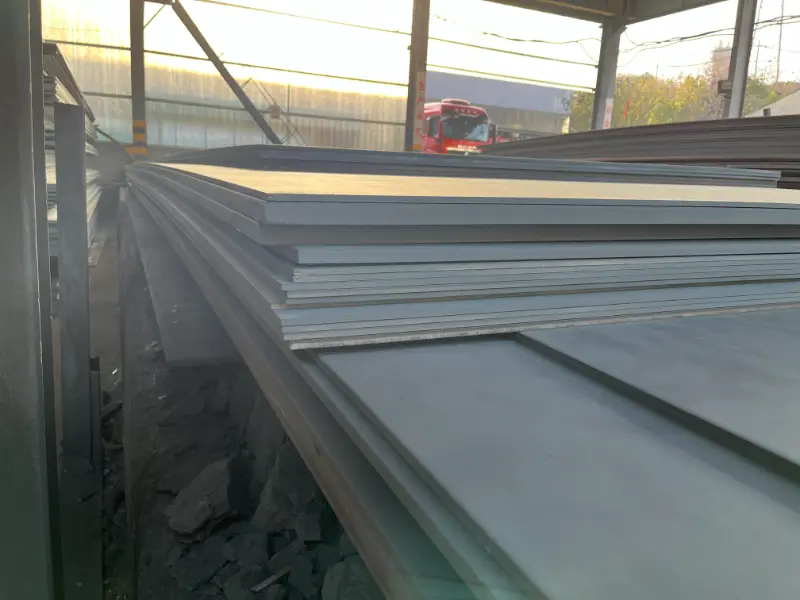
S890QL Quenched & Tempered Steel Plate EN 10025-6
S890QL Quenched & Tempered Steel Plate EN 10025-6: Technical Data & Equivalents
Complete material data for EN 10025-6 S890QL carbon and low-alloy high-strength steel plate. Chemical composition, mechanical and physical properties, international equivalents, and application guide.
Hot rolling followed by quenching and tempering (+QT); can be cold formed with limitations; welded with low-hydrogen procedures; cut by thermal or mechanical methods.
- Phone : +8618037372205
- Email : [email protected]
- WhatsApp: Contact via Whtsapp
- WeChat: +8618037372205
S890QL Quenched & Tempered Steel Plate EN 10025-6 Introduction
S890QL is a high-strength quenched and tempered structural steel grade defined in EN 10025-6. It belongs to the family of fine-grain weldable steels with minimum yield strength of 890 MPa in thicknesses up to 50 mm. The 'Q' denotes quenching and tempering, while 'L' indicates guaranteed impact toughness at low temperature (-40°C).
- Key properties: excellent strength-to-weight ratio, good weldability when proper procedures are followed, and reliable notch toughness at sub-zero temperatures.
- Typical delivery condition: quenched and tempered (+QT).
- Applications: heavy-duty machinery, crane booms, offshore structures, pressure vessels, and bridges.
S890QL Quenched & Tempered Steel Plate EN 10025-6 Chemical Composition
The chemical composition complies with EN 10025-6:2004 Table 3 for grade S890Q (applicable to S890QL). Values are maximum unless a range is given. The steel is fully killed and fine-grain treated. A carbon equivalent (CEV) is specified to ensure weldability.
| Element | Standard Value (max %) | Remarks |
|---|---|---|
| Carbon (C) | 0.20 | Max.; for t>50 mm slightly higher allowed per standard |
| Silicon (Si) | 0.80 | Max. |
| Manganese (Mn) | 1.70 | Max. |
| Phosphorus (P) | 0.020 | Max. |
| Sulfur (S) | 0.010 | Max. |
| Nitrogen (N) | 0.015 | Max. |
| Boron (B) | 0.005 | Max. |
| Chromium (Cr) | 1.50 | Max. |
| Copper (Cu) | 0.50 | Max. |
| Molybdenum (Mo) | 0.70 | Max. |
| Niobium (Nb) | 0.06 | Max. |
| Nickel (Ni) | 2.0 | Max. |
| Titanium (Ti) | 0.05 | Max. |
| Vanadium (V) | 0.12 | Max. |
| Zirconium (Zr) | 0.15 | Max. |
| Aluminium (Al) total | 0.015 min | Usually present as grain refiner; minimum content ensures fine grain |
| Carbon Equivalent (CEV) | 0.65 typical (max 0.72 for t≤50 mm) | CEV = C + Mn/6 + (Cr+Mo+V)/5 + (Ni+Cu)/15 |
S890QL Quenched & Tempered Steel Plate EN 10025-6 Thermal and Electrical Physical Properties
These physical properties are representative for quenched and tempered high-strength low-alloy steels like S890QL. Actual values may vary slightly with exact composition and heat treatment. Data are provided for engineering calculations.
| Property | Typical Value | Unit | Test Condition / Remarks |
|---|---|---|---|
| Density (ρ) | 7.85 | g/cm³ | at 20°C |
| Elastic Modulus (E) | 210 | GPa | at 20°C |
| Shear Modulus (G) | 81 | GPa | calculated from E and ν |
| Poisson's Ratio (ν) | 0.3 | — | at 20°C |
| Thermal Expansion Coefficient (α) | 11.5 | 10⁻⁶/K | 20°C to 100°C |
| Thermal Expansion Coefficient (α) | 12.5 | 10⁻⁶/K | 20°C to 300°C |
| Thermal Conductivity (λ) | 40 | W/(m·K) | at 20°C |
| Specific Heat Capacity (cp) | 460 | J/(kg·K) | at 20°C |
| Electrical Resistivity (ρe) | 0.22 | μΩ·m | at 20°C |
S890QL Quenched & Tempered Steel Plate EN 10025-6 Mechanical Properties
Mechanical properties are according to EN 10025-6 for S890QL grade. Values depend on product thickness. The steel exhibits high strength with adequate ductility. Impact energy is guaranteed at -40°C (L-grade). Bending tests are performed to verify formability.
| Property | Standard Requirement | Unit | Test Condition / Thickness Range |
|---|---|---|---|
| Yield Strength (ReH) | 890 min | MPa | t ≤ 50 mm |
| Yield Strength (ReH) | 830 min | MPa | 50 mm < t ≤ 100 mm |
| Yield Strength (ReH) | 780 min | MPa | 100 mm < t ≤ 150 mm |
| Tensile Strength (Rm) | 940 - 1100 | MPa | t ≤ 50 mm |
| Tensile Strength (Rm) | 880 - 1100 | MPa | 50 mm < t ≤ 100 mm |
| Elongation after Fracture (A) | 11 min | % | Proportional test piece L0=5.65√S0, transverse, t ≤ 50 mm |
| Elongation after Fracture (A) | 11 min | % | 50 mm < t ≤ 100 mm |
| Impact Energy (KV, Charpy-V) | 27 min (longitudinal) | J | at -40°C (QL grade) |
| Bend Test (Mandrel Diameter) | 4t (t=thickness) | — | t ≤ 16 mm, bend angle 180° |
| Bend Test | 5t | — | 16 mm < t ≤ 50 mm |
| Hardness (HBW) | typically 280-340 | HBW | For information; not a delivery condition requirement |
S890QL Quenched & Tempered Steel Plate EN 10025-6 Exact Equivalent Standards and Designations
| Country/Region | Standard | Grade Designation | Remarks |
|---|---|---|---|
| European Union | EN 10025-6 | S890QL | Original standard; Quenched & Tempered, Low temp. toughness (-40°C) |
| International | ISO 630-6 | S890Q and S890QL | ISO adopts similar grades; QL for -40°C impact option |
| United Kingdom | BS EN 10025-6 | S890QL | Identical to EN standard |
| Germany | DIN EN 10025-6 | S890QL | Identical to EN standard |
| France | NF EN 10025-6 | S890QL | Identical to EN standard |
| Italy | UNI EN 10025-6 | S890QL | Identical to EN standard |
| Spain | UNE EN 10025-6 | S890QL | Identical to EN standard |
| Sweden | SS EN 10025-6 | S890QL | Identical to EN standard |
| Japan | JIS G 3128 | SHY 685 (or SHY 685N) | Not identical; strength level lower (685 MPa yield). Concept of quenched & tempered high-strength steel. |
| USA | ASTM A514 | Grade S / Grade H / etc. | Quenched & tempered alloy steel plate; min yield 690 MPa. Higher toughness grades available. S890QL is stronger. |
S890QL Quenched & Tempered Steel Plate EN 10025-6 Application Introduction
S890QL steel is designed for structural applications where high strength, low weight, and good low-temperature toughness are essential. Its weldability permits efficient fabrication, making it a preferred choice in demanding engineering sectors.
Product Applications: Quenched and tempered heavy plates in thicknesses from 6 mm up to 150 mm, Cut-to-length sheets and wide flats, Welded beams and fabricated girders, Cold-formed hollow sections (subject to availability)
Processed into products: Crane boom and chassis components, Jack-up rig leg chords and rack plates, Heavy-duty hydraulic cylinder bodies, Offshore wind turbine transition pieces and monopile connection flanges, Mining truck body liners and structural members, Earthmoving equipment load-bearing arms, Long-span bridge box girders and orthotropic deck plates, High-pressure penstock and spiral case sections, Armoured vehicle hulls and add-on protection kits, Lifting and spreader beams
Application industries: Heavy Lifting and Transport (mobile cranes, crawler cranes, reach stackers), Offshore and Marine Engineering (jack-up rig legs, platforms, subsea frames), Mining and Earthmoving Equipment (dump truck bodies, excavator arms, buckets), Bridge Construction (long-span bridges, orthotropic decks), Pressure Vessel and Storage Tank Manufacturing (high-pressure vessels, penstocks), Wind Energy (tower sections, transition pieces, particularly for offshore turbines), Civil Engineering and Infrastructure (stadium roofs, large exhibition hall structures), Military and Defense (armour plating, vehicle components)
S890QL Quenched & Tempered Steel Plate EN 10025-6 Similar or Alternative High-Strength Quenched & Tempered Steels
| Country/Region | Standard | Grade Designation | Remarks |
|---|---|---|---|
| Europe | EN 10025-6 | S890Q | Same strength, but impact test at -20°C (Q) instead of -40°C (QL) |
| Europe | EN 10025-6 | S960QL | Higher yield strength (960 MPa), similar toughness |
| Europe | EN 10025-6 | S690QL | Lower yield strength (690 MPa), excellent toughness; wider usage |
| Europe | EN 10025-6 | S890QL1 | A variant with modified chemistry for improved weldability, not always in current standard |
| International | ISO 630-6 | S890Q/QL | Direct equivalent from ISO |
| Japan | JIS G 3128 | SHY 785 | Higher strength class at 785 MPa yield, similar processing |
| USA | ASTM A517 | Grade B / H / S / etc. | Similar quenched and tempered steel for pressure vessels, min yield 690 MPa; stronger plates available |
Notes:
- Welding: Low-hydrogen processes (SMAW with basic electrodes, SAW, GMAW, FCAW) and preheating according to CEV and thickness are required. Post-weld heat treatment is usually not necessary but may be applied to reduce residual stresses.
- Cold forming: Can be performed with adequate bending radii (typically ≥ 4t). For severe forming, stress relief annealing may be advisable.
- Surface condition: Products are delivered in the as-quenched and tempered condition with a blast-cleaned or pickled surface, often primed if specified.
- Inspection: Ultrasonic testing according to EN 10160 is commonly required for heavy plates.
- Alternatives: For increased toughness or thickness, S890QL1 or direct-quenched grades like S890Q may be specified. For less severe conditions, S690QL offers easier fabrication.
- Share



