
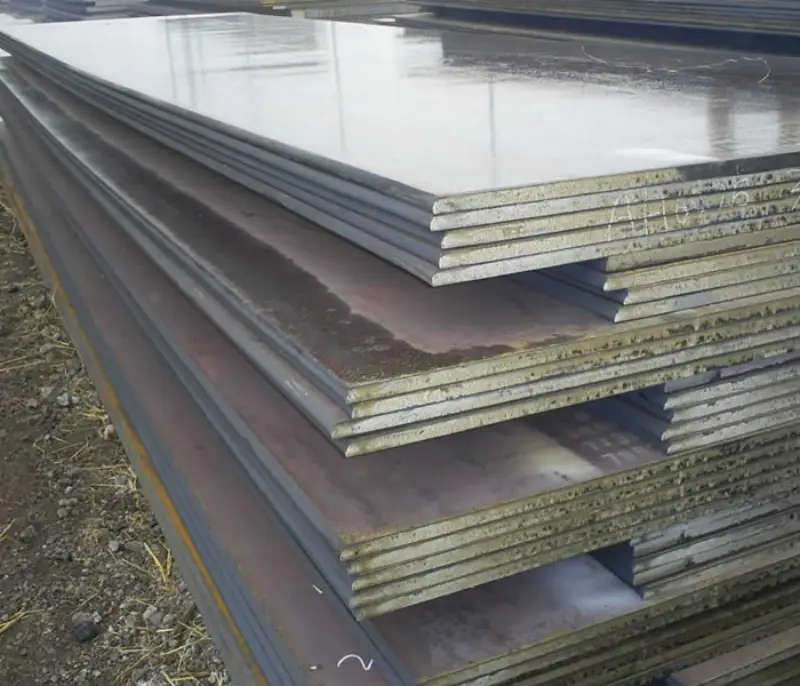
S890QL1 Q&T High-Strength Steel Plate to EN 10025-6
S890QL1 Q&T High-Strength Steel Plate to EN 10025-6 | 890 MPa Yield
Complete material data for S890QL1 according to EN 10025-6: carbon and low-alloy high-strength structural steel plate, supplied in quenched and tempered condition with minimum yield strength 890 MPa and excellent low-temperature toughness. Includes chemical composition, mechanical and physical properties, international equivalents, and application guidance.
Hot rolled + quenching and tempering (Q+T); subsequent cutting, cold forming, and welding with controlled heat input and pre/post-heat treatment
- Phone : +8618037372205
- Email : [email protected]
- WhatsApp: Contact via Whtsapp
- WeChat: +8618037372205
S890QL1 Q&T High-Strength Steel Plate to EN 10025-6 Introduction
S890QL1 is a high-strength, quenched and tempered structural steel plate defined in European standard EN 10025-6. It belongs to the category of carbon and low-alloy steels with a minimum yield strength of 890 MPa for thicknesses up to 50 mm. The grade designation 'S' indicates structural steel, '890' the minimum yield strength in MPa, 'Q' means quenched and tempered delivery condition, and 'L1' guarantees minimum impact energy of 27 J at -40 °C (longitudinal).
The steel combines high strength with excellent toughness and good weldability when proper procedures are followed. It is used in demanding structural applications such as mobile cranes, heavy-duty vehicles, mining equipment, and pressure vessels where weight reduction and high load-bearing capacity are critical. Typical delivery is normalised or as-rolled condition is not applicable; the plate is always supplied in the Q+T state with inspection documents as per EN 10204.
S890QL1 Q&T High-Strength Steel Plate to EN 10025-6 Chemical Composition
Chemical composition as specified in EN 10025-6:2019 for S890QL1 grade. Values are maximum limits unless otherwise indicated. Grain-refining elements such as Al, Nb, V or Ti must be present alone or in combination. Sufficient nitrogen-binding elements are added to ensure fine grain structure.
| Element | Value (%) | Remarks |
|---|---|---|
| C | 0.20 max | Carbon |
| Si | 0.80 max | Silicon |
| Mn | 1.70 max | Manganese |
| P | 0.020 max | Phosphorus |
| S | 0.010 max | Sulfur |
| Cr | 1.50 max | Chromium |
| Mo | 0.70 max | Molybdenum |
| Ni | 2.0 max | Nickel |
| V | 0.12 max | Vanadium |
| Ti | 0.05 max | Titanium |
| Cu | 0.50 max | Copper |
| Nb | 0.06 max | Niobium |
| B | 0.005 max | Boron |
| Zr | 0.15 max | Zirconium |
| Al (total) | 0.015 min | Aluminium, minimum content for grain refinement |
S890QL1 Q&T High-Strength Steel Plate to EN 10025-6 Thermal and Electrical Physical Properties
Typical physical properties for S890QL1 grade at room temperature unless otherwise noted. These values are for general engineering use and are not mandatory requirements of the product standard. Properties may vary slightly with actual composition and tempering parameter.
| Property | Typical value | Unit | Test Conditions / Remarks |
|---|---|---|---|
| Density (ρ) | 7.85 | g/cm³ | 20 °C |
| Modulus of elasticity (E) | 200 – 210 | GPa | 20 °C |
| Shear modulus (G) | 80 | GPa | 20 °C, calculated from E and ν |
| Poisson's ratio (ν) | 0.3 | – | 20 °C, typical for steel |
| Thermal expansion coefficient (α) | 11.1 | 10⁻⁶/K | 20–100 °C |
| Thermal expansion coefficient (α) | 12.5 | 10⁻⁶/K | 20–300 °C |
| Thermal conductivity (λ) | 35 | W/(m·K) | 20 °C |
| Specific heat capacity (cp) | 460 | J/(kg·K) | 20 °C |
| Electrical resistivity (ρₑ) | 0.25 | µΩ·m | 20 °C |
S890QL1 Q&T High-Strength Steel Plate to EN 10025-6 Mechanical Properties
Mechanical properties according to EN 10025-6:2019 for S890QL1 flat products in quenched and tempered condition. Tensile test pieces are taken in longitudinal direction. Impact test values are for Charpy V-notch specimens. Requirements vary with product thickness as shown.
| Property | Value | Unit | Test Conditions |
|---|---|---|---|
| Minimum yield strength (ReH) | 890 | MPa | Nominal thickness ≤ 50 mm |
| Minimum yield strength (ReH) | 830 | MPa | Nominal thickness > 50 mm ≤ 100 mm |
| Minimum yield strength (ReH) | 750 | MPa | Nominal thickness > 100 mm ≤ 150 mm |
| Tensile strength (Rm) | 940 – 1100 | MPa | Nominal thickness ≤ 50 mm |
| Tensile strength (Rm) | 880 – 1100 | MPa | Nominal thickness > 50 mm ≤ 100 mm |
| Tensile strength (Rm) | 840 – 1100 | MPa | Nominal thickness > 100 mm ≤ 150 mm |
| Minimum elongation after fracture (A) | 12 | % | Gauge length Lo = 5.65√So, longitudinal, t ≤ 50 mm |
| Minimum elongation after fracture (A) | 12 | % | Gauge length Lo = 5.65√So, longitudinal, 50 < t ≤ 100 mm |
| Minimum elongation after fracture (A) | 12 | % | Gauge length Lo = 5.65√So, longitudinal, 100 < t ≤ 150 mm |
| Bend test (180°) | No cracks | – | Mandrel diameter = 3 × thickness (t ≤ 50 mm) |
| Impact energy (KV2) at -40 °C | 27 min (longitudinal) | J | Charpy V-notch, t ≤ 150 mm |
| Impact energy (KV2) at -40 °C | 20 min (transverse) | J | Charpy V-notch, if agreed |
S890QL1 Q&T High-Strength Steel Plate to EN 10025-6 Direct Equivalents – Same Chemical and Mechanical Requirements
| Country / Region | Standard | Grade / Designation | Remarks |
|---|---|---|---|
| International | ISO 4950-3:1995 | E890 | High yield strength flat steel products – Quenched and tempered condition; comparable yield and impact properties |
S890QL1 Q&T High-Strength Steel Plate to EN 10025-6 Application Introduction
S890QL1 is engineered for structural applications where extremely high strength, excellent toughness, and good weldability are required. It enables significant weight reduction in mobile equipment and load-bearing structures while maintaining safety and fatigue resistance. Proper fabrication practices, including preheating, controlled interpass temperature, and post-weld heat treatment, are essential to preserve the mechanical properties.
Product Applications: Telescopic crane booms and lattice sections, Heavy vehicle frames and outriggers, Mining truck bodies and excavator buckets, High-pressure vessels and storage tanks, Offshore platform components, Structural nodes and connections in steel construction
Processed into products: Crane boom segments, Hoist arms and lifting forks, Welded box-section beams, Pinned joint plates, Cut and bent stiffeners, Machined bearing housings
Application industries: Mobile crane and lifting equipment manufacturing, Heavy-duty truck and trailer chassis, Mining and earth-moving machinery, Pressure vessel and boiler fabrication, Offshore and marine structural engineering, Building and bridge construction (special applications)
S890QL1 Q&T High-Strength Steel Plate to EN 10025-6 Similar Materials – Close Substitutes from EN 10025-6 Family
| Country / Region | Standard | Grade | Remarks |
|---|---|---|---|
| European Union | EN 10025-6:2019 | S890QL | Same strength, but impact test temperature is -20 °C instead of -40 °C. Suitable where slightly lower toughness is acceptable. |
| European Union | EN 10025-6:2019 | S890Q | Same strength, impact test at 0 °C. Use in applications with less severe low-temperature demands. |
| European Union | EN 10025-6:2019 | S960QL1 | Higher minimum yield strength (960 MPa) with same low-temperature toughness. For weight-critical designs where even higher strength is needed. |
| International | ISO 4950-3:1995 | E960 | Quenched and tempered steel with minimum yield 960 MPa, similar toughness options. Alternative when higher strength is permissible. |
Notes:
S890QL1 plates are usually supplied with inspection certificate 3.1 according to EN 10204. Higher thickness beyond 150 mm requires agreement between manufacturer and purchaser. For welding, low-hydrogen processes and proper filler metals matching the base metal strength level are necessary to avoid hydrogen-induced cracking. Typical preheat temperatures range from 100 °C to 175 °C depending on combined thickness and hydrogen scale. Post-weld heat treatment is generally not recommended because it can reduce strength; stress-relief at 530–580 °C may be applied if essential, but verification testing is required.
- Share



