
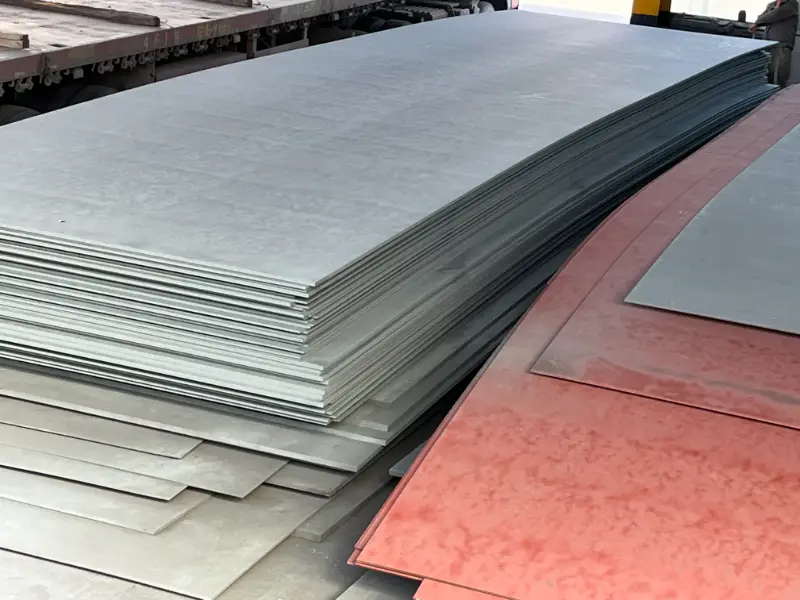
S960Q Steel Plate
S960Q Steel Plate | EN 10025-6 High-Strength Quenched & Tempered Structural Steel
Detailed material data for S960Q steel plate according to EN 10025-6. Includes chemical composition, mechanical properties, thermal and electrical physical properties, international equivalents, and application guide for high-strength structural engineering.
Hot rolling with subsequent quenching and tempering heat treatment
- Phone : +8618037372205
- Email : [email protected]
- WhatsApp: Contact via Whtsapp
- WeChat: +8618037372205
S960Q Steel Plate Introduction
S960Q is a high-strength, quenched and tempered structural steel grade defined in EN 10025-6. It is a carbon and low-alloy steel designed for superior mechanical properties, offering a minimum yield strength of 960 MPa in thicknesses up to 50 mm. This grade provides an excellent strength-to-weight ratio, enabling lighter structures without compromising load-bearing capacity. Key characteristics include good weldability when appropriate procedures are followed, and adequate toughness at low temperatures, making it suitable for demanding applications in mobile cranes, heavy transport equipment, and advanced structural engineering. Its fine-grained microstructure, achieved through the quenching and tempering process, ensures high strength and fatigue resistance.
S960Q Steel Plate Chemical Composition
The chemical composition of S960Q steel is precisely controlled during steelmaking to achieve its high strength and toughness after quenching and tempering. Elements like carbon and manganese provide base strength, while micro-alloying additions such as niobium, vanadium, and titanium form fine carbides and nitrides that refine the grain structure. The maximum carbon equivalent value (CEV) is typically specified, often below 0.65-0.72% depending on thickness, to ensure adequate weldability.
| Element | Standard Value (%) | Remarks |
|---|---|---|
| Carbon (C) | ≤ 0.22 | Max |
| Silicon (Si) | ≤ 0.86 | Max |
| Manganese (Mn) | ≤ 1.80 | Max |
| Phosphorus (P) | ≤ 0.025 | Max |
| Sulfur (S) | ≤ 0.015 | Max |
| Chromium (Cr) | ≤ 1.60 | Max |
| Nickel (Ni) | ≤ 3.10 | Max |
| Molybdenum (Mo) | ≤ 0.74 | Max |
| Copper (Cu) | ≤ 0.55 | Max |
| Niobium (Nb) | ≤ 0.08 | Max |
| Vanadium (V) | ≤ 0.14 | Max |
| Titanium (Ti) | ≤ 0.07 | Max |
| Boron (B) | ≤ 0.006 | Max |
| Zirconium (Zr) | ≤ 0.19 | Max |
| Aluminium (Al total) | ≥ 0.018 | Min, for nitrogen binding |
| Nitrogen (N) | ≤ 0.017 | Max |
S960Q Steel Plate Thermal and Electrical Physical Properties
The physical properties of S960Q are representative of low-alloy, high-strength structural steels. The density is standard for steels. The thermal expansion coefficient is crucial for calculating thermal stresses during welding or in structures subjected to temperature variations. The lower thermal conductivity compared to pure iron requires attention in thermal cutting and welding preheat/interpass temperature control. These properties are generally constant for this steel family and less affected by the tempering process.
| Property | Typical Value | Unit | Test Condition |
|---|---|---|---|
| Density (ρ) | 7850 | kg/m³ | At 20°C |
| Modulus of Elasticity (E) | 205 | GPa | At 20°C |
| Shear Modulus (G) | 80 | GPa | At 20°C |
| Poisson's Ratio (ν) | 0.3 | - | At 20°C |
| Thermal Expansion Coefficient (α) | 11.5 | 10⁻⁶/K | At 20-100°C range |
| Thermal Expansion Coefficient (α) | 12.5 | 10⁻⁶/K | At 20-300°C range |
| Thermal Expansion Coefficient (α) | 13.5 | 10⁻⁶/K | At 20-500°C range |
| Thermal Conductivity (λ) | 38 | W/(m·K) | At 20°C |
| Thermal Conductivity (λ) | 36 | W/(m·K) | At 200°C |
| Thermal Conductivity (λ) | 34 | W/(m·K) | At 400°C |
| Specific Heat Capacity (cp) | 460 | J/(kg·K) | At 20°C |
| Electrical Resistivity (ρe) | 0.25 | µΩ·m | At 20°C |
S960Q Steel Plate Mechanical Properties
These mechanical properties are guaranteed for Quenched and Tempered (Q+T) delivery condition at ambient temperature. The high minimum yield strength of 960 MPa for thicknesses up to 50 mm is the defining characteristic of this grade. A minimum elongation of 10% ensures ductility. The Charpy-V impact energy is specified at different test temperatures (e.g., at -20°C or -40°C) and a minimum value of 27 J or 30 J is typical, ensuring toughness against brittle fracture in critical structural applications.
| Property | Standard Requirement | Unit | Test Condition/Thickness Range (mm) |
|---|---|---|---|
| Minimum Yield Strength (ReH) | 960 | MPa | t ≤ 50 |
| Minimum Yield Strength (ReH) | 940 | MPa | 50 < t ≤ 100 |
| Minimum Yield Strength (ReH) | 900 | MPa | 100 < t ≤ 150 |
| Tensile Strength (Rm) | 980 - 1180 | MPa | t ≤ 50 |
| Tensile Strength (Rm) | 950 - 1180 | MPa | 50 < t ≤ 100 |
| Tensile Strength (Rm) | 880 - 1150 | MPa | 100 < t ≤ 150 |
| Minimum Elongation (A5) | 11 | % | t ≤ 50, longitudinal specimen |
| Minimum Elongation (A5) | 10 | % | 50 < t ≤ 100, longitudinal specimen |
| Minimum Elongation (A5) | 9 | % | 100 < t ≤ 150, longitudinal specimen |
| Impact Energy (KV) | ≥ 27 | J | Test at -20°C, longitudinal specimen |
| Impact Energy (KV) | ≥ 27 | J | Test at -40°C, longitudinal specimen, Option QL1 |
S960Q Steel Plate Completely Equivalent Material Standards and Replaceable Grades
| Country/Region | Standard | Grade | Remarks |
|---|---|---|---|
| Germany | DIN EN 10025-6 | S960Q | Unique number 1.8941 |
| United Kingdom | BS EN 10025-6 | S960Q | Identical adoption of European standard |
| France | NF EN 10025-6 | S960Q | Identical adoption of European standard |
| Italy | UNI EN 10025-6 | S960Q | Identical adoption of European standard |
| Spain | UNE EN 10025-6 | S960Q | Identical adoption of European standard |
| Sweden | SS-EN 10025-6 | S960Q | Identical adoption of European standard |
| International | ISO 4950-3 | E960DD | Equivalent high yield strength steel; always verify chemical and mechanical property match |
S960Q Steel Plate Application Introduction
Due to its extremely high strength-to-weight ratio, S960Q enables significant weight reduction in complex steel structures, which leads to lower fuel consumption in mobile equipment and reduced foundation costs in buildings. It is designed for welded load-bearing structures where high static and dynamic loads occur. Strict adherence to welding procedures, including the use of low-hydrogen processes and appropriate preheating, is mandatory to prevent hydrogen-induced cold cracking. The steel can be cold-formed in a limited manner due to its high strength, and hot forming is not recommended as it degrades the carefully engineered quenched and tempered microstructure.
Product Applications: Telescopic crane booms and chassis frames, Heavy load transport trailers and steel decking, Offshore platform topside structures and jack-up frames, Complex bridge girders and large-span roof structures, Hydraulic excavator arms and dump truck bodies, High-strength security and blast-resistant components
Processed into products: Welded box sections and box girders, High-stress shear plates and gussets, Load-bearing pins and structural joints, Fifth-wheel coupling plates on trucks, Structural stiffeners and stringers in ship hulls, Articulating arm segments for heavy robots
Application industries: Heavy Mobile Equipment and Crane Manufacturing, Transport and Logistics (Heavy-Duty Trailer Frames), Shipbuilding and Offshore Engineering, Civil Engineering and Bridge Construction, Mining and Earthmoving Machinery, Pressure Vessel and Energy Sector (subsea frames)
S960Q Steel Plate Recommendations for Materials with Similar/Comparable Performance
| Country/Region | Standard | Grade | Remarks |
|---|---|---|---|
| European Union | EN 10025-6 | S890Q | Predecessor strength level with minimum 890 MPa yield. Offers higher toughness and may be substituted where 960 MPa strength is not fully required, providing easier welding and procurement. |
| European Union | EN 10025-6 | S960QL | The 'L' suffix guarantees minimum impact energy at -40°C. Fully interchangeable with S960Q if the optional QL1 condition is specified, otherwise offers superior low-temperature toughness. |
| USA | ASTM A514/A514M | Grade S | A quenched and tempered alloy steel plate with minimum 690 MPa yield. Not a direct 960 MPa substitute, but used in similar heavy structural applications. Higher strength requirements would necessitate comparing modified grades or S960Q. |
| Germany | Siemens/VEW Specification | NAXTRA 96 | A proprietary quenched and tempered fine-grained structural steel with a minimum yield strength of 960 MPa. Very closely aligned in application and properties, often used in mobile cranes and heavy machinery frames. |
Notes:
Welding: Strict heat control is mandatory. A typical preheat temperature of 100-175°C is required, depending on plate thickness and carbon equivalent. Use low-hydrogen welding consumables matching the base metal strength. Cold Forming: Due to high springback, overbending is necessary. The minimum recommended bending radius is typically 3-4 times the plate thickness (t) for transverse bends. Hot forming or heat treatment after hot forming is strictly prohibited as it destroys the quenched and tempered microstructure and its mechanical properties. Surface Condition: Delivered with a blast-cleaned or pickled surface to ensure good paint adhesion and initial corrosion protection during fabrication.
- Share



