
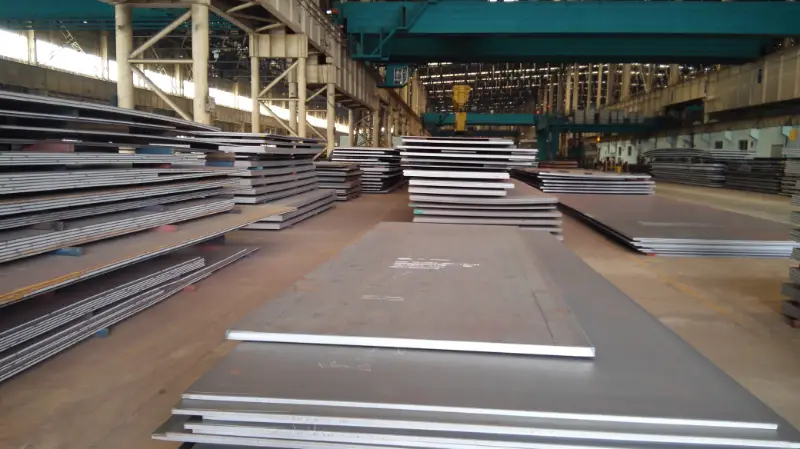
JIS G3106 SM520B Carbon and Low-alloy High-strength Steel Plate
JIS G3106 SM520B Steel Plate: Carbon & Low-Alloy High-Strength Welded Structural Steel
Detailed data on JIS G3106 SM520B carbon and low-alloy high-strength steel plate: chemical composition, mechanical and physical properties, international equivalents, and applications.
Hot rolling, controlled rolling, normalizing, cutting, welding, forming, machining
- Phone : +8618037372205
- Email : [email protected]
- WhatsApp: Contact via Whtsapp
- WeChat: +8618037372205
JIS G3106 SM520B Carbon and Low-alloy High-strength Steel Plate Introduction
SM520B is a carbon and low-alloy high-strength structural steel plate in accordance with Japanese Industrial Standard JIS G3106. It provides a guaranteed minimum tensile strength of 520 MPa and exhibits good weldability with notch toughness at 0°C. The material is intended for welded structures subjected to static and dynamic loads. Typical delivery conditions include as-rolled, controlled-rolled, or normalized states, making it suitable for heavy fabrication in bridge, shipbuilding, and building construction industries. The balanced chemistry with limited carbon ensures reliable strength while maintaining ductility and weldability.
JIS G3106 SM520B Carbon and Low-alloy High-strength Steel Plate Chemical Composition
Chemical requirements according to JIS G3106. Maximum limits unless otherwise stated. Trace elements may be added for grain refinement as agreed between manufacturer and purchaser, but not specified mandatorily.
| Element | Standard Value (max, wt%) | Notes |
|---|---|---|
| Carbon (C) | 0.20 | Max |
| Silicon (Si) | 0.55 | Max |
| Manganese (Mn) | 1.60 | Max |
| Phosphorus (P) | 0.035 | Max |
| Sulfur (S) | 0.035 | Max |
| Others | - | Other alloying elements may be added upon agreement |
JIS G3106 SM520B Carbon and Low-alloy High-strength Steel Plate Thermal and Electrical Physical Properties
Typical physical properties for carbon-manganese structural steel, applicable to SM520B at room temperature unless otherwise noted. These values are not mandatory requirements but serve as engineering estimates based on similar steel grades.
| Property | Typical Value | Unit | Test Condition / Remarks |
|---|---|---|---|
| Density (ρ) | 7.85 | g/cm³ | At 20 °C |
| Modulus of Elasticity (E) | 210 | GPa | At 20 °C |
| Shear Modulus (G) | 81 | GPa | At 20 °C |
| Poisson's Ratio (ν) | 0.3 | - | At 20 °C |
| Thermal Expansion Coefficient (α) | 12.0 | 10⁻⁶/K | 20 - 100 °C |
| Thermal Conductivity (λ) | 53 | W/(m·K) | At 20 °C |
| Specific Heat Capacity | 460 | J/(kg·K) | At 20 °C |
| Electrical Resistivity (ρ_e) | 0.16 | 10⁻⁶ Ω·m | At 20 °C |
JIS G3106 SM520B Carbon and Low-alloy High-strength Steel Plate Mechanical Properties
Mechanical properties per JIS G3106 for SM520B. Test specimens are taken in the transverse direction unless otherwise agreed. Tensile testing according to JIS Z2241, impact testing according to JIS Z2242 (Charpy V-notch).
| Property | Specified Value | Unit | Test Condition |
|---|---|---|---|
| Yield Strength (ReH) | ≥365 | MPa | Plate thickness t ≤ 16 mm |
| Yield Strength (ReH) | ≥355 | MPa | 16 < t ≤ 40 mm |
| Yield Strength (ReH) | ≥335 | MPa | 40 < t ≤ 75 mm |
| Yield Strength (ReH) | ≥325 | MPa | 75 < t ≤ 100 mm |
| Yield Strength (ReH) | ≥305 | MPa | 100 < t ≤ 160 mm |
| Yield Strength (ReH) | ≥295 | MPa | 160 < t ≤ 200 mm |
| Tensile Strength (Rm) | 520 - 640 | MPa | All thicknesses |
| Elongation (A) | ≥ 15 | % | t ≤ 5 mm, JIS No.5 specimen |
| Elongation (A) | ≥ 19 | % | 5 < t ≤ 16 mm, JIS No.1A specimen |
| Elongation (A) | ≥ 17 | % | 16 < t ≤ 50 mm, JIS No.1A specimen |
| Elongation (A) | ≥ 23 | % | 50 < t ≤ 100 mm, JIS No.10 specimen |
| Elongation (A) | ≥ 24 | % | 100 < t ≤ 160 mm, JIS No.10 specimen |
| Elongation (A) | ≥ 24 | % | 160 < t ≤ 200 mm, JIS No.10 specimen |
| Charpy Impact Energy (KV) | ≥ 27 | J | 0 °C, V-notch, longitudinal |
| Bend Test (Bend diameter) | 2.0 a | - | t ≤ 16 mm, 180° bend, a=thickness |
| Bend Test (Bend diameter) | 3.0 a | - | 16 < t ≤ 100 mm, 180° bend |
JIS G3106 SM520B Carbon and Low-alloy High-strength Steel Plate Fully Equivalent Standards & Replaceable Grades
| Country/Region | Standard | Grade | Remarks |
|---|---|---|---|
| South Korea | KS D 3515 | SM520B | Identical technical requirements to JIS G3106 SM520B |
| Taiwan | CNS 2947 | SM520B | Equivalent specification, same chemistry and properties |
JIS G3106 SM520B Carbon and Low-alloy High-strength Steel Plate Application Introduction
SM520B is engineered for welded structures where a 520 MPa tensile strength and 0°C impact toughness are adequate. Its good formability and weldability allow efficient fabrication of heavy sections. Typical applications span civil engineering, shipbuilding, and industrial machinery.
Product Applications: Welded bridge girders and arches, Ship hulls, decks, and bulkheads, High-rise building frames and columns, Spherical and cylindrical pressure vessels, Transport and earthmoving equipment, Wind turbine towers and foundations
Processed into products: Butt-welded plate assemblies, Box beams and I-beams, Stiffeners and ribs, Flanges and web plates, Load-bearing welded joints, Chassis frames and boom sections
Application industries: Bridge construction, Shipbuilding and offshore engineering, Building and civil structures, Pressure vessels and storage tanks, Mechanical engineering and heavy machinery, Mining and material handling equipment
JIS G3106 SM520B Carbon and Low-alloy High-strength Steel Plate Similar Materials and Alternative Grades
| Country/Region | Standard | Grade | Remarks |
|---|---|---|---|
| EU | EN 10025-3 | S420N | Higher yield (min 420 MPa for t≤16mm), similar tensile 520-680 MPa, impact at -20°C; S420M thermomechanical option |
| EU | EN 10025-2 | S355J2+N | Lower tensile (490-630 MPa) but widely available; impact at -20°C; may suit less demanding applications |
| USA | ASTM A572/A572M | Grade 55 [380] | Minimum yield 380 MPa, tensile 485 MPa; lower strength than SM520B; check for thickness effect |
| China | GB/T 1591 | Q390D | Yield ≥390 MPa (t≤16mm), tensile 490-650 MPa; impact at -20°C; close in tensile but slightly stronger in yield |
Notes:
Welding considerations: Preheating may be required for thick sections or under low ambient temperatures to avoid hydrogen cracking. Low-hydrogen welding processes are recommended. Post-weld heat treatment is generally not required but can be applied upon agreement. The material is not intended for prolonged service above approximately 400°C as strength reduction may occur.
- Share



