
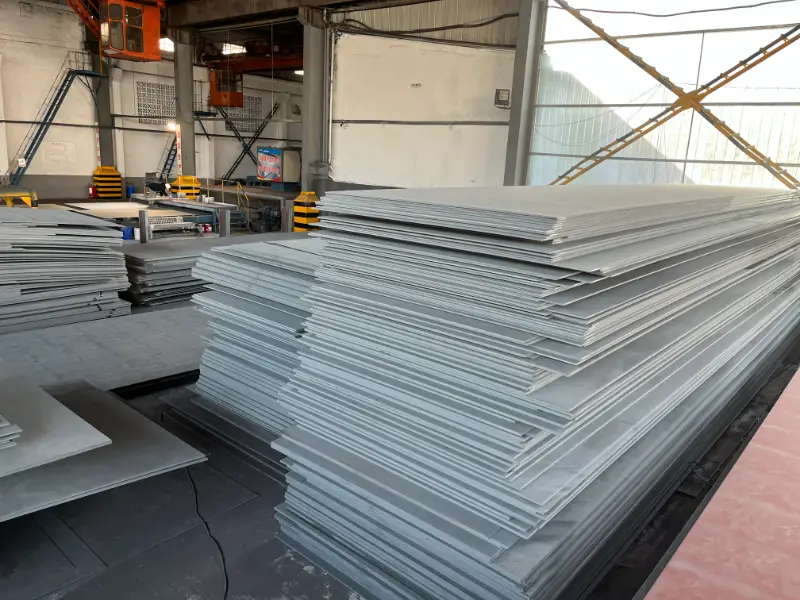
JIS G3106 SM490YB Steel Plate
JIS G3106 SM490YB Steel Plate - High-strength weldable structural steel with improved through-thickness properties
Detailed material data for SM490YB according to JIS G3106: high strength carbon and low-alloy steel plate for welded structures, featuring guaranteed through-thickness ductility.
Hot rolling, thermo-mechanical controlled rolling (TMCP), normalising; suitable for welding, cold forming, machining
- Phone : +8618037372205
- Email : [email protected]
- WhatsApp: Contact via Whtsapp
- WeChat: +8618037372205
JIS G3106 SM490YB Steel Plate Introduction
SM490YB is a hot-rolled weldable structural steel plate defined in JIS G3106. It belongs to the SM490Y series, where the suffix 'Y' indicates suitability for applications requiring guaranteed through-thickness properties (lamellar tearing resistance). This grade offers minimum tensile strength of 490 MPa and excellent weldability. The 'B' designation refers to a Charpy impact test requirement at 0°C. SM490YB is widely used in building construction, bridges, offshore structures, and heavy machinery where both strength and Z‑direction ductility are essential. Typical delivery condition is as-rolled, thermo-mechanically rolled, or normalised depending on thickness and agreement.
JIS G3106 SM490YB Steel Plate Chemical Composition
Ladle analysis according to JIS G3106. SM490YB features tight control of sulphur to ensure good through-thickness ductility. For thickness >100 mm, carbon equivalent (CE) and/or PCM values may be agreed. Typical CE ≤0.44% for thicknesses up to 50 mm.
| Element | Specified Value (max, unless range) | Remarks |
|---|---|---|
| C | ≤0.20 | Heat analysis; for plates >100 mm, may be adjusted by agreement |
| Si | ≤0.55 | Silicon content |
| Mn | ≤1.60 | Manganese may be increased for thicker gauges with CE control |
| P | ≤0.035 | Phosphorus |
| S | ≤0.035 (typically ≤0.008 for Z-quality) | Sulphur; for through-thickness property guarantee, Z25 or Z35 requirements per JIS G3199 usually apply (S ≤0.008% or 0.005%) |
JIS G3106 SM490YB Steel Plate Thermal and Electrical Physical Properties
Typical data for carbon-manganese low-alloy structural steel at room temperature (20°C). Values are informative and not part of the standard's mandatory requirements. Properties may vary with actual composition and heat treatment condition.
| Property | Typical Value | Unit | Test Condition |
|---|---|---|---|
| Density (ρ) | 7.85 | g/cm³ | 20°C |
| Modulus of Elasticity (E) | 205 | GPa | 20°C, static |
| Shear Modulus (G) | 79 | GPa | 20°C, calculated |
| Poisson's Ratio (ν) | 0.30 | — | 20°C, typical |
| Thermal Expansion (α) | 11.5 – 12.5 | 10⁻⁶/K | 20–300°C (average) |
| Thermal Conductivity (λ) | approx. 50 | W/(m·K) | 20°C |
| Specific Heat Capacity | approx. 0.46 | J/(g·K) | 20°C |
| Electrical Resistivity (ρ_e) | 0.15 – 0.20 | Ω·mm²/m | 20°C |
JIS G3106 SM490YB Steel Plate Mechanical Properties
Minimum values obtained from transverse test pieces (unless otherwise noted). The impact test is required for nominal thicknesses ≥12 mm. 1A test piece is for thickness ≤5 mm; No. 1A or No. 2 test pieces for thickness 5–16 mm; No. 1A or No. 10 for 16–50 mm. Specified according to JIS G3106:2015.
| Property | Required Value | Unit | Test Condition/Thickness |
|---|---|---|---|
| Yield Strength (ReH) | ≥365 | MPa | t ≤ 16 mm |
| Yield Strength (ReH) | ≥355 | MPa | 16 mm < t ≤ 40 mm |
| Yield Strength (ReH) | ≥335 | MPa | 40 mm < t ≤ 75 mm |
| Yield Strength (ReH) | ≥325 | MPa | 75 mm < t ≤ 100 mm |
| Yield Strength (ReH) | ≥305 | MPa | 100 mm < t ≤ 160 mm |
| Tensile Strength (Rm) | 490 – 610 | MPa | t ≤ 160 mm (all thicknesses) |
| Elongation (A) | ≥15 | % | t ≤ 5 mm; gauge length 50 mm (1A test piece) |
| Elongation (A) | ≥17 | % | 5 < t ≤ 16 mm; gauge length 50 mm (1A test piece) |
| Elongation (A) | ≥21 | % | 16 < t ≤ 50 mm; gauge length 200 mm (No. 1A) or 50 mm (No. 10) |
| Elongation (A) | ≥23 | % | 50 < t ≤ 100 mm; gauge length 200 mm (No. 1A) |
| Elongation (A) | ≥22 | % | 100 < t ≤ 160 mm; gauge length 200 mm (No. 1A) |
| Charpy Impact (KV2) | ≥27 at 0°C | J | Longitudinal, 2 mm V-notch; t ≥ 12 mm (Grade B requirement) |
| Through-thickness reduction of area (Z) | ≥25 (for Z25) / ≥35 (for Z35) | % | According to JIS G3199; agreed at time of order (typical for Y-grade) |
JIS G3106 SM490YB Steel Plate Internationally Equivalent Standards and Substitutable Grades
| Country/Region | Standard | Grade | Remarks |
|---|---|---|---|
| Europe | EN 10025-3 | S355N / S355NL | Normalised/normalised rolled fine grain structural steel with through-thickness properties; impact test temperature may differ (N: -20°C, NL: -50°C). Close in strength (yield 355 MPa) and Z-quality. |
| United States | ASTM A572/A572M | Grade 50 [345] with Z-direction test | Requires supplementary through-thickness test per ASTM A770. Yield strength 345 MPa is slightly lower than SM490YB. |
| China | GB/T 5313 | Q355D-Z25 / Q355D-Z35 | When base steel Q355D (yield 355 MPa, impact -20°C) is ordered with through-thickness properties, it closely matches SM490YB. May need to adjust S content. |
JIS G3106 SM490YB Steel Plate Application Introduction
Thanks to its guaranteed through-thickness properties, SM490YB is the first choice for thick welded connections where lamellar tearing is a risk. It combines a minimum yield strength of 365–305 MPa (depending on thickness) with good weldability and notch toughness at 0°C. Typical applications include heavy steel frames, trusses, and nodes in high-rise buildings, long-span bridges, offshore structures, and equipment subjected to significant out‑of‑plane loading. Plates are normally delivered in the as‑rolled or TMCP condition, with normalising available for thicker sections. Where through‑thickness tensile test results are critical, the required Z‑class (Z25 or Z35) should be specified in the purchase order.
Product Applications: Welded H-beams and box columns, Built-up bridge girders, Offshore structural nodes, Ship frames and bulkheads, Crane rails and runway girders, Padeyes and lifting lugs for heavy loads, Base plates and end plates for moment connections
Processed into products: Thick gusset plates and stiffeners in moment‑resisting frames, End‑plate connections in beam‑to‑column joints, Cruciform welded joints and T‑joints with high restraint, Corner joints in thick‑walled box sections, Lifting trunnions and heavy shackle points, Rotary table beams on drilling rigs, Pillar‑jib crane base plates
Application industries: Construction (high‑rise buildings, stadiums, industrial halls), Bridge engineering (plate girder bridges, box girders), Shipbuilding (hull structures, decks), Offshore and marine (platforms, jack‑up rig legs, padeyes), Heavy machinery (crane booms, excavator bases), Pressure vessels and penstocks (with supplementary requirements), Mining (dump truck bodies, crusher frames)
JIS G3106 SM490YB Steel Plate Similar Alternative Materials with Comparable Properties
| Country/Region | Standard | Grade | Remarks |
|---|---|---|---|
| Japan | JIS G3106 | SM490A / SM490B | Equivalent strength but without through-thickness property guarantee; no Z‑direction requirement. SM490B has 0°C impact test. |
| Europe | EN 10025-2 | S355J0 | Hot-rolled structural steel; similar strength (yield 355 MPa, tensile 470-630 MPa), impact 0°C. No inherent Z-quality. |
| Europe | EN 10025-3 | S355N | Fine grain steel with Z-quality possible. Slightly lower minimum yield (355 MPa) compared to SM490YB thin gauges. |
| United States | ASTM A709/A709M | Grade 50 (345) / 50W | Bridge steel; 345 MPa yield; comparable in strength but not direct through-thickness designation. |
| China | GB/T 1591 | Q355D | Low-alloy high-strength structural steel; yield 355 MPa, 0°C or -20°C impact, no inherent Z-quality unless specified. |
Notes:
Z-quality ordering: When SM490YB is ordered for through-thickness properties, the desired Z‑class (Z25 or Z35 according to JIS G3199) and the applicable inspection frequency must be clearly stated. Welding: SM490YB exhibits good weldability with low carbon equivalent; preheating may be advisable for thicker sections (>30 mm) or when using low heat input processes. Casting sequence: The steel is fully killed and fine‑grain treated. Further processing: Hot‑dip galvanising is possible without significant loss of mechanical properties. Supplementary tests: Ultrasonic testing per JIS G0801 or EN 10160 is frequently specified for structural safety applications.
- Share



