
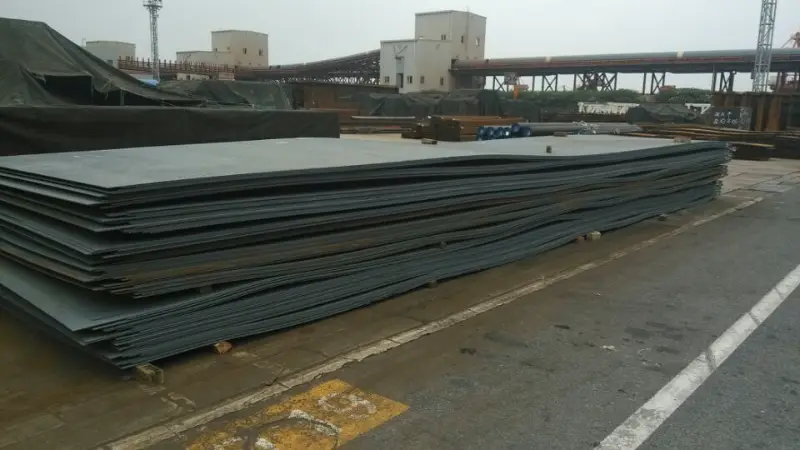
DIN 17102 StE500
DIN 17102 StE500 High-Strength Fine-Grain Structural Steel Plate for Heavy Fabrication
Detailed material data for StE500 according to DIN 17102, a weldable fine-grain structural steel with minimum 500 MPa yield strength, often used in bridges, cranes, and heavy machinery.
Normalizing rolling or normalizing heat treatment; weldable with conventional methods; suitable for cold forming and machining
- Phone : +8618037372205
- Email : [email protected]
- WhatsApp: Contact via Whtsapp
- WeChat: +8618037372205
DIN 17102 StE500 Introduction
DIN 17102 StE500 is a German standard high-strength, low-alloy structural steel produced through normalizing treatment to achieve a fine-grain microstructure. It offers a minimum yield strength of 500 MPa in thicknesses up to 16 mm, combined with high tensile strength, excellent toughness, and very good weldability. The steel is designed for welded, heavily loaded structures where weight savings and high reliability are required. Its chemical composition is carefully balanced with micro-alloying elements such as niobium, vanadium, and titanium to refine grain size and improve mechanical properties while maintaining low carbon equivalent for ease of welding. StE500 is widely used in
- bridge construction
- heavy crane booms
- offshore structures
- pressure vessels
- industrial machinery frames
The grade was originally specified in the withdrawn standard DIN 17102 and has been succeeded by the European standard EN 10025-3 under designation S500N (1.8901).
DIN 17102 StE500 Chemical Composition
The chemical composition of StE500 according to DIN 17102 is designed to ensure a fine-grain structure and high strength after normalizing. Alloying elements such as Nb, V, and Ti are added for grain refinement, while Al is used for deoxidation and nitrogen binding. Maximum limits on impurities (P, S) ensure good toughness and processing properties.
| Element | Content (wt%) | Remarks |
|---|---|---|
| Carbon (C) | ≤ 0.20 | Max |
| Silicon (Si) | ≤ 0.60 | Max |
| Manganese (Mn) | 1.00 – 1.70 | Range |
| Phosphorus (P) | ≤ 0.025 | Max |
| Sulfur (S) | ≤ 0.015 | Max |
| Nitrogen (N) | ≤ 0.020 | Max |
| Aluminium (Al), total | ≥ 0.020 | Min; acid-soluble Al may be specified |
| Chromium (Cr) | ≤ 0.30 | Max, residual |
| Copper (Cu) | ≤ 0.50 | Max, residual |
| Molybdenum (Mo) | ≤ 0.20 | Max, residual |
| Nickel (Ni) | ≤ 0.80 | Max, residual |
| Niobium (Nb) | ≤ 0.05 | Max, grain refiner |
| Titanium (Ti) | ≤ 0.05 | Max, grain refiner |
| Vanadium (V) | ≤ 0.10 | Max, grain refiner |
DIN 17102 StE500 Physical Properties
Physical properties are not part of the DIN 17102 delivery condition but are typical for normalized fine-grain carbon-manganese steels. They are useful for design calculations regarding thermal expansion, stiffness, and thermal/electrical conductivity.
| Property | Value | Unit | Test Condition / Remarks |
|---|---|---|---|
| Density (ρ) | 7850 | kg/m³ | At 20 °C |
| Elastic modulus (E) | 210 | GPa | At 20 °C |
| Shear modulus (G) | 81 | GPa | At 20 °C (calculated) |
| Poisson ratio (ν) | 0.3 | - | Within elastic range |
| Thermal expansion coefficient (α) | 11.1 × 10⁻⁶ | K⁻¹ | Between 20 °C and 100 °C |
| Thermal expansion coefficient (α) | 12.5 × 10⁻⁶ | K⁻¹ | Between 20 °C and 300 °C |
| Thermal conductivity (λ) | 53 | W/(m·K) | At 20 °C |
| Specific heat capacity (c) | 460 | J/(kg·K) | At 20 °C |
| Electrical resistivity (ρₑ) | 0.23 | Ω·mm²/m | At 20 °C |
DIN 17102 StE500 Mechanical Properties
Mechanical properties are dependent on product thickness and test direction. Values below represent longitudinal tensile and impact requirements as per DIN 17102 for the normalized condition. The bending test ensures formability and freedom from defects.
| Property | Value | Unit | Test Condition / Remarks |
|---|---|---|---|
| Upper yield strength (ReH) | 500 | MPa | Thickness ≤ 16 mm |
| Upper yield strength (ReH) | 480 | MPa | Thickness 16 < t ≤ 40 mm |
| Upper yield strength (ReH) | 460 | MPa | Thickness 40 < t ≤ 70 mm |
| Upper yield strength (ReH) | 440 | MPa | Thickness 70 < t ≤ 100 mm |
| Tensile strength (Rm) | 610 – 790 | MPa | All thicknesses ≤ 100 mm |
| Elongation after fracture (A5) | ≥ 16 | % | Longitudinal, proportional gauge length L₀ = 5.65√S₀ |
| Elongation after fracture (A5) | ≥ 14 | % | Transverse (typical supplementary requirement) |
| Charpy V-notch impact energy (KV₂) | ≥ 27 | J | At -20 °C, longitudinal; minimum average of three tests |
| Bending test (180°) | d = 2a | – | Mandrel diameter; thickness ≤ 16 mm |
| Bending test (180°) | d = 3a | – | Mandrel diameter; thickness > 16 mm up to 100 mm |
DIN 17102 StE500 Directly Equivalent Material Standards and Substitutions
StE500 has been officially replaced by the European standard EN 10025-3 S500N (1.8901). This equivalent shows the same minimum yield strength and similar chemical requirements. International equivalents that closely match the chemistry and normalized delivery are listed below.
| Country/Region | Standard | Designation | Remarks |
|---|---|---|---|
| Europe | EN 10025-3:2019 | S500N (1.8901) | Normalized fine-grain structural steel, direct successor to StE500 |
| International | ISO 4950-3 | E500 | High yield strength flat products, normalized steel; close match |
DIN 17102 StE500 Application Introduction
Due to its high strength, good weldability, and excellent low-temperature toughness in the normalized condition, StE500 (and its current equivalent S500N) is ideal for heavy welded structures that operate under static and dynamic loading. It can be safely used down to -20°C without brittle fracture. The fine-grain microstructure ensures uniform properties through the thickness.
- Bridges: main girders, box sections, diaphragms
- Offshore: jacket legs, bracing members, deck structures
- Mechanical engineering: heavy-duty machine frames, hydraulic press columns
- Crane manufacturing: lattice boom sections, outrigger beams
- Pressure vessels and penstocks
Processing should follow standard practices for normalizing steels: pre-heat for thick sections before welding, use low-hydrogen consumables, and avoid excessive cold forming without stress relief.
Product Applications: Welded bridge girder assemblies, Heavy crane chassis and telescopic booms, Offshore platform sub-structures, Rolled and welded pressure vessel shells, Large-diameter high-pressure penstocks, Industrial building frames and large span trusses
Processed into products: Main plates of box girders, Base frames and support legs of excavators, Lifting lugs, connection plates and gusset plates, Crane outrigger pads and extension beams, Pile driving hammer cases, Thick-walled hollow sections for structural nodes
Application industries: Bridge and civil engineering, Shipbuilding and offshore, Crane and heavy lifting equipment, Pressure vessel and piping (qualified for specific design codes), Mining and earthmoving machinery, Wind turbine tower and foundation structures
DIN 17102 StE500 Similar / Substitute Material Recommendations
In the absence of StE500 or S500N, the following grades offer comparable strength levels but may differ in delivery condition or stricter toughness requirements. They should be selected with careful consideration of welding and forming performance.
| Country/Region | Standard | Designation | Remarks |
|---|---|---|---|
| Europe | EN 10025-3 | S500M | Thermomechanical rolled; yield 500 MPa, slightly different welding behaviour |
| USA | ASTM A572/A572M | Grade 65 [450 MPa YS] | Yield strength 450 MPa (65 ksi), lower than StE500; increase thickness may compensate |
| Japan | JIS G 3106 | SM570 | Tensile strength 570-720 MPa; typical yield ~460 MPa, not an exact match |
| Europe | EN 10025-6 | S500Q | Quenched and tempered steel with minimum 500 MPa yield and high toughness |
Notes:
Welding: Use low-hydrogen processes (SMAW, SAW, GMAW) with consumables matching the base metal strength (e.g., E5018/ER70S-6 or higher). Preheat typically 100–150°C for thicknesses >20 mm to avoid hydrogen cracking. Post-weld heat treatment: Usually not required, but stress relieving at 530–580°C may be applied for dimensional stability or in pressure vessel applications. Cold forming: Suitable for bending with minimum radii of 2t–3t; for critical parts de-embrittlement at 250°C or stress relieving may be necessary after severe forming. Surface protection: Can be blast cleaned and painted; hot-dip galvanizing is possible with attention to silicon content. Inspection: Ultrasonic testing to EN 10160 Class S1/E1 is commonly specified for heavy plates.
- Share



