
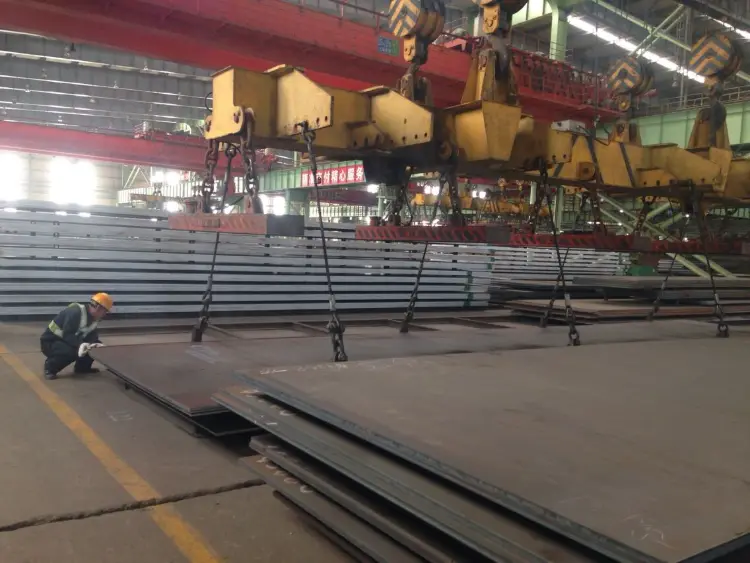
DIN 17102 StE460 Weldable Normalized Fine Grain High-Strength Structural Steel Plate
DIN 17102 StE460: High-Strength Fine-Grain Structural Steel for Welded Structures
DIN 17102 StE460 is a normalized fine-grain structural steel with minimum yield strength 460 MPa, designed for heavy welded constructions. Excellent toughness and weldability.
Hot rolling, normalizing, thermo-mechanical controlled processing (TMCP)
- Phone : +8618037372205
- Email : [email protected]
- WhatsApp: Contact via Whtsapp
- WeChat: +8618037372205
DIN 17102 StE460 Weldable Normalized Fine Grain High-Strength Structural Steel Plate Introduction
StE460 is a weldable fine-grain structural steel grade defined in the German standard DIN 17102, intended for use in heavily loaded welded structures such as bridges, cranes, storage tanks, and offshore components. It is supplied in normalized condition (often with option for thermo-mechanically rolled delivery) to achieve a fine-grained microstructure that ensures high strength combined with good toughness. The grade guarantees a minimum yield strength of 460 MPa in thicknesses up to 16 mm, with stepwise reduction for greater thicknesses, while maintaining excellent weldability and cold-forming properties. Typical alloy design relies on controlled micro-alloying additions (Nb, V, Ti, Al) to refine grain size, which promotes both high strength and resistance to brittle fracture. Its balanced composition and clean steel practice make it suitable for demanding structural engineering applications where safety and reliability are critical.
DIN 17102 StE460 Weldable Normalized Fine Grain High-Strength Structural Steel Plate Chemical Composition
The chemical composition according to DIN 17102 for StE460 aims at fine-grain practice with mandatory aluminium or alternative micro-alloying elements. Maximum limits for residual elements ensure good weldability. The values shown are typical for heat analysis and may be subject to slight product analysis deviations.
| Element | Content (%) | Notes |
|---|---|---|
| Carbon (C) | ≤0.20 | Base strength |
| Silicon (Si) | 0.10 – 0.60 | Deoxidizer, strength |
| Manganese (Mn) | 1.00 – 1.70 | Strength and toughness |
| Phosphorus (P) | ≤0.035 | Impurity |
| Sulfur (S) | ≤0.030 | Impurity |
| Aluminium (Altotal) | ≥0.020 | Grain refining (mandatory if Nb/V/Ti not added) |
| Niobium (Nb) | ≤0.05 | Optional grain refiner |
| Vanadium (V) | ≤0.20 | Optional grain refiner |
| Titanium (Ti) | ≤0.20 | Optional grain refiner |
| Chromium (Cr) | ≤0.30 | Residual |
| Copper (Cu) | ≤0.50 | Residual (may be higher by agreement) |
| Molybdenum (Mo) | ≤0.10 | Residual |
| Nickel (Ni) | ≤0.80 | Residual |
| Nitrogen (N) | ≤0.020 | Bound by micro-alloying |
DIN 17102 StE460 Weldable Normalized Fine Grain High-Strength Structural Steel Plate Thermal and Electrical Physical Properties
The following physical properties are typical for StE460 in the normalized condition at ambient temperature, unless otherwise noted. These values serve as design approximations and may vary slightly depending on specific production route.
| Property | Typical Value | Unit | Test Condition / Remarks |
|---|---|---|---|
| Density (ρ) | 7.85 | g/cm³ | At 20 °C |
| Modulus of Elasticity (E) | 210 | GPa | At room temperature |
| Shear Modulus (G) | ≈80 | GPa | At room temperature |
| Poisson's Ratio (ν) | ≈0.3 | – | At room temperature |
| Thermal Expansion Coefficient (α) | 12.0 | 10⁻⁶ / K | 20 – 100 °C |
| Thermal Conductivity (λ) | ≈50 | W/(m·K) | At 20 °C |
| Specific Heat Capacity | ≈460 | J/(kg·K) | At 20 °C |
| Electrical Resistivity (ρₑ) | 0.20 – 0.25 | μΩ·m | At 20 °C |
DIN 17102 StE460 Weldable Normalized Fine Grain High-Strength Structural Steel Plate Mechanical Properties
Mechanical properties are thickness-dependent as per DIN 17102. The values represent minimum requirements based on standard test pieces (longitudinal direction). Yield strength (ReH) reduces gradually with increasing product thickness. Elongation is measured on proportional gauges (A5 or A as indicated).
| Property | Value | Unit | Test Condition / Thickness Range |
|---|---|---|---|
| Yield Strength (ReH) | ≥460 | MPa | t ≤ 16 mm |
| Yield Strength (ReH) | ≥440 | MPa | 16 < t ≤ 35 mm |
| Yield Strength (ReH) | ≥420 | MPa | 35 < t ≤ 50 mm |
| Yield Strength (ReH) | ≥400 | MPa | 50 < t ≤ 70 mm |
| Yield Strength (ReH) | ≥370 | MPa | 70 < t ≤ 100 mm |
| Tensile Strength (Rm) | 530 – 720 | MPa | t ≤ 70 mm |
| Tensile Strength (Rm) | 470 – 670 | MPa | 70 < t ≤ 100 mm |
| Elongation (A) | ≥17 | % | t ≤ 40 mm (gauge length 5.65√S₀) |
| Elongation (A) | ≥16 | % | 40 < t ≤ 63 mm |
| Elongation (A) | ≥15 | % | 63 < t ≤ 100 mm |
| Bend Test (Mandrel Diameter) | Agreed upon at time of order | – | As required |
| Impact Energy (KV) – optional | As agreed (e.g., ≥27 J at -20 °C) | J | Upon request with quality suffix |
DIN 17102 StE460 Weldable Normalized Fine Grain High-Strength Structural Steel Plate Completely Equivalent Material Standards and Substitute Grades
| Country/Region | Standard | Grade | Remarks |
|---|---|---|---|
| Europe | EN 10025-3 | S460N | Normalized fine-grain steel, direct successor to DIN 17102 StE460 |
| Europe | EN 10025-3 | S460NL | Normalized fine-grain steel with low-temperature toughness (L) |
| Europe | EN 10025-4 | S460M | Thermo-mechanically rolled equivalent |
| Europe | EN 10025-4 | S460ML | TMCP with guaranteed low-temperature impact properties |
| International | ISO 4951-2 | E460 | Fine-grain structural steel, directly comparable |
| Japan | JIS G3106 | SM570 | High tensile strength steel, yield ≥460 MPa, tensile 570-720 MPa |
DIN 17102 StE460 Weldable Normalized Fine Grain High-Strength Structural Steel Plate Application Introduction
StE460 is employed in heavy welded constructions where high static and dynamic load-bearing capacity is required. Its fine-grained microstructure ensures satisfactory toughness even at low ambient temperatures (when ordered with appropriate impact requirements). Typical application areas and products are summarized below.
Product Applications: Long-span bridge girders, box sections, and stiffeners, Pressure vessel shells and heads, Offshore platform decks, nodes, and legs, Crane booms, jibs, and undercarriage frames, Excavator arms and mining dump truck frames, Steel columns and beams for high-rise buildings, Penstocks and hydroelectric components
Processed into products: Welded built-up beams and columns, Flanges and webs for plate girders, Ear plates and padeyes for lifting points, Circular and rectangular hollow sections, Machined and drilled connection plates, Chords and bracings in truss structures, Support rings and stiffening ribs in tanks
Application industries: Bridge engineering (road and railway bridges), Pressure vessel and storage tank manufacturing, Offshore and marine structures (platforms, wind turbine foundations), Crane and heavy lifting equipment, Mining and earth-moving machinery, High-rise and industrial steel buildings, Power plant construction (steel stacks, boiler structures)
DIN 17102 StE460 Weldable Normalized Fine Grain High-Strength Structural Steel Plate Closely Related or Similar Material Recommendations
| Country/Region | Standard | Grade | Remarks |
|---|---|---|---|
| Europe | EN 10025-6 | S460Q | Quenched and tempered fine-grain steel; higher strength but different processing |
| Europe | EN 10025-3 | S460N/NL | Already listed as direct equivalent; can be used interchangeably with proper specification |
| USA | ASTM A572 / A572M | Grade 65 [450] | Minimum yield 450 MPa (65 ksi); slightly lower strength than StE460, acceptable for some designs |
| USA | ASTM A709 / A709M | Grade 50W [345W] / 50 [345] | Structural bridge steel; strength levels lower, but relevant for weathering applications |
| China | GB/T 1591 | Q460C/D/E | 460 MPa yield class HSLA steel; similar strength and weldability |
| Europe | EN 10025-4 | S460M/ML | TMCP version, often used as direct substitute with improved weldability and toughness |
Notes:
Welding considerations: StE460 exhibits good weldability with low carbon equivalent (CEV typically ≤0.45). Preheating may be required depending on plate thickness and heat input. Suitable welding consumables should match the strength and toughness requirements.
Forming: The normalized condition permits cold forming within limits; hot forming above A3 temperature should be followed by normalizing to restore properties.
Testing: Unless otherwise specified, verification of yield and tensile properties is performed at ambient temperature. Impact tests are optional and must be indicated at the time of order, e.g., StE460 with the suffix for energy and temperature (often 27 J at -20 °C).
- Share



