
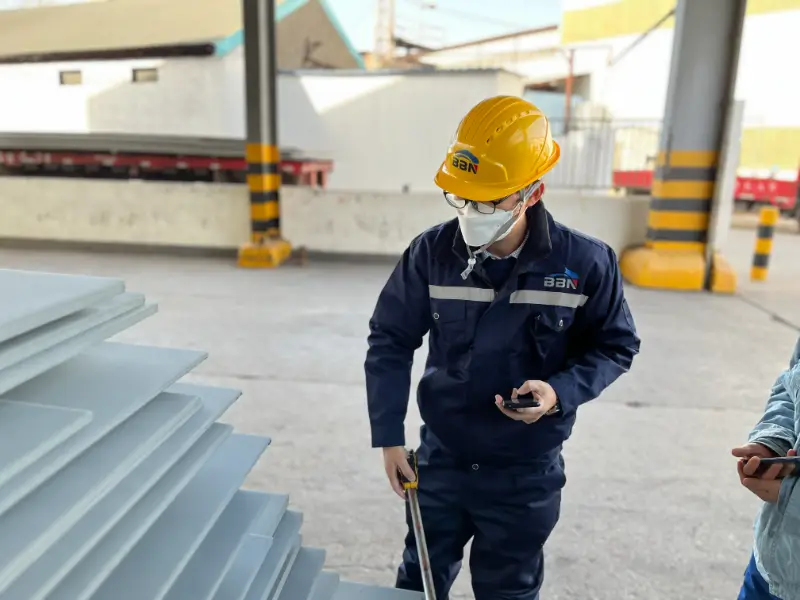
DIN 17102 WStE460 Carbon and Low-alloy High-strength Structural Steel Plate
WStE460 Carbon and Low-alloy High-strength Structural Steel Plate per DIN 17102
Detailed data sheet for WStE460 weldable fine-grain structural steel according to the withdrawn DIN 17102 standard, including chemical composition, mechanical and physical properties, international equivalents, and application guidance.
Thermal cutting, cold forming, welding, machining, hot dip galvanizing, normalizing
- Phone : +8618037372205
- Email : [email protected]
- WhatsApp: Contact via Whtsapp
- WeChat: +8618037372205
DIN 17102 WStE460 Carbon and Low-alloy High-strength Structural Steel Plate Introduction
WStE460 is a weldable fine‑grain structural steel specified in the superseded German standard DIN 17102. The designation indicates: W – weldable, St – structural steel, E – fine‑grain (characterized by a minimum yield strength of 460 MPa for thicknesses ≤ 16 mm).
It is supplied in the normalized (N) or controlled‑rolled (M) condition and offers a well‑balanced combination of high strength, good toughness, and excellent weldability.
Typical applications include heavy welded structures, bridges, cranes, offshore components, and pressure vessels.
The current European equivalent is S460N according to EN 10025‑3.
DIN 17102 WStE460 Carbon and Low-alloy High-strength Structural Steel Plate Chemical Composition
The chemical composition conforms to the limits defined in DIN 17102. The steel is fully killed and fine‑grain treated with a minimum aluminium content or other strong nitride formers. Typical grain‑refining elements are niobium, vanadium, and titanium, which may be added singly or in combination. The sum of Nb+V+Ti shall not exceed 0.22%.
| Element | Standard Value (max unless range given) | Remarks |
|---|---|---|
| Carbon (C) | 0.20 | |
| Silicon (Si) | 0.60 | |
| Manganese (Mn) | 1.00 – 1.70 | |
| Phosphorus (P) | 0.035 | |
| Sulfur (S) | 0.030 | |
| Aluminium (Altotal) | ≥ 0.020 | Minimum required for fine‑grain practice |
| Nitrogen (N) | 0.020 | Applies if no nitride‑forming elements are present |
| Niobium (Nb)* | 0.06 | Single element limit; may be lower according to product thickness |
| Vanadium (V)* | 0.20 | Single element limit |
| Titanium (Ti)* | 0.20 | Single element limit |
| Nb+V+Ti* | ≤ 0.22 | Summation limit for grain refiners; optional |
DIN 17102 WStE460 Carbon and Low-alloy High-strength Structural Steel Plate Physical Properties
The following physical properties are representative for WStE460 (and similar structural steels) at room temperature unless otherwise stated. They are not mandatory requirements of the standard but are commonly used for design and engineering calculations. The values may vary slightly depending on the exact chemical composition and heat treatment condition.
| Property | Typical Reference Value | Unit | Condition / Temperature |
|---|---|---|---|
| Density (ρ) | 7.85 | g/cm³ | 20 °C |
| Modulus of elasticity (E) | 205 – 210 | GPa | 20 °C |
| Shear modulus (G) | ≈ 80 | GPa | 20 °C |
| Poisson's ratio (ν) | 0.3 | – | 20 °C |
| Thermal expansion coefficient (α) | 11.1 | 10⁻⁶/K | 20 – 100 °C |
| Thermal expansion coefficient (α) | 12.5 | 10⁻⁶/K | 20 – 200 °C |
| Thermal expansion coefficient (α) | 13.5 | 10⁻⁶/K | 20 – 400 °C |
| Thermal conductivity (λ) | 50 – 55 | W/(m·K) | 20 °C |
| Specific heat capacity (cp) | 460 – 490 | J/(kg·K) | 20 °C |
| Electrical resistivity (ρe) | 0.20 – 0.25 | μΩ·m | 20 °C |
DIN 17102 WStE460 Carbon and Low-alloy High-strength Structural Steel Plate Mechanical Properties
Minimum mechanical properties as specified in DIN 17102 for normalized (N) or controlled‑rolled (M) condition. The values depend on the product thickness. Impact properties are given for longitudinal Charpy-V specimens; the exact temperature requirement depends on the quality suffix (e.g. WStE460‑2 for 0 °C, WStE460‑3 for –20 °C). The values below represent common technical delivery conditions.
| Property | Standard Requirement Value | Unit | Test Condition / Thickness (mm) |
|---|---|---|---|
| Yield strength (ReH) | ≥ 460 | MPa | t ≤ 16 |
| Yield strength (ReH) | ≥ 440 | MPa | 16 < t ≤ 35 |
| Yield strength (ReH) | ≥ 420 | MPa | 35 < t ≤ 50 |
| Yield strength (ReH) | ≥ 400 | MPa | 50 < t ≤ 70 |
| Yield strength (ReH) | ≥ 380 | MPa | 70 < t ≤ 100 |
| Tensile strength (Rm) | 520 – 680 | MPa | t ≤ 100 |
| Elongation (A, L0=5.65√S0) | ≥ 19 | % | t ≤ 16, longitudinal |
| Elongation (A, L0=5.65√S0) | ≥ 18 | % | 16 < t ≤ 35, longitudinal |
| Elongation (A, L0=5.65√S0) | ≥ 17 | % | 35 < t ≤ 50, longitudinal |
| Elongation (A, L0=5.65√S0) | ≥ 17 | % | 50 < t ≤ 70, longitudinal |
| Bend test (bend radius) | 3t (no cracks) | – | 180° bend, t = specimen thickness |
| Impact energy (KV, longitudinal) | ≥ 27 (typically 40) | J | 0 °C (for WStE460‑2/J0 grade) |
| Impact energy (KV, longitudinal) | ≥ 27 (typically 40) | J | –20 °C (for WStE460‑3/J2 grade) |
DIN 17102 WStE460 Carbon and Low-alloy High-strength Structural Steel Plate Identical/Equivalent Material Standards and Replaceable Grades
| Country/Region | Standard | Grade | Remarks |
|---|---|---|---|
| Europe | EN 10025‑3:2019 | S460N | Normalized fine‑grain structural steel, directly replaces WStE460 (N) |
| Europe | EN 10025‑3:2004 | S460NL | Low‑temperature version (–50 °C), similar to WStE460‑3 |
| International | ISO 4951‑1:2001 | E460DD | Thermomechanically rolled, comparable strength and weldability |
| United Kingdom (obsolete) | BS 4360:1990 | 50E | Weldable structural steel with min. 450 MPa yield; close predecessor |
| China | GB/T 1591‑2018 | Q460N (Q460NC/ND/NE) | Similar for normalized delivery, check impact requirements |
| Japan | JIS G 3106 | SM570 | High‑strength welded structural steel, s=520 MPa tensile class |
DIN 17102 WStE460 Carbon and Low-alloy High-strength Structural Steel Plate Application Introduction
WStE460 is designed for welded steel structures where weight reduction and high strength are critical. Its fine‑grain microstructure provides excellent toughness at low temperature and good resistance to brittle fracture. The steel is easily weldable using common arc welding processes (SMAW, SAW, GMAW) with low‑hydrogen consumables and typical preheat requirement only when thickness exceeds about 30–40 mm. Cold bending up to a radius of 3t is normally possible without cracking.
Product Applications: Welded I‑girders and box girders for bridges, Flange plates and web plates in plate‑welded sections, Circular and rectangular hollow sections for offshore jackets, Rolled and welded beams with high strength‑to‑weight ratio, Structural nodes and cast‑in‑steel connections, Pressure vessel shells and heads (when toughness requirements are met)
Processed into products: Bridge main girders, diaphragms, and stiffeners, Offshore platform tubular joints and transition cones, Crane pedestals and slew rings, Wind turbine tower cans and door frames, Excavator boom and stick plates, Mill housing frames and press columns, Pressure vessel reinforcing pads and lifting lugs, Railcar trailer frames and bolsters, Shipbuilding hatch coamings and deck machinery foundations
Application industries: Bridge and civil engineering (road and railway bridges, viaducts, pedestrian overpasses), Offshore and marine engineering (jack‑up rig legs, heavy‑lift vessel components, deck structures), Wind energy (towers, transition pieces, foundation plates), Pressure vessel and storage tank fabrication (LPG bullets, water reservoirs, chemical tanks where strength governs), Heavy machinery and earthmoving equipment (crane booms, excavator arms, dump truck bodies), Mining and mineral processing (chutes, hoppers, conveyor gantries), Building construction (high‑rise columns, long‑span trusses, stadium structures)
DIN 17102 WStE460 Carbon and Low-alloy High-strength Structural Steel Plate Similar/Close Substitute Materials – Performance Near WStE460
| Country/Region | Standard | Grade | Remarks / Analysis |
|---|---|---|---|
| USA | ASTM A572/A572M | Grade 65 (Type 3 or with added microalloying) | Minimum yield 450 MPa, tensile 550 MPa. May require supplementary microalloying to match the fine‑grain property. Typically as‑rolled or normalized. Good weldability but impact values are individually agreed. |
| USA | ASTM A633/A633M | Grade E | Normalized high‑strength low‑alloy structural steel with min. yield 380–415 MPa (depending on thickness, maximum 415 MPa for t>65mm). Provides excellent notch toughness at low temperature, slightly lower strength than WStE460. |
| China | GB/T 1591‑2018 | Q460D | High‑strength structural steel with min. yield 460 MPa (thickness ≤ 16 mm), delivered in TMCP or normalized condition, with –20 °C impact guarantee. Good match for WStE460‑3 applications. |
| Japan | JIS G 3106 | SM570TMC | Thermo‑mechanical controlled process steel with tensile strength 570–720 MPa, yield ≥ 460 MPa (t≤16mm). Toughness guaranteed at 0 °C or –5 °C; similar weldability requirements. |
| Europe | EN 10025‑6 | S500QL/S500QL1 | Quenched and tempered structural steel, min. yield 500 MPa. Higher strength, but different delivery condition; may be used when higher wear resistance is needed but formability differs. |
Notes:
- Weldability: WStE460 has a carbon equivalent (CEV) typically below 0.45%, ensuring good weldability. Preheating and interpass temperature control are recommended for thicker sections to avoid hydrogen cracking.
- Post‑weld heat treatment (PWHT): If stress relieving is required, the temperature should be kept below the subcritical annealing range (typically 550–580 °C) to maintain the fine grain structure. Extended holding may reduce strength slightly.
- Corrosion protection: The steel accepts all common coating systems (painting, metallizing, hot‑dip galvanizing). For galvanizing, the silicon content should be controlled (Si ≤ 0.04% or 0.15–0.25%) to avoid excessive coating growth.
- Delivery documentation: Based on DIN 17102, material can be supplied with inspection certificate according to DIN 50049 (now EN 10204) type 3.1 or 3.2.
- Standard obsolescence: DIN 17102 has been withdrawn and replaced by EN 10025‑3. When ordering to EN 10025‑3 S460N, the same technical performance is obtained.
- Tolerance requirements: Dimensional and shape tolerances follow EN 10029 (for plates) or EN 10034 (for sections) unless agreed otherwise.
- Share



