
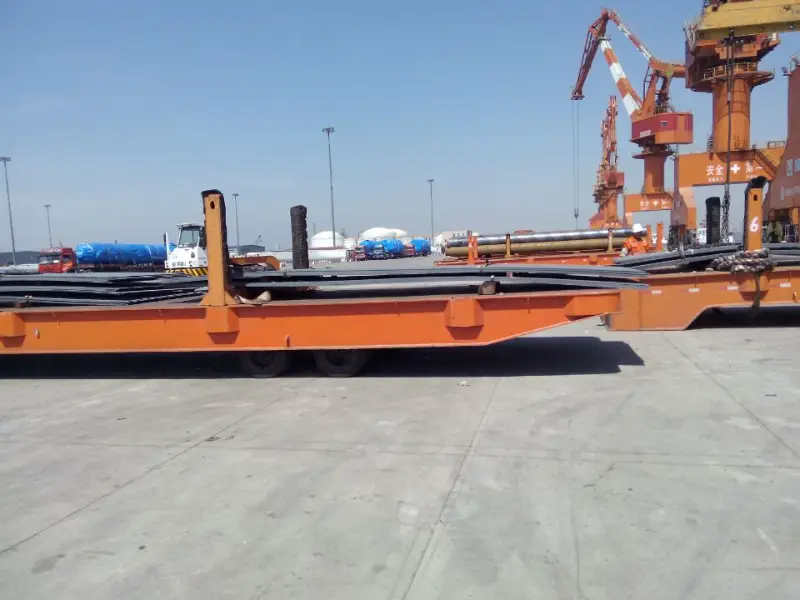
EStE355 Steel Plate (DIN 17102) High-Strength Fine Grain Structural Steel
DIN 17102 EStE355 Carbon Low-Alloy High-Strength Steel Plate | Fine-Grain Weldable Structural Steel
Comprehensive material data for EStE355 steel according to DIN 17102, including chemical composition, mechanical and physical properties, international equivalents, and application guidance for welding and structural engineering.
Welding, cutting, cold forming, machining, hot-dip galvanizing, stress-relief annealing
- Phone : +8618037372205
- Email : [email protected]
- WhatsApp: Contact via Whtsapp
- WeChat: +8618037372205
EStE355 Steel Plate High-Strength Fine Grain Structural Steel Introduction
DIN 17102 EStE355 is a normalized, fine-grain, low-alloy high-strength structural steel plate with a specified minimum yield strength of 355 MPa for thicknesses up to 50 mm. It combines high strength with excellent weldability and good notch toughness at low temperatures. The steel is produced via a fully killed and fine-grain practice, resulting in a homogeneous microstructure that meets the requirements of stress-relieved welded structures. Key features:
- Yield strength ≥ 355 MPa
- Excellent weldability due to low carbon equivalent
- Guaranteed impact energy at -20°C (longitudinal)
- Normalized delivery condition
- Suitable for cold forming and hot-dip galvanizing
EStE355 Steel Plate High-Strength Fine Grain Structural Steel Chemical Composition
Chemical requirements according to DIN 17102 for EStE355. Values are maximum unless a range is given. The steel is fully killed and fine-grain treated. Key control elements:
- Low carbon (≤0.20%) for good weldability
- Niobium, vanadium, and/or titanium for grain refinement and precipitation strengthening
- Phosphorus and sulfur are strictly limited to ensure ductility and toughness
| Element | Value (%) | Remarks |
|---|---|---|
| Carbon (C) | ≤ 0.20 | For thickness ≤ 50 mm; for >50–100 mm max 0.22 permissible |
| Silicon (Si) | ≤ 0.60 | Killed steel; may be reduced by agreement for hot-dip galvanizing |
| Manganese (Mn) | 0.90 – 1.65 | Range depending on thickness |
| Phosphorus (P) | ≤ 0.035 | Low P for toughness |
| Sulfur (S) | ≤ 0.030 | Low S for cleanliness |
| Aluminium (Al) | ≥ 0.020 (total) or ≤ 0.015 (acid-soluble) | Fine-grain requirement met by Al, Nb, V, or Ti |
| Niobium (Nb) | ≤ 0.05 | Optional grain refiner, sum Nb+V+Ti ≤ 0.12 |
| Vanadium (V) | ≤ 0.10 | Optional, sum as above |
| Titanium (Ti) | ≤ 0.05 | Optional, sum as above |
| Nitrogen (N) | ≤ 0.020 | Unless sufficient amount of N-binding elements present |
| Copper (Cu) | ≤ 0.45 | If Cu > 0.25% may affect hot shortness; can be used for weather resistance |
| Nickel (Ni) | ≤ 0.85 | Permitted, not required |
| Chromium (Cr) | ≤ 0.35 | Permitted, not required |
| Molybdenum (Mo) | ≤ 0.10 | Residual level |
| Carbon Equivalent (CEV) | ≤ 0.39 | Typical for thickness ≤ 50 mm; formula: C+Mn/6+(Cr+Mo+V)/5+(Ni+Cu)/15 |
EStE355 Steel Plate High-Strength Fine Grain Structural Steel Physical Properties
Physical properties are typical for low-alloy structural steels and are not subject to standard requirements. Values are provided for engineering calculations. Note:
- Density is approximately 7850 kg/m³.
- Thermal expansion, conductivity, and electrical resistivity vary with temperature; values at 100°C and 200°C are also given.
- Modulus of elasticity E = 210 GPa, valid up to approx. 300°C.
| Property | Typical Value | Unit | Test Condition / Remarks |
|---|---|---|---|
| Density (ρ) | 7850 | kg/m³ | At 20°C |
| Modulus of Elasticity (E) | 210 | GPa | At 20°C |
| Shear Modulus (G) | 81 | GPa | Calculated from E and ν |
| Poisson's Ratio (ν) | 0.3 | - | Elastic range |
| Thermal Expansion Coefficient (α) | 11.5 × 10⁻⁶ | K⁻¹ | Between 20°C and 100°C |
| Thermal Expansion Coefficient (α) | 12.0 × 10⁻⁶ | K⁻¹ | Between 20°C and 200°C |
| Thermal Expansion Coefficient (α) | 12.5 × 10⁻⁶ | K⁻¹ | Between 20°C and 300°C |
| Thermal Conductivity (λ) | 50 | W/(m·K) | At 20°C |
| Thermal Conductivity (λ) | 47 | W/(m·K) | At 100°C |
| Thermal Conductivity (λ) | 44 | W/(m·K) | At 200°C |
| Specific Heat Capacity (cp) | 460 | J/(kg·K) | At 20°C (approx.) |
| Electrical Resistivity (ρe) | 0.23 × 10⁻⁶ | Ω·m | At 20°C, for calculation purposes |
EStE355 Steel Plate High-Strength Fine Grain Structural Steel Mechanical Properties
Mechanical properties are tested according to DIN EN 10002-1 (tensile) and DIN EN 10045-1 (impact). Values apply to plates in normalized delivery condition. Important:
- Yield strength and tensile strength depend on product thickness.
- Impact energy is guaranteed at -20°C for longitudinal direction; transverse values to be agreed.
- Bend test requirement: mandrel diameter = 3×thickness (t) for t ≤ 16 mm; for thicker plates mandrel diameter increases.
| Property | Standard Requirement | Unit | Test Condition / Remarks |
|---|---|---|---|
| Yield Strength (ReH) min. | 355 | MPa | Thickness ≤ 16 mm |
| Yield Strength (ReH) min. | 345 | MPa | Thickness >16 ≤ 40 mm |
| Yield Strength (ReH) min. | 335 | MPa | Thickness >40 ≤ 63 mm |
| Yield Strength (ReH) min. | 325 | MPa | Thickness >63 ≤ 80 mm |
| Yield Strength (ReH) min. | 315 | MPa | Thickness >80 ≤ 100 mm |
| Tensile Strength (Rm) | 490 – 630 | MPa | Thickness ≤ 63 mm |
| Tensile Strength (Rm) | 470 – 610 | MPa | Thickness >63 ≤ 100 mm |
| Elongation (A) min. | 22 | % | Gauge length Lo=5.65√So; thickness ≤ 63 mm, longitudinal |
| Elongation (A) min. | 21 | % | Thickness >63 ≤ 100 mm |
| Elongation (A) min. | 20 | % | Transverse, all thicknesses (reference value) |
| Impact Energy (KV) min. | 40 | J | Longitudinal, at -20°C, average of 3 specimens; single min 36 J |
| Impact Energy (KV) min. | 27 | J | Transverse, at -20°C (by agreement) |
| Bend Test | No cracks | - | Mandrel diameter: 3×t (t ≤ 16 mm); 4×t (16 |
EStE355 Steel Plate High-Strength Fine Grain Structural Steel Fully Equivalent Material Standards and Replaceable Grades
| Country/Region | Standard | Grade | Remarks |
|---|---|---|---|
| Europe | EN 10025-3:2019 | S355N | Normalized fine-grain steel; 355 MPa yield, impact at -20°C optional. Identical coverage. |
| Europe | EN 10025-3:2019 | S355NL | As S355N but with guaranteed impact at -50°C; for lower temperature requirements. |
| Germany | DIN 17102:1983 (withdrawn) | EStE355 | Original source; replaced by EN 10025-3. |
| International | ISO 630-3:2021 | S355N | Equivalent to EN 10025-3 S355N. |
| China | GB/T 1591-2018 | Q355NE | Normalized, fine-grain; impact at -40°C; minor differences in CEV limits. |
EStE355 Steel Plate High-Strength Fine Grain Structural Steel Application Introduction
EStE355 is widely employed in welded load-bearing structures where high strength, good weldability, and low-temperature toughness are required. Its fine-grain structure prevents brittle fracture and allows safe use in dynamic loading conditions. This steel is particularly suitable for structural components that must withstand high stress and harsh environments, such as bridges, offshore platforms, and heavy machinery.
Typical applications include:
Product Applications: Welded bridge girders and box sections, Offshore platform decks and modules, Crane booms, jibs, and chassis, Heavy-duty vehicle frames and dump bodies, Penstocks and hydraulic steel structures, Storage tanks and silos, Structural frames for high-rise buildings
Processed into products: Main beams and cross girders, Splice plates and gusset plates, Welded I-beams and built-up columns, Cylindrical shells for pressure vessels, Flange and web plates for crane girders, Reinforcement ribs and stiffeners, Brackets and support frames
Application industries: Bridge and highway construction, Offshore and marine engineering, Crane and lifting equipment, Pressure vessel and boiler manufacturing (within code limits), Mining and earth-moving machinery, Wind energy towers and foundations, General heavy steel fabrication
EStE355 Steel Plate High-Strength Fine Grain Structural Steel Similar or Near-Equivalent Material Recommendations
| Country/Region | Standard | Grade | Remarks |
|---|---|---|---|
| USA | ASTM A572/A572M | Grade 50 (Type 1) | 345 MPa yield; not fully killed/fine-grain guaranteed; impact test not inherent; may require supplementary requirements. |
| USA | ASTM A588/A588M | Grade A/B | Weathering steel with similar strength; higher Cu/Cr/Ni; impact properties not standardized. |
| Japan | JIS G 3106 | SM490A/B/C | Yield 325–365 MPa depending on thickness; impact test option for grade C; slightly different chemistry. |
| Japan | JIS G 3136 | SN490B/C | For building structures; similar strength; fine-grain guaranteed; impact test options. |
| China | GB/T 1591-2018 | Q355D | 355 MPa yield; impact at -20°C; not always normalized, may be TMCP; chemistry slightly broader. |
| India | IS 2062:2011 | E350BR/E350C | 355 MPa normalized; impact test options; close match when impact requirements are met. |
Notes:
Welding: Preheating is generally not required for plates up to 30 mm thickness at ambient temperature >5°C. For thicker sections or low temperatures, preheat to 75–125°C may be recommended. The steel is compatible with all conventional arc welding processes (SMAW, GMAW, SAW, FCAW). Heat treatment: Stress relieving at 530–580°C may be performed if required by fabrication code, with no deterioration of mechanical properties. Cold forming: The steel can be cold bent to a radius of 2×t (t = plate thickness) for t ≤ 16 mm without cracking; increase radius for thicker plates. Ordering: Specify standard, grade, thickness, and additional requirements like impact testing direction, ultrasonic testing, or restricted chemistry for galvanizing.
- Share



