
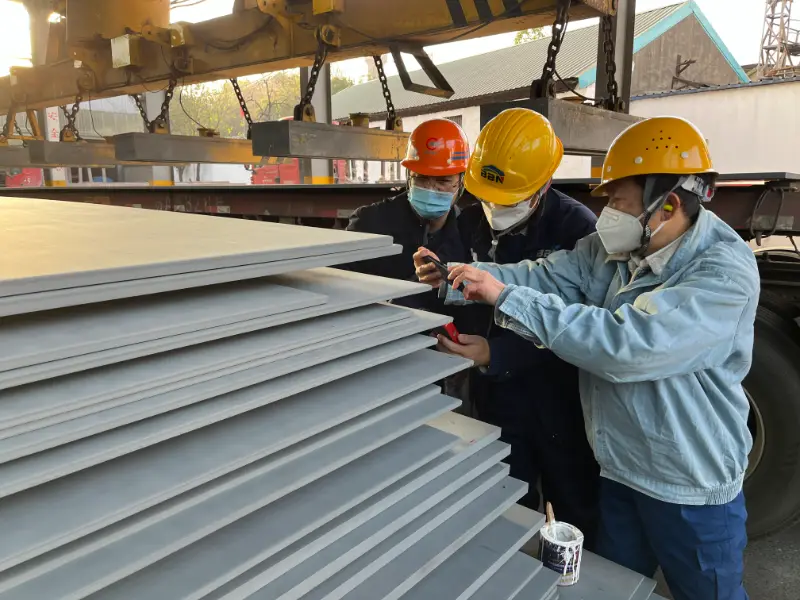
DIN 17102 TStE355 Carbon & Low-Alloy High-Strength Structural Steel Plate
DIN 17102 TStE355 Carbon & Low-Alloy High-Strength Structural Steel Plate - Comprehensive Data
Explore the complete technical profile of TStE355 steel under DIN 17102, including chemical composition, mechanical and physical properties, international equivalents, and application guidance.
Normalizing, controlled rolling, welding, cutting, cold forming, bending, machining
- Phone : +8618037372205
- Email : [email protected]
- WhatsApp: Contact via Whtsapp
- WeChat: +8618037372205
DIN 17102 TStE355 Carbon & Low-Alloy High-Strength Structural Steel Plate Introduction
TStE355 is a German standard weldable fine-grain structural steel specified in DIN 17102, supplied in the normalized condition. It is characterized by a minimum yield strength of 355 MPa for thicknesses up to 16 mm and excellent notch toughness down to -20°C. The steel is microalloyed to achieve fine grain size, ensuring a good combination of high strength, superior weldability, and good cold formability. Typical applications include heavy-duty welded structures in bridge building, civil engineering, offshore structures, and pressure vessels where both high load-bearing capacity and reliable low-temperature performance are required.
DIN 17102 TStE355 Carbon & Low-Alloy High-Strength Structural Steel Plate Chemical Composition
The ladle analysis requirements for TStE355 according to DIN 17102. The steel contains microalloying elements for grain refinement and precipitation strengthening. Grain-refining elements (Nb, V, Ti) may be added singly or in combination up to the specified limits. The maximum carbon equivalent (CEV) is typically controlled to ensure good weldability (CEV ~0.40–0.45 depending on thickness).
| Element | Standard Value (max, unless range) | Remarks |
|---|---|---|
| C | ≤ 0.20 | |
| Si | ≤ 0.50 | |
| Mn | 0.90 – 1.65 | |
| P | ≤ 0.035 | |
| S | ≤ 0.030 | |
| N | ≤ 0.020 | |
| Al (total) | ≥ 0.02 | Grain-refining element |
| Nb | ≤ 0.05 | Optional grain refiner, singly or combined |
| V | ≤ 0.10 | Optional grain refiner, singly or combined |
| Ti | ≤ 0.05 | Optional grain refiner, singly or combined |
| Cr+Cu+Mo | ≤ 0.75 (optional) | Combined residual elements, if applicable |
DIN 17102 TStE355 Carbon & Low-Alloy High-Strength Structural Steel Plate Thermal and Electrical Physical Properties
Typical room-temperature physical properties for normalized low-alloy structural steel of similar composition to TStE355. Actual values may vary slightly with exact composition and heat treatment. These values are suitable for engineering calculations.
| Property | Typical Value | Unit | Test Condition |
|---|---|---|---|
| Density (ρ) | 7.85 | g/cm³ | At 20°C |
| Elastic modulus (E) | 210 | GPa | At room temperature |
| Shear modulus (G) | 81 | GPa | Approximate |
| Poisson's ratio (ν) | 0.30 | – | Within elastic range |
| Thermal expansion coefficient (α) | 12.0 | 10⁻⁶/K | Between 20°C and 100°C |
| Thermal conductivity (λ) | 50 | W/(m·K) | At 20°C |
| Specific heat capacity | 460 | J/(kg·K) | At 20°C |
| Electrical resistivity (ρ_e) | 0.23 | µΩ·m | At 20°C |
DIN 17102 TStE355 Carbon & Low-Alloy High-Strength Structural Steel Plate Mechanical Properties
Mechanical properties according to DIN 17102 for normalized TStE355. The test pieces are taken in the transverse direction unless otherwise specified. Impact tests are performed on Charpy-V-notch longitudinal specimens at -20°C. Bend test requirements apply to the delivery condition. Values for thicker plates may be agreed upon at the time of ordering.
| Property | Required Value | Unit | Test Condition |
|---|---|---|---|
| Yield strength (ReH) | ≥ 355 | MPa | Thickness ≤ 16 mm |
| Yield strength (ReH) | ≥ 345 | MPa | 16 mm < thickness ≤ 40 mm |
| Yield strength (ReH) | ≥ 335 | MPa | 40 mm < thickness ≤ 63 mm |
| Yield strength (ReH) | ≥ 325 | MPa | 63 mm < thickness ≤ 80 mm |
| Yield strength (ReH) | ≥ 315 | MPa | 80 mm < thickness ≤ 100 mm |
| Tensile strength (Rm) | 470 – 630 | MPa | All thicknesses |
| Elongation after fracture (A) | ≥ 22 | % | Thickness ≤ 40 mm, gauge length Lo=5.65√So |
| Elongation after fracture (A) | ≥ 21 | % | 40 mm < thickness ≤ 63 mm |
| Elongation after fracture (A) | ≥ 20 | % | 63 mm < thickness ≤ 100 mm |
| Impact energy (KV, longitudinal) | ≥ 27 | J | At -20°C, Charpy-V specimen |
| Bend test (bending angle 180°) | d = 2a | – | Thickness ≤ 16 mm, a = specimen thickness |
| Bend test (bending angle 180°) | d = 3a | – | 16 mm < thickness ≤ 100 mm |
DIN 17102 TStE355 Carbon & Low-Alloy High-Strength Structural Steel Plate Internationally Equivalent Standards and Replaceable Grades
| Country/Region | Standard | Grade | Remarks |
|---|---|---|---|
| Europe | EN 10025-3 | S355N | Normalized fine-grain steel; identical minimum yield and -20°C impact 27J |
| International | ISO 4950-2 | E355 DD (or E355 C) | Similar chemistry and mechanical requirements |
| United Kingdom (historic) | BS 4360 | 50D | Superseded by EN standards, comparable properties |
| Japan (comparable) | JIS G 3106 | SM490B | Yield ~355 MPa, but 0°C impact energy; need to specify low-temp options |
| China (comparable) | GB/T 1591 | Q355D | Yield 355 MPa, -20°C impact; close substitute |
DIN 17102 TStE355 Carbon & Low-Alloy High-Strength Structural Steel Plate Application Introduction
TStE355 is widely used in heavy welded structures that require high strength and assured notch toughness at low ambient temperatures. It is suitable for both static and dynamic loading conditions. The normalized microstructure ensures consistent mechanical properties across thickness and excellent weldability without preheating for moderate plate thicknesses. It can be formed, machined, and welded using conventional fabrication methods.
Product Applications: Hot-rolled heavy plates for welded girders and built-up sections, Wide flats for stiffener fabrication, Normalized and stress-relieved structural assemblies, Welded tubular structures (circular and rectangular hollow sections produced from plate), Flame-cut parts for shipbuilding and offshore platforms, Formed and cold-bent profiles for architectural applications
Processed into products: Bridge bearing stiffeners and diaphragms, Crane runway beams and end carriages, Wind turbine tower base sections and flanges, Excavator booms and dipper arms, Oil platform module support beams, Heavy machinery frames and press tables, Lorry chassis longitudinal members and cross-members, Pressure vessel dished heads and shell plates
Application industries: Bridge construction (box girders, orthotropic decks, bracing), Civil engineering and building (columns, beams, heavy trusses), Offshore and marine structures (deck plates, stiffeners, jacket legs), Pressure vessels and storage tanks (shell courses, heads), Mobile cranes and heavy-lift equipment (booms, chassis), Mining and earthmoving machinery (frames, booms), Railway rolling stock (underframes, structural components)
DIN 17102 TStE355 Carbon & Low-Alloy High-Strength Structural Steel Plate Similar Materials with Close Chemical and Mechanical Characteristics
| Country/Region | Standard | Grade | Remarks |
|---|---|---|---|
| Europe | EN 10025-2 | S355J2 (+N) | Non-alloy structural steel; normalized, -20°C impact, yield 355 MPa, but lower toughness guarantee than fine-grain TStE355 |
| USA | ASTM A572 / A709 | Grade 50 | High-strength low-alloy Nb-V, yield 345 MPa (50 ksi), suitable for structural applications, often used as alternative |
| USA | ASTM A633 | Grade E | Normalized HSLA steel, yield ~380 MPa, good low-temperature toughness; slightly higher strength |
| Russia | GOST 19281 | 09G2S (09Г2С) | Low-alloy structural steel with yield ~345 MPa, widely used in Russia for welded structures; careful comparison required |
| India | IS 2062 | E350 BR / E350 C | High-strength structural steel with yield 350 MPa; can replace in many general structural applications |
Notes:
- Welding: TStE355 has good weldability; preheating may be required for thick sections (>50 mm) or low hydrogen environments. Suitable welding consumables should match the minimum yield strength and low-temperature toughness requirements.
- Forming: Can be cold formed with a minimum bending radius of 2t to 3t depending on thickness and orientation. Hot forming should be followed by normalizing if specified properties are to be retained.
- Surface protection: Standard painting and corrosion protection systems apply. In marine environments, use appropriate coating systems.
- Certification: According to DIN 17102, inspection documents of type 3.1 (formerly Abnahmeprüfzeugnis A) are typically issued.
- Note on replaced standards: DIN 17102 has been replaced by EN 10025-3; the grade S355N is the direct replacement and should be specified for new projects.
- Share



