
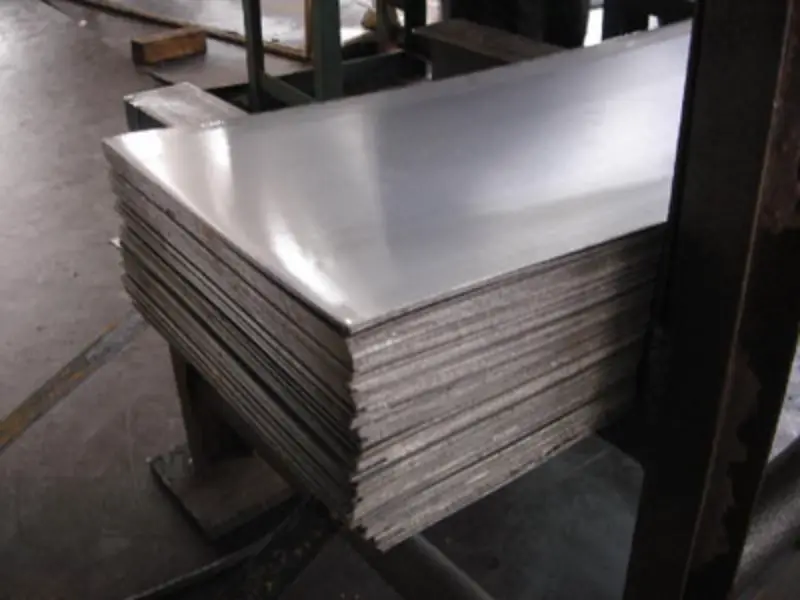
DIN 17102 EStE315
DIN 17102 EStE315: High-Strength Weldable Fine-Grain Structural Steel for Heavy Engineering
Detailed material properties and specifications of DIN 17102 EStE315 carbon and low-alloy high-strength steel plate. Includes chemical composition, mechanical and thermal properties, equivalent grades, and application guidance.
Hot rolling, normalizing, thermomechanical rolling, welding, bending, cutting, forming
- Phone : +8618037372205
- Email : [email protected]
- WhatsApp: Contact via Whtsapp
- WeChat: +8618037372205
DIN 17102 EStE315 Introduction
DIN 17102 EStE315 is a normalized or thermomechanically rolled weldable fine-grain structural steel with a minimum yield strength of 315 MPa (for thickness ≤ 16 mm). It belongs to the family of carbon and low-alloy high-strength steels designed for demanding structural applications where weight savings and high load-bearing capacity are required. The fine-grain structure, achieved through controlled microalloying with elements such as niobium, vanadium, titanium, and aluminium, ensures excellent notch toughness at low temperatures and good weldability. Typical delivery condition is normalized (N) or as agreed thermomechanically rolled (M), offering a balanced combination of strength and ductility. Its technical characteristics make it suitable for bridges, buildings, cranes, offshore platforms, and heavy machinery components.
DIN 17102 EStE315 Chemical Composition
Ladle analysis according to DIN 17102 for EStE315. Fine-grain practice is ensured by the addition of grain-refining elements such as aluminium, niobium, vanadium, or titanium. The steel is fully killed and contains sufficient acid-soluble aluminium for grain refinement.
| Chemical Element | Nominal Value (wt.%) | Remarks |
|---|---|---|
| C | ≤ 0.20 | |
| Si | ≤ 0.55 | |
| Mn | 0.90 – 1.60 | |
| P | ≤ 0.035 | |
| S | ≤ 0.035 | |
| Al (total) | ≥ 0.02 | Minimum for fine-grain practice |
| Nb | ≤ 0.05 | Microalloying element |
| V | ≤ 0.12 | Microalloying element |
| Ti | ≤ 0.03 | Microalloying element |
| N | ≤ 0.020 | |
| Ni | ≤ 0.70 (residual) | May be present as residual element |
DIN 17102 EStE315 Thermal & Electrical Physical Properties
The following physical properties are typical for carbon-manganese structural steels at room temperature unless otherwise stated. These values are not part of the DIN 17102 delivery conditions but are widely accepted for engineering calculations.
| Property | Typical Value | Unit | Condition |
|---|---|---|---|
| Density (ρ) | 7.85 | g/cm³ | At 20°C |
| Modulus of Elasticity (E) | 210 | GPa | At 20°C |
| Shear Modulus (G) | 81 | GPa | At 20°C |
| Poisson's Ratio (ν) | 0.3 | – | At 20°C |
| Thermal Expansion Coefficient (α) | 11.1 | 10⁻⁶/K | 20 – 100°C |
| Thermal Expansion Coefficient (α) | 12.1 | 10⁻⁶/K | 20 – 200°C |
| Thermal Expansion Coefficient (α) | 12.9 | 10⁻⁶/K | 20 – 300°C |
| Thermal Expansion Coefficient (α) | 13.5 | 10⁻⁶/K | 20 – 400°C |
| Thermal Conductivity (λ) | 51 | W/(m·K) | At 20°C |
| Thermal Conductivity (λ) | 50 | W/(m·K) | At 100°C |
| Thermal Conductivity (λ) | 48 | W/(m·K) | At 200°C |
| Thermal Conductivity (λ) | 46 | W/(m·K) | At 300°C |
| Specific Heat Capacity (cp) | 460 | J/(kg·K) | At 20°C |
| Electrical Resistivity (ρₑ) | 0.17 | 10⁻⁶ Ω·m | At 20°C |
DIN 17102 EStE315 Mechanical Properties
Tensile and impact properties as required by DIN 17102 for EStE315 in normalized or thermomechanically rolled condition. The values apply to transverse test specimens for tensile tests and both longitudinal and transverse for impact tests, depending on specification.
| Property | Specified Value | Unit | Test Condition |
|---|---|---|---|
| Yield Strength (ReH), min. | ≥ 315 | MPa | Transverse, t ≤ 16 mm |
| Yield Strength (ReH), min. | ≥ 305 | MPa | Transverse, 16 < t ≤ 40 mm |
| Yield Strength (ReH), min. | ≥ 295 | MPa | Transverse, 40 < t ≤ 63 mm |
| Yield Strength (ReH), min. | ≥ 285 | MPa | Transverse, 63 < t ≤ 80 mm |
| Yield Strength (ReH), min. | ≥ 275 | MPa | Transverse, 80 < t ≤ 100 mm |
| Yield Strength (ReH), min. | ≥ 265 | MPa | Transverse, 100 < t ≤ 150 mm |
| Tensile Strength (Rm) | 440 – 560 | MPa | Transverse, t ≤ 16 mm |
| Tensile Strength (Rm) | 420 – 540 | MPa | Transverse, 16 < t ≤ 40 mm |
| Tensile Strength (Rm) | 410 – 530 | MPa | Transverse, 40 < t ≤ 63 mm |
| Tensile Strength (Rm) | 400 – 520 | MPa | Transverse, 63 < t ≤ 80 mm |
| Tensile Strength (Rm) | 390 – 510 | MPa | Transverse, 80 < t ≤ 100 mm |
| Tensile Strength (Rm) | 380 – 500 | MPa | Transverse, 100 < t ≤ 150 mm |
| Elongation (A), min. | ≥ 22 | % | Longitudinal, L0=5.65√S0, t ≤ 40 mm |
| Elongation (A), min. | ≥ 22 | % | Longitudinal, L0=5.65√S0, 40 < t ≤ 63 mm |
| Elongation (A), min. | ≥ 21 | % | Longitudinal, L0=5.65√S0, 63 < t ≤ 80 mm |
| Elongation (A), min. | ≥ 20 | % | Longitudinal, L0=5.65√S0, 80 < t ≤ 100 mm |
| Elongation (A), min. | ≥ 20 | % | Longitudinal, L0=5.65√S0, 100 < t ≤ 150 mm |
| Impact Energy (KV), min. | ≥ 40 (longitudinal) / ≥ 27 (transverse) | J | -20°C, 10×10 mm specimen |
| Bend Test (Bend Angle 180°) | D = 3a | – | t ≤ 16 mm |
| Bend Test (Bend Angle 180°) | D = 4a | – | 16 < t ≤ 35 mm |
| Bend Test (Bend Angle 180°) | D = 5a | – | 35 < t ≤ 50 mm |
| Bend Test (Bend Angle 180°) | D = 6a | – | 50 < t ≤ 80 mm |
| Bend Test (Bend Angle 180°) | D = 7a | – | 80 < t ≤ 100 mm |
| Bend Test (Bend Angle 180°) | D = 8a | – | 100 < t ≤ 150 mm |
DIN 17102 EStE315 Completely Equivalent Material Standards & Substitutable Grades
| Country/Region | Standard | Grade | Remarks |
|---|---|---|---|
| Europe | EN 10025-3 | S315N (1.0246) | Identical to EStE315; replaces DIN 17102 |
| International | ISO 630-3 | S315N | Direct equivalent |
| Germany | DIN EN 10025-3 | S315N | Current national standard, supersedes DIN 17102 |
DIN 17102 EStE315 Application Introduction
DIN 17102 EStE315 is specifically designed for welded structures that require high strength and good toughness. Its fine-grain structure ensures reliability in demanding conditions, making it a preferred material in heavy engineering sectors. Typical applications include:
Product Applications: Welded bridge girders and box sections, High-rise building columns and beams, Offshore platform legs and modules, Mobile crane booms and chassis, Excavator arms and mining equipment frames, Wind turbine towers and support structures
Processed into products: Main load-bearing beams and girders, Welded joints and node plates, Flanges and web plates, Crane lattice members, Boom segments, Heavy-duty welded brackets and supports
Application industries: Bridge construction, Building and civil engineering, Offshore and marine structures, Crane and heavy machinery manufacturing, Pressure vessel and storage tank fabrication, Transportation and railway vehicles
DIN 17102 EStE315 Similar/Comparable Alternative Material Recommendations
| Country/Region | Standard | Grade | Remarks |
|---|---|---|---|
| USA | ASTM A572/A572M | Grade 50 [345 MPa] | Higher yield strength, similar weldable low-alloy steel; not a direct match |
| Japan | JIS G3106 | SM490A | Comparable tensile strength and toughness; normalized condition available |
| China | GB/T 1591 | Q345D | Minimum yield 345 MPa; low-temperature impact properties comparable with some thickness adaptation |
| Europe | EN 10025-3 | S355N | Higher strength level but similar chemical concept; fine-grain normalized steel |
| Russia | GOST 19281 | 10G2BD | Low-alloy structural steel with similar yield and impact requirements |
Notes:
Welding: EStE315 has good weldability with conventional arc welding processes (SMAW, MAG, SAW). Preheating may be necessary for thicker sections according to EN 1011-2.
Forming: Suitable for cold and hot forming; minimum bend radii should respect the bend test requirements.
Corrosion Resistance: As a carbon-manganese steel, it requires protective coatings (painting, galvanizing) in corrosive environments.
Inspection Documents: Usually supplied with inspection certificate 3.1 according to EN 10204.
- Share



