
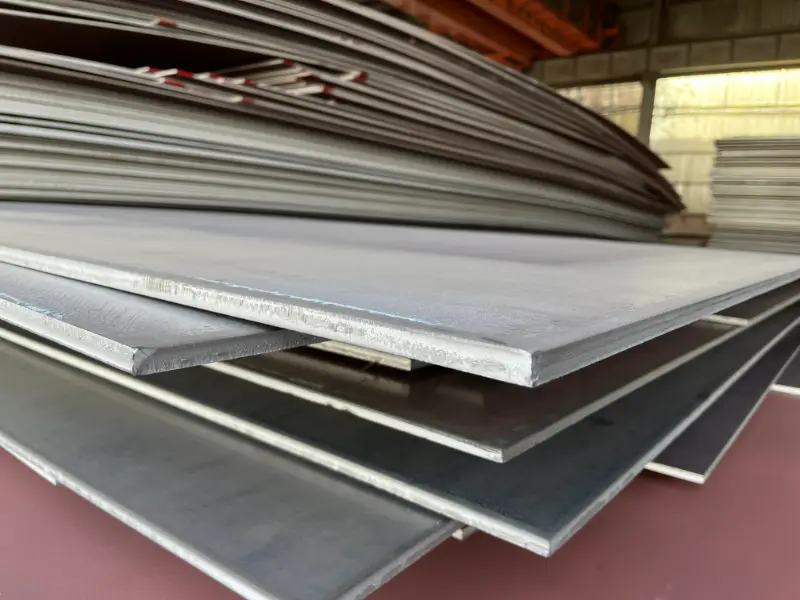
DIN 17102 StE355 Fine-Grain Structural Steel
DIN 17102 StE355 Fine-Grain Structural Steel - Composition, Properties & Global Equivalents
Complete material data for StE355 steel per DIN 17102: chemical composition, mechanical and physical properties, international equivalents like S355N, and application guidelines for welded structures.
Hot rolling, normalizing, cold forming, welding, thermal cutting, machining
- Phone : +8618037372205
- Email : [email protected]
- WhatsApp: Contact via Whtsapp
- WeChat: +8618037372205
DIN 17102 StE355 Fine-Grain Structural Steel Introduction
StE355 is a carbon and low-alloy high-strength fine-grain structural steel defined in the withdrawn German standard DIN 17102, now superseded by EN 10025-3. It is intended for welded, dynamically loaded structures and pressure vessels. The steel is supplied in the normalized condition, guaranteeing a minimum yield strength of 355 MPa for thicknesses up to 16 mm. Its fine-grain microstructure, achieved by aluminium and optional microalloying (Nb, V, Ti), provides excellent notch toughness and weldability. Key features:
- Minimum yield strength 355 MPa in thin gauges
- Good low-temperature impact energy (27 J at +20 °C for the basic grade)
- Excellent weldability due to low carbon equivalent
- Uniform mechanical properties through the thickness after normalizing
Typical applications include bridges, crane booms, offshore platforms, pressure vessels, and heavy machinery components.
DIN 17102 StE355 Fine-Grain Structural Steel Chemical Composition
The chemical composition of StE355 according to DIN 17102 is designed to achieve fine-grain strengthening and good weldability. Carbon is limited to max. 0.20 %, and manganese is controlled between 1.10 % and 1.70 %. The steel must contain at least 0.020 % total aluminium for grain refinement; alternatively, niobium, vanadium, or titanium may be added individually or in combination within the specified limits. Residual elements such as chromium, copper, molybdenum, and nickel are typically held to low levels unless otherwise agreed. Key points:
- Low carbon content ensures good weldability
- Microalloying elements guarantee fine grain size after normalizing
- Phosphorus and sulfur are strictly limited for toughness and cleanliness
| Element | Standard Value (wt%) | Remarks |
|---|---|---|
| C | ≤ 0.20 | Carbon |
| Si | ≤ 0.50 | Silicon |
| Mn | 1.10 – 1.70 | Manganese |
| P | ≤ 0.035 | Phosphorus |
| S | ≤ 0.030 | Sulfur |
| Al total | ≥ 0.020 | Aluminium (total), for grain refinement |
| Nb | 0.015 – 0.05¹ | Niobium, optional grain refiner |
| V | 0.02 – 0.12¹ | Vanadium, optional grain refiner |
| Ti | 0.02 – 0.05¹ | Titanium, optional grain refiner |
| Cr | ≤ 0.30 | Chromium, residual |
| Cu | ≤ 0.35 | Copper, residual |
| Mo | ≤ 0.10 | Molybdenum, residual |
| Ni | ≤ 0.30 | Nickel, residual |
DIN 17102 StE355 Fine-Grain Structural Steel Thermal and Electrical Physical Properties
The physical properties listed below are typical for normalized fine-grain structural steels like StE355 and serve as engineering reference data. Actual values may vary slightly depending on exact composition and heat treatment. Highlights:
- Density is about 7.85 g/cm³, consistent with most carbon-manganese steels.
- Linear thermal expansion increases with temperature; the coefficient from 20 °C to 200 °C is approximately 12.1 × 10⁻⁶/K.
- Thermal conductivity decreases as temperature rises, from around 53 W/(m·K) at 20 °C to about 44.5 W/(m·K) at 400 °C.
- Electrical resistivity at room temperature is about 0.20 μΩ·m, typical for such low-alloy steels.
| Property | Typical Value | Unit | Test Condition |
|---|---|---|---|
| Density (ρ) | 7.85 | g/cm³ | 20 °C |
| Elastic Modulus (E) | 210 | GPa | 20 °C |
| Shear Modulus (G) | 81 | GPa | 20 °C |
| Poisson's Ratio (ν) | 0.3 | – | 20 °C |
| Thermal Expansion Coeff. (α) | 11.1 | 10⁻⁶/K | 20 – 100 °C |
| Thermal Expansion Coeff. (α) | 12.1 | 10⁻⁶/K | 20 – 200 °C |
| Thermal Expansion Coeff. (α) | 12.9 | 10⁻⁶/K | 20 – 300 °C |
| Thermal Expansion Coeff. (α) | 13.5 | 10⁻⁶/K | 20 – 400 °C |
| Thermal Conductivity (λ) | 53 | W/(m·K) | 20 °C |
| Thermal Conductivity (λ) | 48.5 | W/(m·K) | 200 °C |
| Thermal Conductivity (λ) | 44.5 | W/(m·K) | 400 °C |
| Specific Heat Capacity (cp) | 465 | J/(kg·K) | 20 °C |
| Electrical Resistivity (ρ_e) | 0.20 | μΩ·m | 20 °C |
DIN 17102 StE355 Fine-Grain Structural Steel Mechanical Properties
The mechanical properties of StE355 steel depend on the product thickness. The tables below give minimum yield strength, tensile strength, elongation, bending test requirements, and Charpy-V impact energy at +20 °C for the basic StE355 grade. Values refer to longitudinal direction testing at room temperature unless otherwise noted. Impact energy is determined on ISO-V specimens. For improved low-temperature toughness, grades with suffixes W (0 °C) and T (-20 °C) are available. Important:
- Yield strength decreases with increasing thickness.
- Elongation is measured on a gauge length of 5.65√S₀ (A5) for thickness ≤ 40 mm, and on a proportional specimen (A) for thicker products.
- Bend test mandrel diameter depends on thickness and is given as a multiple of specimen thickness (a).
| Property | Required Value | Unit | Test Condition / Remarks |
|---|---|---|---|
| Yield Strength (ReH) | ≥ 355 | MPa | Thickness ≤ 16 mm |
| Yield Strength (ReH) | ≥ 345 | MPa | 16 < thickness ≤ 35 mm |
| Yield Strength (ReH) | ≥ 335 | MPa | 35 < thickness ≤ 50 mm |
| Yield Strength (ReH) | ≥ 325 | MPa | 50 < thickness ≤ 70 mm |
| Tensile Strength (Rm) | 490 – 630 | MPa | Thickness ≤ 40 mm |
| Tensile Strength (Rm) | 490 – 610 | MPa | 40 < thickness ≤ 70 mm |
| Elongation (A5) | ≥ 22 | % | Thickness ≤ 40 mm, gauge length 5.65√S₀ |
| Elongation (A) | ≥ 21 | % | 40 < thickness ≤ 63 mm, proportional specimen |
| Bend Test (Mandrel Diameter) | d = 2a | – | Thickness ≤ 16 mm, 180° bend |
| Bend Test (Mandrel Diameter) | d = 3a | – | 16 < thickness ≤ 35 mm |
| Bend Test (Mandrel Diameter) | d = 4a | – | 35 < thickness ≤ 50 mm |
| Charpy Impact Energy (KV) | ≥ 27 | J | At +20 °C, longitudinal, ISO-V specimen, for basic StE355 |
DIN 17102 StE355 Fine-Grain Structural Steel Exact Equivalent Material Standards & Substitution Grades
| Country / Region | Standard | Grade | Remarks |
|---|---|---|---|
| Europe | EN 10025-3:2004 | S355N | Normalized, direct successor to DIN 17102 StE355. Chemical and mechanical properties fully match. |
| Europe | EN 10025-3:2004 | S355NL | Normalized with impact tested at -50 °C; suitable for severe low‑temperature service. |
| International | ISO 4950-2:1995 | E355DD | High yield strength flat products, normalized; equivalent to StE355. |
| United Kingdom (historic) | BS 4360:1990 | 50D | Obsolete standard, but 50D plates in normalized condition correspond to StE355. |
| Germany (historic) | DIN 17102 | StE355W | Guaranteed 27 J at 0 °C (W) – same base steel. |
| Germany (historic) | DIN 17102 | StE355T | Guaranteed 27 J at -20 °C (T) – same base steel. |
DIN 17102 StE355 Fine-Grain Structural Steel Application Introduction
StE355 steel is tailored for welded structures where high strength combined with good toughness and weldability is required. Its normalized delivery condition ensures a homogeneous, fine-grain microstructure that delivers predictable mechanical properties and excellent resistance to brittle fracture. This makes it suitable for both static and dynamically loaded components in civil engineering, heavy machinery, and pressure‑retaining equipment. Typical application areas:
- Bridge construction: main girders, cross‑beams, stiffeners
- Offshore structures: deck plates, leg components, transition pieces
- Pressure vessels and storage tanks: shells, heads, flanges
- Cranes and lifting equipment: booms, jibs, slewing rings
- Heavy machinery: frames, bases, earth‑moving equipment parts
Product Applications: Welded girders and trusses, Storage tanks and silos, Pressure vessels (up to moderate temperatures), Offshore platform topsides, Crane booms and masts, Heavy‑duty vehicle chassis, Pipe piling and structural hollow sections
Processed into products: Bridge plate and box girder components, Welded pressure vessel shells and dished ends, Flanges and reinforcing pads for vessels, Boom sections for crawler and mobile cranes, Support frames for mining excavators, Lifting lugs and padeyes (when toughness design allows), Welded constructions for wind turbine towers
Application industries: Civil and structural engineering, Bridge and highway construction, Shipbuilding and offshore engineering, Pressure vessel and boiler manufacturing, Heavy lifting and transport equipment, Mining and earth‑moving machinery, Wind energy (tower and foundation structures)
DIN 17102 StE355 Fine-Grain Structural Steel Closely Related / Similar Substitute Materials
| Country / Region | Standard | Grade | Remarks |
|---|---|---|---|
| Europe | EN 10025-2:2004 | S355J2(+N) | Similar strength but produced by hot rolling; impact tested at -20 °C. Not always fine‑grain treated, thicker gauges may need normalizing to match toughness. |
| USA | ASTM A572/A572M | Grade 50 [345] | Yield strength 345 MPa, tensile 450 MPa min. Slightly lower strength; chemistry and microstructure differ. Often substituted in non‑critical applications. |
| USA | ASTM A516/A516M | Grade 70 | Pressure vessel plate, normalized, 485-620 MPa tensile. Similar toughness, but designed for elevated‑temperature service. |
| Japan | JIS G3106 | SM490A | Yield ≥ 325 MPa, tensile 490-610 MPa. Good weldability, often used for bridges and structures; similar class. |
| China | GB/T 1591-2018 | Q355D | Normalized or TMCP, yield 355 MPa min, impact at -20 °C. Modern Chinese equivalent for S355N/StE355. |
Notes:
Welding recommendations: StE355 exhibits good weldability with all common arc processes (SMAW, GMAW, SAW). Preheating is generally not required for moderate thicknesses (<30 mm) when low‑hydrogen consumables are used and the material is at ambient temperature. For thicker sections or highly restrained joints, a preheat of 100–150 °C may be applied. Post‑weld stress relief can be performed at 530–580 °C, but the time‑at‑temperature should be limited to avoid grain coarsening.
Forming: Cold forming is permissible up to the limiting strain ratio; hot forming should be carried out in the range of 850–1050 °C followed by normalizing to restore mechanical properties.
Certification: When ordering to EN 10025-3 S355N, inspection certificates type 3.1 (EN 10204) are typically required. Ultrasonic testing to EN 10160 may be specified for critical applications.
- Share



