
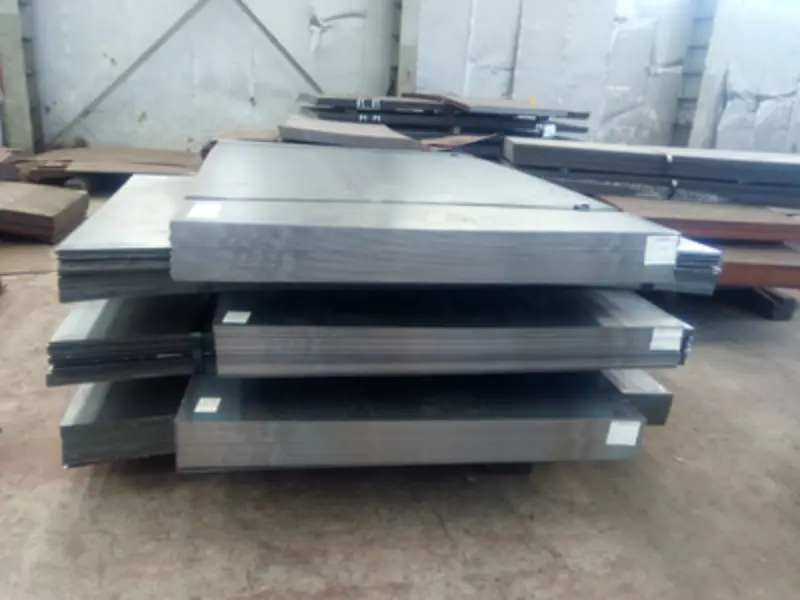
DIN 17102 TStE315 Normalized High-Strength Fine Grain Steel
DIN 17102 TStE315 Normalized High-Strength Fine Grain Steel for Welded Structures
Explore the properties, chemical composition, mechanical and physical data of TStE315 fine-grain structural steel according to DIN 17102. Find equivalent grades (EN S315N) and application guidance.
Hot rolling, normalising, welding, cold forming, cutting, bending, machining, hot-dip galvanising
- Phone : +8618037372205
- Email : [email protected]
- WhatsApp: Contact via Whtsapp
- WeChat: +8618037372205
DIN 17102 TStE315 Normalized High-Strength Fine Grain Steel Introduction
TStE315 is a weldable, normalised, fine-grained structural steel defined in the German standard DIN 17102. It belongs to the class of carbon and low-alloy high-strength steels, with a specified minimum yield strength of 315 MPa in thicknesses up to 16 mm. The material is refined by microalloying elements (Al, Nb, V, Ti) which provide grain refinement and improved notch toughness. This allows good weldability, cold formability, and reliable low-temperature impact properties. TStE315 is typically delivered in the normalised or normalised-rolled condition, ensuring uniform microstructure and mechanical properties. It is predominantly used in steel constructions where high strength, good weldability, and adequate ductility are required, such as bridges, towers, offshore structures, crane building, and heavy machinery. The steel is suitable for all conventional welding processes and can be readily hot-dip galvanised. Compared to lower-strength carbon steels, TStE315 allows weight savings while maintaining fabrication versatility.
DIN 17102 TStE315 Normalized High-Strength Fine Grain Steel Chemical Composition
The table below shows the chemical composition limits for TStE315 according to DIN 17102. The steel is killed and fine-grained through aluminium and/or microalloying elements such as niobium, vanadium, and titanium. The low carbon equivalent (CEV) ensures good weldability without preheating for typical plate thicknesses. All values are in weight percent unless otherwise noted.
| Element | Standard Value (max, unless range given) | Remarks |
|---|---|---|
| C | 0.18 | Carbon equivalent CEV typically ≤ 0.40 for thickness ≤ 40 mm |
| Si | 0.50 | |
| Mn | 0.90 – 1.60 | Depending on thickness and desired strength level |
| P | 0.025 | |
| S | 0.015 | Low sulphur for improved through-thickness properties |
| Al (total) | ≥ 0.015 | Minimum total aluminium for fine grain practice |
| Nb | 0.05 | Optional microalloying element |
| V | 0.10 | Optional microalloying element |
| Ti | 0.05 | Optional microalloying element |
| N | 0.012 | Maximum nitrogen content |
| Cr | 0.25 | Residual element (max) |
| Ni | 0.25 | Residual element (max) |
| Mo | 0.08 | Residual element (max) |
| Cu | 0.30 | Residual element (max), may be higher by agreement |
DIN 17102 TStE315 Normalized High-Strength Fine Grain Steel Physical Properties
The physical properties given below are typical for normalised structural steels of this strength level. They are not standardised but are useful design values. Properties vary with temperature; thermal expansion and conductivity change slightly with temperature. The density is standard for low-alloy steel, and the elastic modulus is typical for carbon-manganese steels. These values are applicable for engineering calculations unless more precise data from specific tests are available.
| Property | Typical Value | Unit | Test Conditions / Remarks |
|---|---|---|---|
| Density (ρ) | 7850 | kg/m³ | At 20 °C |
| Modulus of Elasticity (E) | 210 | GPa | At 20 °C |
| Shear Modulus (G) | 81 | GPa | About E/(2(1+ν)) |
| Poisson's Ratio (ν) | 0.3 | – | Typical for structural steel |
| Coefficient of Thermal Expansion (α) | 11.5 | 10⁻⁶ /K | 20 °C to 100 °C |
| Coefficient of Thermal Expansion (α) | 12.5 | 10⁻⁶ /K | 20 °C to 200 °C |
| Thermal Conductivity (λ) | 42 | W/(m·K) | At 20 °C |
| Thermal Conductivity (λ) | 40 | W/(m·K) | At 200 °C |
| Specific Heat Capacity (cp) | 460 | J/(kg·K) | At 20 °C |
| Specific Heat Capacity (cp) | 490 | J/(kg·K) | At 200 °C |
| Electrical Resistivity (ρe) | 0.18 | ×10⁻⁶ Ω·m | At 20 °C |
DIN 17102 TStE315 Normalized High-Strength Fine Grain Steel Mechanical Properties
Mechanical properties at room temperature according to DIN 17102 for the normalised condition (+N). The values depend on the nominal thickness. Longitudinal test pieces are used unless transverse testing is specified. The impact energy (Charpy V-notch) is guaranteed for the temperature –20 °C for TStE315. When a specific toughness class is required, the suffix is added (e.g. TStE315 N). The tensile test is performed according to EN 10002-1 (withdrawn, but referenced in the standard).
| Property | Required Value | Unit | Test Conditions / Thickness Range |
|---|---|---|---|
| Yield Strength (ReH) | 315 | MPa | Nominal thickness ≤ 16 mm |
| Yield Strength (ReH) | 295 | MPa | > 16 mm to 40 mm |
| Yield Strength (ReH) | 275 | MPa | > 40 mm to 63 mm |
| Yield Strength (ReH) | 255 | MPa | > 63 mm to 80 mm |
| Tensile Strength (Rm) | 490 – 630 | MPa | Nominal thickness ≤ 63 mm |
| Tensile Strength (Rm) | 490 – 610 | MPa | > 63 mm to 80 mm |
| Elongation (A), Lo=5.65√So | 18 | % | Longitudinal, ≤ 63 mm |
| Elongation (A), Lo=5.65√So | 17 | % | Longitudinal, > 63 mm to 80 mm |
| Charpy Impact Energy (KV) | 27 | J | Longitudinal, at –20 °C, average of 3 tests |
DIN 17102 TStE315 Normalized High-Strength Fine Grain Steel Exact Equivalent Material Standards and Substitution Grades
TStE315 was originally covered by the withdrawn German standard DIN 17102. The current European equivalent is EN 10025-3:2004. Other international standards provide grades with comparable chemical composition and mechanical properties. The table below lists materials that can be considered direct substitutes, though careful comparison of minimum impact energy requirements and delivery conditions is recommended.
| Country/Region | Standard | Grade | Remarks |
|---|---|---|---|
| Europe | EN 10025-3:2004 | S315N (+N) | Direct replacement; normalised delivery, –20 °C impact energy 27 J guaranteed as option |
| Germany | DIN EN 10025-3 (withdrawn DIN 17102) | TStE315 (historic) | Original designation, now superseded by S315N |
| United Kingdom | BS 4360:1990 | 50D | Normalised, minimum 355 MPa yield; verify toughness class for –20 °C |
| International (ISO) | ISO 4950-3:1995 | E315 | Equivalent to TStE315/E315 (now replaced by ISO 4950-3:1981 withdrawn) |
DIN 17102 TStE315 Normalized High-Strength Fine Grain Steel Application Introduction
TStE315 steel is designed primarily for welded steel constructions where normalised fine-grain structure provides the optimum balance of strength, toughness, and fabricability. It can replace lower-strength grades to lighten structures without compromising safety. The recommended welding procedure should follow EN 1011-2 and account for the carbon equivalent and plate thickness. The steel is suitable for hot-dip galvanising and can be bent to moderate radii without cracking. Below are typical industries, products, and specific components that benefit from this material.
Product Applications: Welded bridge girders and box sections, High-rise building columns and floor beams, Lattice towers and antenna masts, Offshore platform decks and nodes, Pipe piles and sheet piles, Boiler and pressure vessel shells (non-fire side), Storage tank roofs and walls, Heavy-duty vehicle chassis, Excavator booms and arms
Processed into products: Webs and flanges of welded I-beams, Chord and brace members of trusses, Base plates and stiffeners in column connections, Lifting lugs and pad-eyes, Brackets and brackets for crane booms, Wheel rims and hubs for heavy vehicles, Support rings for penstocks, Transition pieces for wind turbine towers, Flange joints in pressure piping
Application industries: Civil Engineering & Construction, Bridge Building, Offshore and Marine Engineering, Wind Energy, Crane and Lifting Equipment, Heavy Machinery Manufacturing, Shipbuilding (secondary structures, deck components), Transport and Infrastructure, Agricultural and Forestry Equipment
DIN 17102 TStE315 Normalized High-Strength Fine Grain Steel Similar / Alternative Material Recommendations
If TStE315 is not available, other high-strength structural steels with similar strength and weldability can be used with careful assessment of toughness, fabrication, and delivery condition. The following grades offer comparable minimum yield strengths (around 315-355 MPa) and are commonly used in welded structures.
| Country/Region | Standard | Grade | Remarks |
|---|---|---|---|
| Europe | EN 10025-2:2004 (thermo-mechanically rolled) | S355M/ML | Higher yield (355 MPa), –20 °C or –50 °C toughness options; TMCP delivery |
| Europe | EN 10025-3:2004 | S355N/NL | Higher yield, normalised delivery, excellent toughness |
| China | GB/T 1591-2018 | Q345D / Q345E | Yield 345 MPa, D for -20 °C, E for -40 °C impact; normalised or hot-rolled |
| China | GB/T 19879-2015 | Q345GJ (C, D) | Building structural steel with improved quality and through-thickness properties |
| USA | ASTM A572/A572M-21 | Grade 50 [345] | 345 MPa yield, carbon-manganese; verify notch toughness by supplementary requirement (S5) |
| USA / Canada | CSA G40.21-13 | 350W / 350WT | 350 MPa yield, weldable; WT – low temperature toughness (-20 °C) |
| Japan | JIS G3106:2015 | SM490A/B/C/YA/YB | 490 N/mm² tensile class; B (0 °C) or C (–10 °C) toughness |
Notes:
Important note: DIN 17102 is a withdrawn standard. Today, orders should be placed according to EN 10025-3 grade S315N (+N), which covers the same technical requirements. For thicknesses above 80 mm, different specifications (e.g., EN 10225 for offshore structures) may be necessary. When substituting materials, always check the project-specific toughness class (temperature) and through-thickness properties (Z-quality) if required. For corrosion protection, hot-dip galvanising is fully feasible; for painting, the normalised surface does not cause excessive scaling and accepts standard primers well. The steel is not intended for use above 350 °C in load-bearing applications due to potential loss of strength and oxidation. All data given here are informative and based on published standards; for critical applications, verify with the mill test certificate.
- Share



