
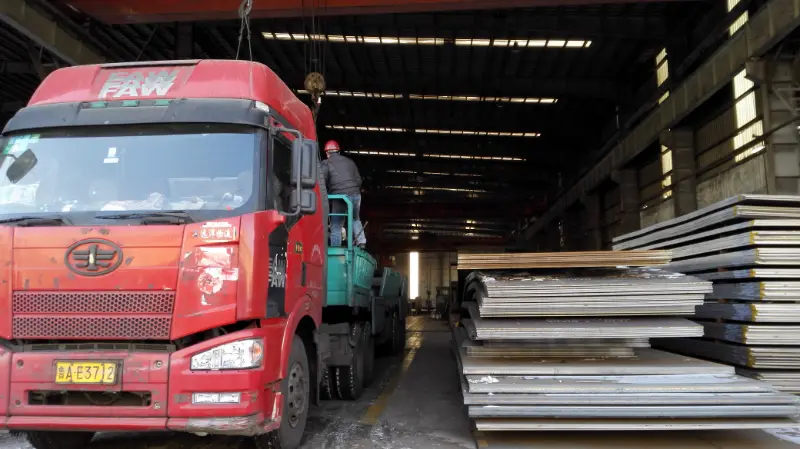
DIN 17102 StE380
DIN 17102 StE380: High-Strength Structural Steel Plate Properties, Equivalents & Applications
Complete material data for StE380 steel according to DIN 17102. Chemical composition, mechanical & thermal properties, international equivalents and application guide for this weldable structural plate.
Hot rolling, normalizing or controlled rolling; suitable for welding, forming, machining, and cutting
- Phone : +8618037372205
- Email : [email protected]
- WhatsApp: Contact via Whtsapp
- WeChat: +8618037372205
DIN 17102 StE380 Introduction
StE380 is a carbon and low-alloy high-strength structural steel defined in the German standard DIN 17102 for weldable fine-grain structural steels. It is supplied as hot-rolled plate, strip or wide flat with a minimum yield strength of 380 MPa for thicknesses up to 16 mm. The steel is microalloyed with elements such as niobium, vanadium or titanium to achieve grain refinement and improved toughness. Owing to its balanced composition, StE380 offers excellent weldability, good cold formability and reliable mechanical properties after normalizing or controlled rolling. Typical applications include welded bridges, crane structures, offshore platforms, heavy machinery and vehicle frames. The grade is now largely replaced by modern EN 10025-3 grades such as S355N/S420N, but the designation StE380 is still used for legacy projects and maintenance. Delivery condition is usually normalizing rolled or as agreed between purchaser and manufacturer.
DIN 17102 StE380 Chemical Composition
The chemical composition of DIN 17102 StE380 is designed to provide a fine-grain microstructure and high strength while maintaining good weldability and notch toughness. Carbon content is limited, and microalloying elements such as niobium, vanadium and titanium are used for grain refinement and precipitation strengthening. The total content of Nb+V+Ti is controlled to ensure consistent mechanical properties. Phosphorus and sulfur are kept low to improve ductility and resistance to lamellar tearing. Aluminium is added as a deoxidizer and grain refiner; the minimum soluble aluminium content ensures fine-grain practice. Nitrogen is restricted to avoid strain aging.
| Element | Standard Value (wt%) | Remarks |
|---|---|---|
| Carbon (C) | ≤0.20 | Ladle analysis, max. |
| Silicon (Si) | 0.10 – 0.50 | |
| Manganese (Mn) | 0.80 – 1.50 | |
| Phosphorus (P) | ≤0.035 | Maximum |
| Sulfur (S) | ≤0.030 | Maximum |
| Aluminium (Al total) | ≥0.020 | Minimum, soluble Al ≥0.015 |
| Nitrogen (N) | ≤0.015 | Maximum |
| Niobium (Nb) | ≤0.05 | Microalloying element |
| Vanadium (V) | ≤0.10 | Microalloying element |
| Titanium (Ti) | ≤0.05 | Microalloying element |
| Nb+V+Ti | ≤0.22 | Sum of microalloying elements |
DIN 17102 StE380 Thermal and Electrical Physical Properties
The physical constants of StE380 are typical of low-carbon, low-alloy structural steels. The density is similar to that of pure iron, and elastic moduli remain stable up to about 300°C. Thermal expansion, thermal conductivity and specific heat capacity govern the steel's response during welding preheat, flame cutting and service in elevated-temperature environments. Electrical resistivity affects induction heating and magnetic properties. These values are approximate and may vary slightly with heat treatment condition and actual chemical composition.
| Property | Standard Value (Nominal) | Unit | Test Condition / Remarks |
|---|---|---|---|
| Density (ρ) | 7.85 | g/cm³ | At 20°C |
| Elastic modulus (E) | 205 – 210 | GPa | At 20°C |
| Shear modulus (G) | 80 | GPa | Calculated from E and ν |
| Poisson's ratio (ν) | 0.30 | - | In elastic range |
| Thermal expansion coefficient (α) | 12.0 | 10⁻⁶/K | 20–100°C |
| Thermal conductivity (λ) | 48 – 52 | W/(m·K) | At 20°C |
| Specific heat capacity (cₚ) | 460 – 480 | J/(kg·K) | At 20°C |
| Electrical resistivity (ρₑ) | 0.20 – 0.25 | µΩ·m | At 20°C |
DIN 17102 StE380 Mechanical Properties
Mechanical property requirements for StE380 depend on the product thickness. The steel achieves its strength through a combination of fine-grain microstructure and controlled rolling/normalizing. Yield strength and tensile strength are guaranteed in the transverse direction. Elongation is measured on a gauge length of 5.65√S₀. Charpy impact energy is normally specified at a temperature of -20°C (optionally at 0°C or -40°C by agreement), with a minimum average value of 27 J for the basic quality grade. Bend tests are performed with a mandrel diameter related to the specimen thickness.
| Property | Standard Value | Unit | Test Condition / Remarks |
|---|---|---|---|
| Yield Strength (ReH) | ≥380 | MPa | Thickness ≤ 16 mm |
| Yield Strength (ReH) | ≥370 | MPa | Thickness 16–40 mm |
| Yield Strength (ReH) | ≥360 | MPa | Thickness 40–63 mm |
| Tensile Strength (Rm) | 510 – 610 | MPa | All thicknesses |
| Elongation after fracture (A) | ≥20 | % | Gauge length 5.65√S₀, thickness ≤16 mm |
| Elongation after fracture (A) | ≥19 | % | Gauge length 5.65√S₀, thickness 16–40 mm |
| Elongation after fracture (A) | ≥18 | % | Gauge length 5.65√S₀, thickness 40–63 mm |
| Bend test (mandrel diameter) | 2.0 × thickness | - | Bending angle 180°, specimen width ≥50 mm, thickness ≤16 mm |
| Bend test (mandrel diameter) | 3.0 × thickness | - | Thickness 16–40 mm |
| Charpy impact energy (KV₂) | ≥27 | J | At -20°C, longitudinal; minimum average of three tests |
DIN 17102 StE380 Exact Equivalent Material Standards and Substitute Grades
| Country/Region | Standard | Grade | Remarks |
|---|---|---|---|
| International | ISO 4950-2:1995 (withdrawn) | E380 | High yield strength structural steel, yield 380–420 MPa, similar weldable fine grain concept |
| Europe | EN 10113-2:1993 (withdrawn) | S380M | Thermomechanical rolled weldable fine grain structural steel, nearest nominal yield strength |
| Europe | EN 10025-3:2004 / EN 10025-3:2019 | S420N / S420NL | Modern normalized fine grain steel; yield strength 420 MPa (higher than StE380, may be used as substitution with design revision) |
DIN 17102 StE380 Application Introduction
StE380 steel's combination of high yield strength, excellent weldability and notch toughness makes it suitable for heavy-duty welded structures. It can be formed, punched, drilled and machined using standard workshop practices. Preheating before welding is recommended only for thick sections (>40 mm) to avoid hydrogen cracking. Post-weld heat treatment is generally not required, but stress relieving may be applied if specified. The steel is frequently chosen for dynamically loaded components and structures exposed to low ambient temperatures.
Product Applications: Welded I-beams and box girders for bridges, Boom sections and chassis of mobile cranes, Excavator arms and bulldozer blades, Offshore platform decks and jacket structures, Pressure vessel shells (where applicable under pressure vessel codes), Wind turbine tower sections and transition pieces
Processed into products: Bridge bearing plates and stiffeners, Crane runway girders and end carriages, Heavy-duty frame rails for trucks and trailers, Lifting lugs, clevises and structural brackets, Flange and web plates for welded built-up sections, Gearbox housing support structures in wind turbines
Application industries: Civil engineering and infrastructure, Heavy machinery and crane construction, Shipbuilding and offshore engineering, Transportation (bridges, railroad cars, truck frames), Energy sector (wind turbine towers, support structures), General steel fabrication
DIN 17102 StE380 Recommendations for Similar or Equivalent Substitute Materials
| Country/Region | Standard | Grade | Remarks |
|---|---|---|---|
| USA | ASTM A572/A572M | Grade 55 [380] | High-strength low-alloy structural steel; minimum yield 55 ksi (380 MPa), similar tensile range |
| USA | ASTM A709/A709M | Grade 50 | Structural steel for bridges; yield 345 MPa, slightly lower strength but widely used |
| European Union | EN 10025-2 | S355J2 / S355K2 | Hot rolled structural steel; yield 355 MPa (lower), more common, good toughness |
| European Union | EN 10025-3 | S355N / S355NL | Normalized fine grain steel; yield 355 MPa (lower), direct replacement for less demanding strength requirement |
| China | GB/T 1591-2018 | Q390B / Q390C | High strength low alloy structural steel; yield 390 MPa (thickness ≤16 mm), similar application |
| Japan | JIS G3106 | SM490A / SM490B | Welded structural steel; yield 325–365 MPa depending on thickness, slightly lower strength but good weldability |
| Russia | GOST 19281-2014 | 17G1S (17Г1С) | Low-alloy structural steel; yield 345–375 MPa, similar Mn-Si base with microalloying |
Notes:
The data provided are based on the now-withdrawn DIN 17102 standard and typical supplementary specifications. StE380 is no longer a preferred designation in current European standards. For new designs, equivalent strength and toughness requirements should be transposed to EN 10025-3 (S420N/S420NL) or EN 10025-4 (S420M/S420ML) with corresponding material certificates. Actual mechanical properties may vary depending on thickness, heat treatment, and product form. For critical applications, a detailed material qualification according to the relevant code (e.g., Eurocode, DNV, or API) is recommended. Contact the steel producer for current availability and the specific certificate to EN 10204.
- Share



