
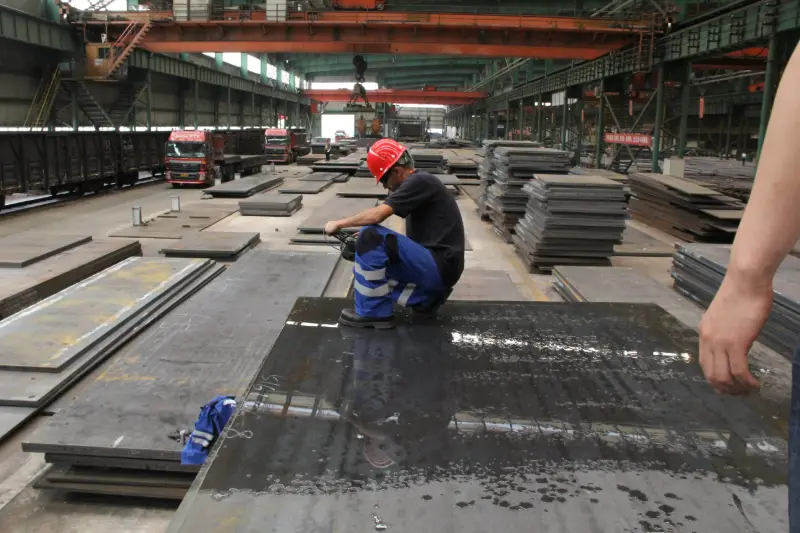
DIN17102 EStE285
DIN17102 EStE285 - Fine Grain Elevated Temperature Weldable Structural Steel Plate
Comprehensive data for DIN17102 EStE285 carbon and low-alloy high-strength steel plate including chemical composition, mechanical properties, thermal and electrical physical properties, international equivalents and application guidance.
Normalizing, hot rolling, thermomechanical rolling, welding, forming, cutting, machining
- Phone : +8618037372205
- Email : [email protected]
- WhatsApp: Contact via Whtsapp
- WeChat: +8618037372205
DIN17102 EStE285 Introduction
DIN17102 EStE285 is a weldable, fine grain structural steel with a minimum yield strength of 285 MPa at room temperature. It is specifically designed for elevated temperature service, offering dependable mechanical properties up to 400°C. This steel grade is supplied in normalized or normalized rolled condition, providing excellent toughness, good weldability, and resistance to brittle fracture. Typical applications include steam boilers, pressure vessels, high-temperature piping, and structural components in energy and petrochemical industries. Its micro-alloyed composition with niobium, vanadium and titanium guarantees fine grain size and consistent elevated-temperature performance.
DIN17102 EStE285 Chemical Composition
Ladle analysis according to DIN 17102. The steel is fully killed and fine grain treated with aluminium. Micro-alloying elements (Nb, V, Ti) are controlled to achieve the required strength and grain refinement. Carbon equivalent (CEV) limited for weldability.
- Thickness ≤16 mm: C ≤0.18
- Thickness >16–40 mm: C ≤0.20
| Chemical Element | Standard Value | Remarks |
|---|---|---|
| C | ≤0.18 (≤16mm); ≤0.20 (>16–40mm) | Depends on thickness |
| Si | ≤0.50 | |
| Mn | 0.90–1.65 | |
| P | ≤0.030 | |
| S | ≤0.025 | |
| Al (total) | ≥0.020 | Fine grain practice |
| Nb | ≤0.05 | |
| V | ≤0.10 | |
| Ti | ≤0.03 | |
| Ni | ≤0.30 | |
| Cr | ≤0.30 | |
| Mo | ≤0.08 | |
| Cu | ≤0.30 | |
| N | ≤0.012 | |
| CEV | ≤0.41 (typical) | For weldability, thickness dependent |
DIN17102 EStE285 Thermal and Electrical Physical Properties
These physical properties are representative for fine grain structural steels at room temperature unless stated otherwise. Actual values may vary slightly with composition and temperature. Used for engineering calculations.
| Property | Standard Value | Unit | Test Condition |
|---|---|---|---|
| Density (ρ) | 7850 | kg/m³ | 20 °C |
| Elastic Modulus (E) | 210 | GPa | 20 °C |
| Shear Modulus (G) | 81 | GPa | 20 °C |
| Poisson's Ratio (ν) | 0.3 | — | 20 °C |
| Thermal Expansion Coefficient (α) | 12 ×10⁻⁶ | K⁻¹ | 20–100 °C |
| Thermal Expansion Coefficient (α) | 13 ×10⁻⁶ | K⁻¹ | 20–200 °C |
| Thermal Expansion Coefficient (α) | 14 ×10⁻⁶ | K⁻¹ | 20–400 °C |
| Thermal Conductivity (λ) | 50 | W/(m·K) | 20 °C |
| Specific Heat Capacity | 460 | J/(kg·K) | 20 °C |
| Electrical Resistivity (ρₑ) | 0.25 ×10⁻⁶ | Ω·m | 20 °C |
DIN17102 EStE285 Mechanical Properties
Room temperature tensile properties for normalized condition in longitudinal direction. Impact energy values apply when agreed upon ordering. Bending test mandrel diameter: d = 2a for ≤16 mm, 3a for >16–100 mm (180° bend). Note: Elevated temperature yield strength is available on request.
| Property | Standard Value | Unit | Test Condition |
|---|---|---|---|
| Yield Strength (ReH) | 285 | MPa | Thickness ≤ 16 mm |
| Yield Strength (ReH) | 275 | MPa | Thickness > 16–35 mm |
| Yield Strength (ReH) | 265 | MPa | Thickness > 35–50 mm |
| Yield Strength (ReH) | 255 | MPa | Thickness > 50–70 mm |
| Yield Strength (ReH) | 235 | MPa | Thickness > 70–100 mm |
| Tensile Strength (Rm) | 410 – 560 | MPa | Thickness ≤ 40 mm |
| Tensile Strength (Rm) | 400 – 550 | MPa | Thickness > 40–63 mm |
| Tensile Strength (Rm) | 390 – 540 | MPa | Thickness > 63–100 mm |
| Elongation (A, %) | ≥ 22 | % | Thickness ≤ 16 mm, L₀=5.65√S₀ |
| Elongation (A, %) | ≥ 22 | % | Thickness > 16–40 mm |
| Elongation (A, %) | ≥ 21 | % | Thickness > 40–63 mm |
| Elongation (A, %) | ≥ 20 | % | Thickness > 63–100 mm |
| Bending Test (180°) | d = 2a | — | Thickness ≤ 16 mm |
| Bending Test (180°) | d = 3a | — | Thickness > 16–100 mm |
| Impact Energy (KV, longitudinal) | ≥ 27 J | J | Test at +20 °C (or as agreed) |
DIN17102 EStE285 Completely Equivalent Standards and Replaceable Grades
| Country/Region | Standard | Grade | Remarks |
|---|---|---|---|
| Germany | DIN 17102 | EStE285 | Original standard for elevated temperature fine grain steel |
| Europe | EN 10025-2 | S275N | Normalized fine grain steel, similar room temperature properties; verify elevated temperature requirements. |
| Japan | JIS G3106 | SM400B | Comparable strength and weldability; different test regime. |
| USA | ASTM A572/A709 | Grade 42 | Similar yield strength; requires supplementary elevated temperature testing. |
| International | ISO 630 | Fe 410C | Structural steel with 410 MPa tensile class; close match. |
DIN17102 EStE285 Application Introduction
EStE285 is optimized for welded constructions operating at elevated temperatures (up to 400°C). It combines good formability, weldability and sustained mechanical strength, making it suitable for many demanding environments. The material can be cold formed, machined, and welded using common techniques. Preheating and post-weld heat treatment may be required depending on thickness and service conditions.
Product Applications: Elevated temperature process piping, Steam and hot water boilers, Pressure vessel shells and heads, Structural frames for high-temperature kilns, Wind turbine tower flanges and internals (if hot) possibly
Processed into products: Boiler drums and headers, Heat exchanger tube sheets, Flanges and forged rings, Welded beams and columns in hot gas ducts, Support structures for superheaters, Transition pieces and nozzles
Application industries: Power generation (boilers, heat exchangers, steam drums), Petrochemical and refinery (pressure vessels, reactor shells), Offshore and marine engineering (structural parts exposed to warm media), Industrial furnace construction, Chemical plant equipment
DIN17102 EStE285 Similar / Substitute Materials
| Country/Region | Standard | Grade | Remarks |
|---|---|---|---|
| Europe | EN 10025-2 | S275NL | Low‑temperature toughness variant; lacks mandated elevated temperature testing. |
| Europe | EN 10025-4 | S275M/ML | Thermomechanically rolled; different production process but similar strength. |
| Germany | DIN 17102 | StE285 | Same standard without elevated temperature guarantee; room temperature properties identical. |
| China | GB/T 1591 | Q345B | Higher yield strength (345 MPa); may be substituted if strength reduction is acceptable. |
| Russia | GOST 19281 | 09G2S | Silicon-manganese steel; similar application range but different micro-alloying. |
Notes:
Additional Information:
- EStE285 is supplied with inspection certificate 3.1 according to EN 10204.
- Ultrasonic testing (e.g., EN 10160) may be specified for critical applications.
- For welding, low hydrogen consumables and controlled heat input are recommended.
- Elevated temperature yield strength values are subject to agreement at the time of order.
- This grade has been superseded for new designs by EN 10025-2 S275N or S275NL with additional agreement on hot testing, but EStE285 remains relevant for maintenance and replacement parts.
- Share



