
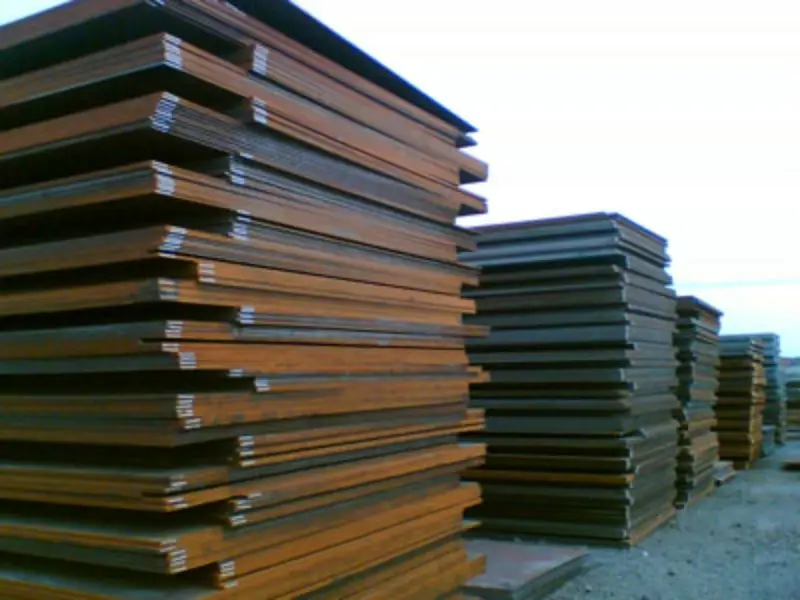
DIN 17102 TStE285 Low
TStE285 Steel Plate: DIN 17102 Normalized High-Strength Structural Steel Data
Complete technical profile of TStE285 steel under DIN 17102: chemical composition, mechanical properties, thermal and electrical physical properties, international equivalents, and application guidance.
Welding (all common methods), hot and cold bending, shearing, flame cutting, machining, cold forming (within specified limits)
- Phone : +8618037372205
- Email : [email protected]
- WhatsApp: Contact via Whtsapp
- WeChat: +8618037372205
DIN 17102 TStE285 Low Introduction
TStE285 is a weldable fine-grain structural steel specified in the German standard DIN 17102 (now superseded by EN 10025-3). It is delivered in the normalized condition and belongs to the category of carbon and low-alloy high-strength steels for welded structures. The minimum specified yield strength is 285 MPa for thicknesses up to 16 mm, with tensile strength in the range of 420–560 MPa. The steel exhibits good weldability, adequate toughness at room temperature (longitudinal Charpy impact energy ≥ 27 J at +20 °C), and excellent formability. Due to its fine-grain microstructure obtained by normalizing, TStE285 provides a balanced combination of strength and ductility, making it suitable for dynamically loaded structures such as bridges, cranes, and offshore components. The material is typically supplied as hot-rolled plates and wide flats, and it can be processed by welding, bending, and cold forming in accordance with standard practices for structural steels.
DIN 17102 TStE285 Low Chemical Composition of TStE285 According to DIN 17102
Ladle analysis limits as specified by the standard. The steel is aluminium-killed fine-grain treated. Microalloying elements such as Nb, V, and Ti may be added individually or in combination to achieve the required mechanical properties and fine grain size.
- Carbon equivalent (CEV) is typically controlled to ensure good weldability; formula: CEV = C + Mn/6 + (Cr+Mo+V)/5 + (Ni+Cu)/15.
- For thicknesses above certain limits, sulfur content may be restricted further to improve through-thickness properties (e.g., Z-quality).
| Element | Ladle Analysis (%) | Remarks |
|---|---|---|
| Carbon (C) | 0.16 max | Product analysis allows slight deviations |
| Silicon (Si) | 0.50 max | - |
| Manganese (Mn) | 0.90 - 1.65 | Higher Mn contributes to strength |
| Phosphorus (P) | 0.030 max | For Z-quality options may be ≤ 0.020 |
| Sulfur (S) | 0.025 max | For improved toughness and through-thickness properties lower limits can be agreed |
| Aluminium (Altotal) | 0.020 min | Indicates fully killed fine-grain practice |
| Niobium (Nb) | 0.050 max | Grain refiner and precipitation strengthener |
| Vanadium (V) | 0.10 max | Grain refiner |
| Titanium (Ti) | 0.05 max | Grain refiner; usually < 0.03 when used alone |
| Chromium (Cr) | 0.30 max | Residual element |
| Nickel (Ni) | 0.30 max | Residual element |
| Copper (Cu) | 0.35 max | Residual element |
| Molybdenum (Mo) | 0.10 max | Residual element |
| Nitrogen (N) | 0.015 max | For aluminium-killed steel; fine-grain stabilisation |
| Others (Cr+Cu+Mo+Ni) | 0.70 max | Sum of residual elements |
DIN 17102 TStE285 Low Thermal and Electrical Physical Properties
These values are representative for normalized fine-grain structural steel similar to TStE285 at room temperature and ambient pressure. They are not mandatory in DIN 17102 but are widely accepted for engineering calculations.
- Thermal properties vary slightly with temperature; the expansion coefficient given is an average for 20–100 °C.
- Heat treatment temperatures: normalizing at 850–940 °C, stress relieving around 550–620 °C.
| Property | Typical Value | Unit | Condition / Temperature |
|---|---|---|---|
| Density (ρ) | 7.85 | g/cm³ | At 20 °C |
| Elastic modulus (E) | 210 | GPa | At 20 °C, static |
| Shear modulus (G) | 81 | GPa | At 20 °C, static |
| Poisson's ratio (ν) | 0.3 | - | Elastic range |
| Thermal expansion coefficient (α) | 12.0 x 10⁻⁶ | K⁻¹ | Average 20 – 100 °C |
| Thermal expansion coefficient (α) | 12.8 x 10⁻⁶ | K⁻¹ | Average 20 – 200 °C |
| Thermal conductivity (λ) | 51 | W/(m·K) | At 20 °C |
| Thermal conductivity (λ) | 48 | W/(m·K) | At 100 °C |
| Specific heat capacity (cp) | 460 | J/(kg·K) | At 20 °C |
| Specific heat capacity (cp) | 490 | J/(kg·K) | At 100 °C |
| Electrical resistivity (ρe) | 0.23 | µΩ·m | At 20 °C |
DIN 17102 TStE285 Low Mechanical Properties of TStE285 in Normalized Condition
Specified tensile and impact properties at room temperature, longitudinal test pieces. Values depend on product thickness.
- Yield strength (ReH) decreases with increasing thickness.
- Tensile strength (Rm) range given for all thicknesses.
- Elongation (A5) based on gauge length 5.65√S₀.
- Charpy impact energy (KV) minimum 27 J at +20 °C (basic grade). Optional lower temperature qualities (e.g., TStE285KZ, TStE285KT) require 27 J at -20 °C or -50 °C; those are not part of the standard designation and must be agreed upon.
- Bend test uses mandrel diameter related to plate thickness (a = specimen thickness).
| Property | Value | Unit | Test Condition / Remarks |
|---|---|---|---|
| Upper yield strength (ReH) | 285 min | MPa | Nominal thickness (t) ≤ 16 mm |
| Upper yield strength (ReH) | 275 min | MPa | 16 < t ≤ 35 mm |
| Upper yield strength (ReH) | 265 min | MPa | 35 < t ≤ 50 mm |
| Upper yield strength (ReH) | 255 min | MPa | 50 < t ≤ 70 mm |
| Upper yield strength (ReH) | 235 min | MPa | 70 < t ≤ 100 mm |
| Tensile strength (Rm) | 420 - 560 | MPa | t ≤ 70 mm |
| Tensile strength (Rm) | 400 - 540 | MPa | 70 < t ≤ 100 mm |
| Elongation after fracture (A5) | 22 min | % | Longitudinal, t ≤ 16 mm |
| Elongation after fracture (A5) | 21 min | % | Longitudinal, 16 < t ≤ 40 mm |
| Elongation after fracture (A5) | 20 min | % | Longitudinal, 40 < t ≤ 100 mm |
| Charpy impact energy (KV2 ) | 27 min | J | Longitudinal, at +20 °C (basic grade) |
| Bend test (mandrel diameter) | 3a | - | 180° bending, t ≤ 16 mm |
| Bend test (mandrel diameter) | 4a | - | 180° bending, 16 < t ≤ 100 mm |
DIN 17102 TStE285 Low Fully Equivalent Material Standards and Replaceable Grades
| Country/Region | Standard | Grade | Remarks |
|---|---|---|---|
| European Union | EN 10025-3 | S275N | Direct equivalent; normalized delivery; S275NL for low-temperature impact option |
| United Kingdom (withdrawn) | BS 4360:1990 | 43EE | Historical equivalent; normalized; impact tested at -50 °C; not identical to basic TStE285 |
| France (withdrawn) | NF A36-201 | E285 | Older French designation; same yield strength class |
| Italy (withdrawn) | UNI 7807 | Fe E285 | Historical equivalent |
DIN 17102 TStE285 Low Application Introduction
TStE285 is intended for welded, dynamically loaded structural components where moderate strength, good ductility, and reliable toughness at ambient to moderately low temperatures are required. The normalized fine-grain microstructure guarantees uniform properties and excellent resistance to brittle fracture. Common processing routes include flame and plasma cutting, cold and hot forming, and all conventional arc welding processes. Preheating is normally not required for thicknesses below approximately 30 mm; for thicker sections or when hydrogen control is necessary, a modest preheat of 100–150 °C may be recommended. Post-weld heat treatment (stress relieving) is advisable for heavy fabrications. The steel is also suitable for galvanizing and painting without any particular restrictions.
Product Applications: Welded structural steel plates, Cut-to-length and shot-blasted plates for bridge fabrication, Normalized heavy plates for crane booms, Prefabricated welded beams and columns, Pressure vessel shells (for operating temperatures down to -10 °C in basic grade)
Processed into products: Bridge girder webs and flanges, Crane boom chords and lattice members, Excavator and loader structural frames, Offshore platform topside beams, Penstock pipes and spiral casings, Support brackets and load-bearing plates in building frames
Application industries: Civil engineering and infrastructure (bridges, high-rise buildings), Heavy machinery and crane construction (mobile cranes, tower cranes, slewing rings), Shipbuilding and offshore engineering (deck structures, jack-up legs, modules), Mining and earth-moving equipment (loader arms, dump truck bodies), Pressure vessel fabrication (low-temperature storage tanks, non-cryogenic service), Wind energy (tower sections)
DIN 17102 TStE285 Low Similar or Closely Related Material Alternatives
| Country/Region | Standard | Grade | Analysis and Remarks |
|---|---|---|---|
| European Union | EN 10025-2 | S275J2 (+N) | Similar yield strength, but not fine-grain treated; impact at -20 °C; less restrictive chemistry |
| USA | ASTM A572 / A572M | Grade 42 (290 MPa) | Slightly higher yield; rimmed or silicon-killed; not fully killed fine-grain, Charpy requirements differ |
| USA | ASTM A573 / A573M | Grade 70 | Carbon-manganese steel for structural use; lower toughness, not normalized by default |
| Japan | JIS G3106 | SM400B / SM400C | SM400B: 0 °C impact; SM400C: 0 °C, both with min. yield 245 MPa for t ≤ 16 mm, lower than TStE285 but widely used |
| China | GB/T 1591-2018 | Q345D (normalized) | Higher strength (345 MPa), but similar fine-grain characteristics when normalized; widely interchangeable with extra margin |
Notes:
- Thickness limitation: This data covers product thicknesses up to 100 mm. For thicker plates, mechanical properties must be agreed upon between purchaser and manufacturer.
- Impact test temperature options: On request, TStE285 can be supplied with guaranteed impact energy at lower temperatures (e.g., -20 °C, -40 °C, -50 °C). In such cases, the purchase order must specify the required test temperature and energy value (usually 27 J min.). Such grades may be designated as TStE285Z or TStE285T according to former terminology.
- Through-thickness properties: For applications with high tensile stress in the thickness direction, Z-quality (e.g., Z15, Z25, Z35 according to EN 10164) can be supplied to improve resistance to lamellar tearing.
- Welding consumables: Filler metals should match the tensile strength class; low-hydrogen processes are recommended. Typical preheat and interpass temperatures: 20–150 °C, depending on section thickness and hydrogen scale.
- Certification: Inspection certificates 3.1 in accordance with EN 10204 are customary.
- Share



