
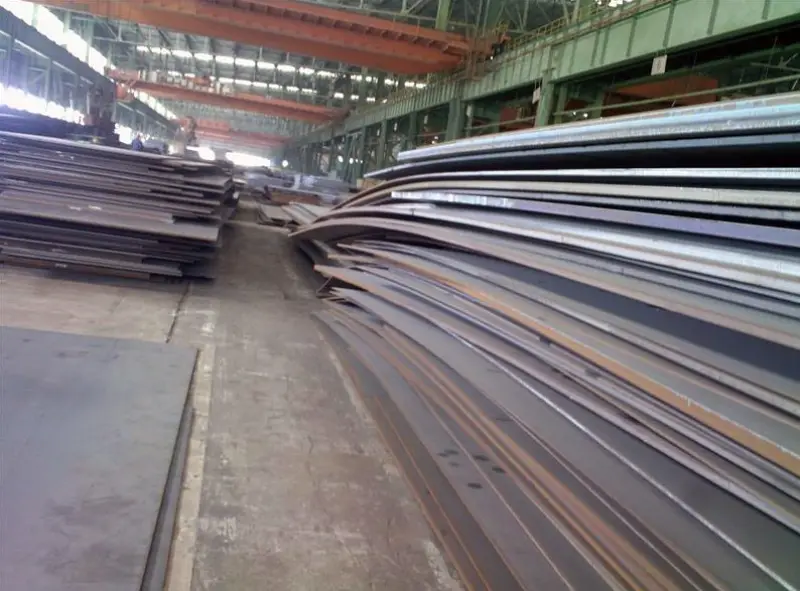
DIN 17102 StE315 High-Strength Fine Grain Structural Steel Plate
StE315 High-Strength Fine Grain Structural Steel Plate per DIN 17102
Technical data and properties of StE315 carbon and low-alloy high-strength steel plate according to DIN 17102, including chemistry, mechanical and physical performance, and global equivalents.
Hot rolling, normalizing, welding, thermal cutting, cold forming
- Phone : +8618037372205
- Email : [email protected]
- WhatsApp: Contact via Whtsapp
- WeChat: +8618037372205
DIN 17102 StE315 High-Strength Fine Grain Structural Steel Plate Introduction
StE315 is a weldable, normalized fine grain structural steel defined in DIN 17102. It belongs to the carbon and low-alloy high-strength category, offering a minimum yield strength of 315 MPa in thin plates. The fine grain treatment (via aluminum, niobium, vanadium or titanium) ensures excellent toughness and ductility even at low temperatures. Its balanced composition provides reliable weldability using common processes without excessive preheating, making it suitable for heavy welded fabrications. Typical applications include bridges, building frameworks, pressure vessels, offshore structures, cranes and earthmoving machinery. The steel is delivered in the normalized condition (N) or optionally with guaranteed impact properties for demanding environments.
DIN 17102 StE315 High-Strength Fine Grain Structural Steel Plate Chemical Composition
The chemical composition reflects a carbon-manganese base with fine grain microalloying elements to ensure the required strength and toughness. Aluminum, niobium, vanadium or titanium are used singly or in combination. Heat analysis limits are per DIN 17102; product analysis tolerances are defined in the standard.
| Element | Standard Value (wt%) | Remarks |
|---|---|---|
| C | ≤ 0.18 | Carbon |
| Si | ≤ 0.50 | Silicon |
| Mn | 1.00 – 1.60 | Manganese |
| P | ≤ 0.035 | Phosphorus |
| S | ≤ 0.030 | Sulfur |
| Altotal | ≥ 0.015 | Minimum for fine grain treatment |
| Nb | ≤ 0.05 | Niobium (optional microalloy) |
| V | ≤ 0.10 | Vanadium (optional microalloy) |
| Ti | ≤ 0.05 | Titanium (optional microalloy) |
| N | ≤ 0.015 | Nitrogen |
| Ni | ≤ 0.30 | Nickel (residual) |
| Cr | ≤ 0.30 | Chromium (residual) |
| Cu | ≤ 0.30 | Copper (residual) |
| Mo | ≤ 0.08 | Molybdenum (residual) |
DIN 17102 StE315 High-Strength Fine Grain Structural Steel Plate Physical Properties
Physical properties are representative for normalized low-alloy structural steel of this strength level. Thermal conductivity, specific heat and thermal expansion are important for welding heat input calculations and fire design. Slight variations may occur depending on exact product analysis.
| Property | Typical Value | Unit | Test / Temperature Range |
|---|---|---|---|
| Density (ρ) | 7.85 | g/cm³ | 20°C |
| Elastic Modulus (E) | 210 | GPa | 20°C |
| Shear Modulus (G) | 81 | GPa | 20°C |
| Poisson's Ratio (ν) | 0.3 | – | 20°C |
| Thermal Expansion (α) | 12.0 | 10⁻⁶ /K | 20 – 100°C |
| Thermal Expansion (α) | 12.5 | 10⁻⁶ /K | 20 – 200°C |
| Thermal Expansion (α) | 13.2 | 10⁻⁶ /K | 20 – 400°C |
| Thermal Conductivity (λ) | 50 | W/m·K | 20°C |
| Specific Heat Capacity (cp) | 460 | J/kg·K | 20°C |
| Electrical Resistivity (ρe) | 0.16 – 0.20 | µΩ·m | 20°C |
DIN 17102 StE315 High-Strength Fine Grain Structural Steel Plate Mechanical Properties
Mechanical properties are guaranteed in the normalized delivery condition. Yield strength and tensile strength vary with plate thickness. Impact energy is verified for ordered quality levels (e.g., at -20°C). Elongation refers to a gauge length of L0 = 5.65√S0 (A5). All values are longitudinal unless noted.
| Property | Standard Value | Unit | Test Condition / Thickness (mm) |
|---|---|---|---|
| Minimum Yield Strength ReH | 315 | MPa | t ≤ 16 |
| Minimum Yield Strength ReH | 295 | MPa | 16 < t ≤ 40 |
| Minimum Yield Strength ReH | 285 | MPa | 40 < t ≤ 63 |
| Minimum Yield Strength ReH | 275 | MPa | 63 < t ≤ 80 |
| Minimum Yield Strength ReH | 265 | MPa | 80 < t ≤ 100 |
| Tensile Strength Rm | 490 – 630 | MPa | t ≤ 100 |
| Minimum Elongation A5 (L) | 20 | % | t ≤ 40 |
| Minimum Elongation A5 (L) | 19 | % | 40 < t ≤ 63 |
| Minimum Elongation A5 (L) | 18 | % | 63 < t ≤ 100 |
| Bend Test (180°) | 3a | – | t ≤ 16 (mandrel dia.) |
| Bend Test (180°) | 4a | – | 16 < t ≤ 40 |
| Bend Test (180°) | 5a | – | 40 < t ≤ 63 |
| Impact Energy KV (L) @ -20°C | ≥ 27 | J | Quality level C, t ≤ 40 |
| Impact Energy KV (T) @ -20°C | ≥ 20 | J | Quality level C, t ≤ 40 |
DIN 17102 StE315 High-Strength Fine Grain Structural Steel Plate Approximate Equivalents – Standards and Grades with Closest Match
StE315 has no exact replacement in current EN standards because EN 10025-3 uses 275 and 355 MPa yield steps. The table below lists materials with similar strength and intended use. All comparisons are based on normalized fine-grain structural steels.
| Country/Region | Standard | Grade | Remarks |
|---|---|---|---|
| Germany | DIN 17102 | StE315 | Original specification |
| Europe | EN 10025-3 | S275N | Slightly lower min. yield (275 MPa); fine grain normalized |
| Europe | EN 10025-3 | S355N | Higher min. yield (355 MPa); often interchangeable with StE355 |
| USA | ASTM A572/A572M | Grade 50 [345] | 345 MPa min. yield; similar weldable structural steel |
| Japan | JIS G3106 | SM490A | 325 MPa min. yield; used for welded structures |
| China | GB/T 1591 | Q345D | 345 MPa min. yield; carbon-manganese with impact -20°C |
| International | ISO 630-3 | S315N | 315 MPa min. yield normalized; exact match but limited availability |
DIN 17102 StE315 High-Strength Fine Grain Structural Steel Plate Application Introduction
StE315 is designed for welded constructions where high strength and toughness are required. Its fine grain structure ensures good ductility and resistance to brittle fracture, making it suitable for both static and dynamic loading. The grade can be easily cut, formed and welded with standard techniques.
Product Applications: Steel bridges (main girders, orthotropic decks), Multi-storey building frames and columns, Pressure vessels and storage tanks, Crane booms, jibs and lattice structures, Heavy-duty truck chassis, Excavator buckets and dump bodies, Penstocks and spiral cases in hydropower plants, Offshore platform structural members
Processed into products: Welded I‑beams and box girders, Flanges, web plates and stiffeners, Base plates and bearing plates, Boom and mast sections for crawler cranes, Main load‑bearing plates in pressure vessels, Ship hull plates and deck panels, Wind turbine tower shell sections, Heavy welded fabrications for mining machinery
Application industries: Civil engineering and infrastructure, Building construction, Mechanical engineering, Shipbuilding and marine structures, Offshore platforms, Mining and earthmoving equipment, Wind energy (tower and foundation plates), Railway bridges and wagons
DIN 17102 StE315 High-Strength Fine Grain Structural Steel Plate Similar / Alternative Materials with Comparable Performance
These grades are not exact matches but can serve as functional substitutes in many applications. Selection must consider exact thickness, toughness requirements and fabrication conditions.
| Country/Region | Standard | Grade | Remarks |
|---|---|---|---|
| Germany | DIN 17100 | St52-3 | Older standard, now replaced by S355; higher yield but similar welding |
| Europe | EN 10025-2 | S355J2+N | Fine grain optional, high toughness; 355 MPa yield |
| USA | ASTM A709/A709M | Grade 50 | Similar to A572 Gr.50; used for bridges |
| Japan | JIS G3136 | SN490B | Yield 325 MPa; used in building structures |
| China | GB/T 1591 | Q345E | Extra low-temperature impact option |
| India | IS 2062 | E350 BR | 350 MPa yield; fine grain, normalized |
Notes:
DIN 17102 has been formally withdrawn and is superseded by EN 10025-3 (flat products) and EN 10025-4 (thermomechanical). However, StE315 remains available from many stockists and is still specified in many legacy designs. When ordering, the appropriate impact quality (C, D, E) and delivery condition (normalized) must be clearly stated. Weldability is assured with preheat recommendations given in EN 1011-2. For thicknesses above 100 mm, reduced mechanical properties apply and should be agreed upon.
- Share



