
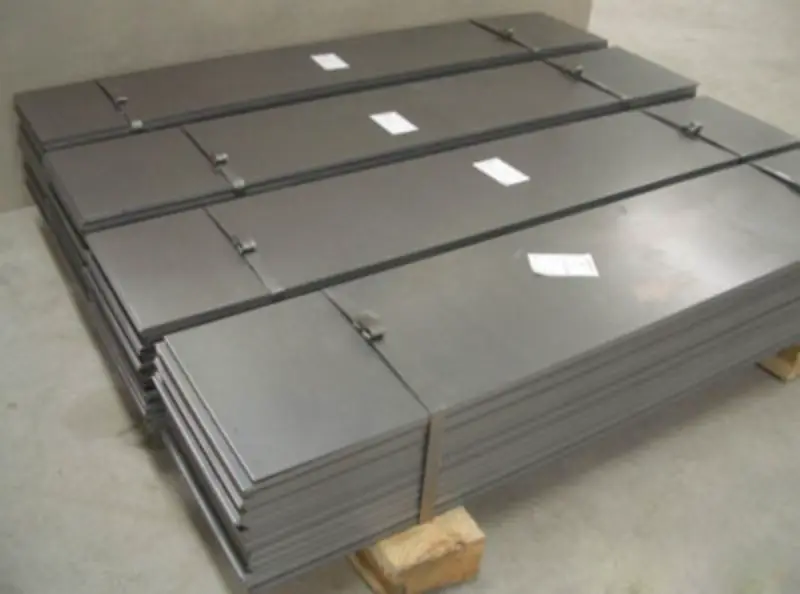
DIN 17102 EStE460 Carbon & Low-Alloy High-Strength Steel Plate
DIN 17102 EStE460 Carbon & Low-Alloy High-Strength Steel Plate - Complete Data
Detailed properties of EStE460 steel to DIN 17102: chemical requirements, tensile and impact properties, thermal and electrical data, international equivalents, and application guidelines for normalised fine-grain weldable structural steel.
Normalising rolling or normalising heat treatment; subsequent hot forming possible; suitable for cold forming within limits; can be welded using all common processes; machining is adequate with carbide tools.
- Phone : +8618037372205
- Email : [email protected]
- WhatsApp: Contact via Whtsapp
- WeChat: +8618037372205
DIN 17102 EStE460 Carbon & Low-Alloy High-Strength Steel Plate Introduction
DIN 17102 EStE460 is a normalised, weldable fine-grain structural steel supplied as plates, wide flats, sections and bars. It belongs to the class of carbon and low-alloy high-strength steels with a minimum yield strength of 460 MPa in the as-delivered normalised condition.
- Main characteristics: high strength combined with good notch toughness at low temperatures, excellent weldability when appropriate heat input is controlled, and fine-grained microstructure achieved by normalising rolling or normalising heat treatment.
- Typically used in bridges, crane constructions, offshore structures, pressure vessels, and heavy machinery where weight savings and reliable low-temperature performance are essential.
- Delivery condition is normalised (N), ensuring uniform mechanical properties and fine grain size meeting the requirements of DIN 17102.
DIN 17102 EStE460 Carbon & Low-Alloy High-Strength Steel Plate Chemical Composition
Ladle analysis according to DIN 17102 Table 1 for EStE460. Fine-grain practice with aluminium or other grain-refining elements is mandatory. Carbon equivalent CEV typically ≤ 0.45% for welding suitability. All values are maximum unless a range is indicated.
| Chemical Element | Standard Value | Remarks |
|---|---|---|
| C | ≤ 0.20 | ladle analysis |
| Si | ≤ 0.50 | ladle analysis |
| Mn | 1.00 – 1.70 | ladle analysis |
| P | ≤ 0.030 | ladle analysis |
| S | ≤ 0.025 | ladle analysis |
| Al (total) | ≥ 0.020 | fine-grain practice; acid-soluble Al ≥ 0.015 |
| N | ≤ 0.020 | ladle analysis; may be limited by Al |
| Nb* | ≤ 0.05 | optional microalloy; may be present |
| V* | ≤ 0.10 | optional microalloy; may be present |
| Ti* | ≤ 0.05 | optional microalloy; may be present |
| Cr+Cu+Ni | ≤ 0.70 | combined limit for residuals |
| Mo* | ≤ 0.10 | if intentionally added |
| CEV | ≤ 0.45 | typical maximum for given thickness range (≤ 50 mm); formula: C+Mn/6+(Cr+Mo+V)/5+(Ni+Cu)/15 |
DIN 17102 EStE460 Carbon & Low-Alloy High-Strength Steel Plate Thermal and Electrical Physical Properties
Ambient-temperature data representative for low‑alloy normalised structural steels. Thermal properties vary moderately with temperature; the values given apply to the temperature range 20–100 °C unless stated.
| Property | Standard Requirement Value | Unit | Testing Condition |
|---|---|---|---|
| Density (ρ) | 7.85 | g/cm³ | ambient temperature |
| Modulus of elasticity (E) | 210 | GPa | ambient temperature |
| Shear modulus (G) | ~81 | GPa | calculated; ambient |
| Poisson's ratio (ν) | 0.3 | – | ambient temperature |
| Thermal expansion coefficient (α) | 12.0 × 10⁻⁶ | K⁻¹ | 20–100 °C |
| Thermal expansion coefficient (α) | 12.8 × 10⁻⁶ | K⁻¹ | 20–200 °C |
| Thermal expansion coefficient (α) | 13.5 × 10⁻⁶ | K⁻¹ | 20–400 °C |
| Thermal conductivity (λ) | ~50 | W/(m·K) | ambient temperature |
| Specific heat capacity (cp) | ~460 | J/(kg·K) | ambient temperature |
| Electrical resistivity (ρe) | 0.15 – 0.25 | µΩ·m | ambient temperature |
DIN 17102 EStE460 Carbon & Low-Alloy High-Strength Steel Plate Mechanical Properties
Minimum requirements for the normalised delivery condition tested in the longitudinal direction at room temperature unless otherwise indicated. Impact energy is guaranteed at -20 °C for grade EStE460 (E = minimum 27 J at -20 °C). Thickness ranges define property levels.
| Property | Standard Requirement Value | Unit | Testing Condition |
|---|---|---|---|
| Yield strength ReH (t ≤ 16 mm) | ≥ 460 | MPa | transverse/longitudinal, room temperature |
| Yield strength ReH (16 < t ≤ 35 mm) | ≥ 450 | MPa | transverse/longitudinal, room temperature |
| Yield strength ReH (35 < t ≤ 50 mm) | ≥ 440 | MPa | transverse/longitudinal, room temperature |
| Yield strength ReH (50 < t ≤ 70 mm) | ≥ 410 | MPa | transverse/longitudinal, room temperature |
| Yield strength ReH (70 < t ≤ 100 mm) | ≥ 390 | MPa | transverse/longitudinal, room temperature |
| Tensile strength Rm (t ≤ 16 mm) | 530 – 720 | MPa | transverse/longitudinal, room temperature |
| Tensile strength Rm (16 < t ≤ 35 mm) | 500 – 720 | MPa | transverse/longitudinal, room temperature |
| Tensile strength Rm (35 < t ≤ 50 mm) | 480 – 720 | MPa | transverse/longitudinal, room temperature |
| Tensile strength Rm (50 < t ≤ 70 mm) | 470 – 720 | MPa | transverse/longitudinal, room temperature |
| Tensile strength Rm (70 < t ≤ 100 mm) | 450 – 720 | MPa | transverse/longitudinal, room temperature |
| Elongation after fracture A (t ≤ 40 mm, L0=5.65√S0) | ≥ 17 | % | longitudinal |
| Elongation after fracture A (t > 40 mm, L0=5.65√S0) | ≥ 18 | % | longitudinal |
| Bend test (mandrel diameter, t ≤ 16 mm) | 3t | – | 180° bend, no cracks |
| Bend test (mandrel diameter, 16 < t ≤ 35 mm) | 4t | – | 180° bend, no cracks |
| Bend test (mandrel diameter, 35 < t ≤ 50 mm) | 5t | – | 180° bend, no cracks |
| Bend test (mandrel diameter, 50 < t ≤ 100 mm) | 6t | – | 180° bend, no cracks |
| Impact energy KV (longitudinal, -20 °C) | ≥ 27 | J | Charpy-V, average of 3 tests, min individual 70% of average |
DIN 17102 EStE460 Carbon & Low-Alloy High-Strength Steel Plate Completely Equivalent Material Standards and Substitutable Grade Recommendations
| Country/Region | Standard | Designation/Grade | Remarks |
|---|---|---|---|
| Europe (EN) | EN 10025-3 | S460N | Normalised fine-grain steel; same yield class, -20 °C impact (27 J). Direct replacement. |
| United Kingdom (obsolete) | BS 4360:1990 | 460E | Withdrawn; equivalent to EStE460 in thickness and properties. |
| Germany (DIN, historical) | DIN 17102 | EStE460 | Exact identity; original standard now superseded by EN 10025-3. |
DIN 17102 EStE460 Carbon & Low-Alloy High-Strength Steel Plate Application Introduction
EStE460 is engineered for heavy structural applications that demand high load‑bearing capacity, reliable low‑temperature toughness, and good fabrication properties. Deliveries are usually in normalised condition, facilitating consistence in forming and welding. The fine‑grained microstructure ensures that mechanical properties are maintained even after hot working following normalising.
Product Applications: Welded plate girders and box girders, Heavy‑duty crane booms and chassis, Offshore deck structures and legs, Water pipes and penstocks, High‑pressure storage tanks and spheres, Wind tower shell sections, Industrial frames and construction machinery
Processed into products: Bridge main beams and orthotropic decks, Crane main chords and outriggers, Platform legs and conductor guides, Penstock segments and bifurcations, Heavy‑duty gears, spindles, shaft housings (when machined from plate), Structural nodes and connection plates in seismic‑resistant frames, Lifting eyes and forged structural parts after normalising
Application industries: Bridge and highway engineering, Offshore platforms and marine structures, Crane and heavy lifting equipment, Pressure vessel and penstock manufacturing, Mining and earthmoving machinery, Wind turbine towers and support structures, Shipbuilding (select applications)
DIN 17102 EStE460 Carbon & Low-Alloy High-Strength Steel Plate Closely Related / Similar Alternative Materials
| Country/Region | Standard | Designation/Grade | Remarks |
|---|---|---|---|
| Europe | EN 10025-3 | S460NL | Lower‑temperature toughness (-50 °C); slightly leaner chemistry allowable. |
| USA | ASTM A572/A572M | Grade 65 | Minimum yield 450 MPa, tensile 550 MPa; lower strength but widely available; CEV may differ. |
| USA | ASTM A633/A633M | Grade E | Normalised, minimum yield 415 MPa, -40 °C impact; lower strength, good toughness. |
| China | GB/T 1591 | Q460E | Hot‑rolled high-strength steel; yield 460 MPa, -40 °C impact; chemistry comparable but process not necessarily normalised. |
| Japan | JIS G 3106 | SM570 | Welded structural steel; tensile 570–720 MPa, yield ≥ 460 MPa for t≤16 mm; no guaranteed normalised state; toughness class dependent. |
Notes:
- DIN 17102 has been formally replaced by EN 10025-3; however, EStE460 stock may still be found and certified to the older standard. When ordering according to the EN standard, specify S460N or S460NL including impact test temperature.
- Welding recommendations: low‑hydrogen processes, preheat may be required for thicker sections (> 40 mm) to avoid cold cracking; interpass temperature typically < 250 °C; heat input 1.5–3.5 kJ/mm for fine‑grain structural steel.
- Strain ageing and hot forming: If the steel is heavily cold formed and subsequently reheated, the toughness may be reduced; stress‑relief treatment at ~530–580 °C can restore properties.
- The data provided are typical and for general guidance; always refer to the original test certificate for exact batch properties.
- Share



