
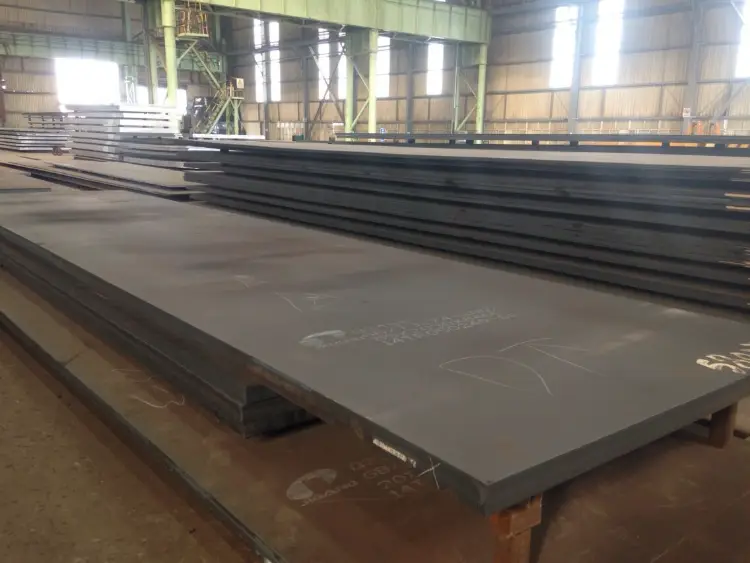
DIN 17102 WStE500 Weldable Fine Grain High-Strength Steel
DIN17102 WStE500: High-Strength Weldable Fine-Grain Structural Steel for Cold Forming
Detailed material data for WStE500 carbon and low-alloy high-strength steel plate according to DIN 17102, covering chemical composition, mechanical and physical properties, international equivalents, and application guidelines.
Suitable for cold forming (bending, flanging, deep drawing), welding (all common methods), and machining
- Phone : +8618037372205
- Email : [email protected]
- WhatsApp: Contact via Whtsapp
- WeChat: +8618037372205
DIN 17102 WStE500 Weldable Fine Grain High-Strength Steel Introduction
WStE500 is a thermomechanically rolled, weldable fine-grain structural steel defined in the withdrawn German standard DIN 17102. It offers a minimum yield strength of 500 MPa and is designed for cold forming and welding without significant loss of strength. The low carbon content and microalloying with elements such as niobium, vanadium, and titanium ensure excellent toughness and formability. Typical applications include highly stressed welded structures in mobile cranes, heavy vehicles, and construction machinery. Key features:
- Minimum yield strength of 500 MPa for thicknesses up to 16 mm
- Good cold formability and weldability
- Fine-grain structure providing high toughness
- Suitable for fatigue-loaded components
DIN 17102 WStE500 Weldable Fine Grain High-Strength Steel Chemical Composition
The chemical composition according to DIN 17102 for WStE500 is based on ladle analysis. The steel is microalloyed with niobium, vanadium, and/or titanium to achieve fine grain size and high strength. The low carbon equivalent ensures good weldability. Limits are as follows:
| Chemical Element | Standard Value (max unless range) | Remarks |
|---|---|---|
| Carbon (C) | ≤ 0.12 | For thickness ≤ 16 mm; for thicker products carbon may be slightly higher |
| Silicon (Si) | ≤ 0.60 | Typical range 0.10–0.50 |
| Manganese (Mn) | ≤ 1.70 | May be reduced to ≤ 1.50 for thickness > 16 mm |
| Phosphorus (P) | ≤ 0.035 | |
| Sulfur (S) | ≤ 0.030 | |
| Aluminium (Al total) | ≥ 0.015 | Minimum for fine grain practice |
| Niobium (Nb) | ≤ 0.09 | Typical microalloying element |
| Vanadium (V) | ≤ 0.20 | Optional microalloying |
| Titanium (Ti) | ≤ 0.22 | Optional microalloying |
| Nitrogen (N) | ≤ 0.020 | Max limit |
| Carbon Equivalent (CEV) | ≤ 0.47 (typical) | Based on formula CEV = C + Mn/6 + (Cr+Mo+V)/5 + (Ni+Cu)/15 |
DIN 17102 WStE500 Weldable Fine Grain High-Strength Steel Thermal and Electrical Physical Properties
Physical properties are not specified in DIN 17102. The following typical values for low-alloy high-strength steels of similar composition and density are provided for design guidance. Properties are valid at room temperature unless otherwise noted.
| Property | Standard Value (Typical) | Unit | Test Condition |
|---|---|---|---|
| Density (ρ) | 7.85 | g/cm³ | At 20 °C |
| Elastic Modulus (E) | 210 | GPa | At 20 °C |
| Shear Modulus (G) | ~81 | GPa | At 20 °C |
| Poisson's Ratio (ν) | 0.3 | — | At 20 °C |
| Thermal Expansion Coefficient (α) | 11.1 | 10⁻⁶/K | Range 20–100 °C |
| Thermal Expansion Coefficient (α) | 12.5 | 10⁻⁶/K | Range 20–200 °C |
| Thermal Expansion Coefficient (α) | 13.5 | 10⁻⁶/K | Range 20–400 °C |
| Thermal Conductivity (λ) | 52 | W/(m·K) | At 20 °C |
| Thermal Conductivity (λ) | 48 | W/(m·K) | At 100 °C |
| Specific Heat Capacity | ~460 | J/(kg·K) | At 20 °C |
| Electrical Resistivity (ρ_e) | ~0.25 | Ω·mm²/m | At 20 °C |
DIN 17102 WStE500 Weldable Fine Grain High-Strength Steel Mechanical Properties
Mechanical properties specified in DIN 17102 for WStE500 in thermomechanically rolled condition (+M). Values are valid for transverse test pieces of flat products. Requirements depend on thickness range.
| Property | Standard Requirement | Unit | Test Condition / Remarks |
|---|---|---|---|
| Yield Strength (ReH) min. | 500 | MPa | Thickness ≤ 16 mm |
| Yield Strength (ReH) min. | 480 | MPa | Thickness 16 < t ≤ 40 mm |
| Yield Strength (ReH) min. | 460 | MPa | Thickness 40 < t ≤ 63 mm |
| Tensile Strength (Rm) | 600–750 | MPa | Thickness ≤ 16 mm |
| Tensile Strength (Rm) | 580–730 | MPa | Thickness 16 < t ≤ 40 mm |
| Tensile Strength (Rm) | 560–710 | MPa | Thickness 40 < t ≤ 63 mm |
| Elongation after fracture (A5) min. | 17 | % | Thickness ≤ 16 mm, gauge length 5.65√S₀ |
| Elongation after fracture (A5) min. | 17 | % | Thickness 16 < t ≤ 40 mm |
| Elongation after fracture (A5) min. | 17 | % | Thickness 40 < t ≤ 63 mm |
| Bend Test (Bend Angle 180°) | Mandrel diameter = 2t | — | t = thickness of test piece; no cracking |
| Impact Energy (KV) at -20 °C, min. | 27 | J | Longitudinal, V-notch; optional (agreed upon order) |
DIN 17102 WStE500 Weldable Fine Grain High-Strength Steel Identical Equivalent Material Standards and Substitute Grades
| Country/Region | Standard | Grade | Remarks |
|---|---|---|---|
| European Union | EN 10149-2: 2013 | S500MC | Direct successor; thermomechanically rolled, minimum yield 500 MPa, same application |
| International | ISO 6930-2: 2004 | FeE500VK | Equivalent high yield strength steel for cold forming |
DIN 17102 WStE500 Weldable Fine Grain High-Strength Steel Application Introduction
WStE500 is used in welded steel constructions where high strength, good cold formability, and excellent toughness are required. It allows for weight reduction and improved payload in mobile equipment. Common usage scenarios include:
Product Applications: Boom sections and outriggers for mobile cranes, Chassis frames and structural members of heavy-duty trucks, Excavator buckets and loader arms, Offshore platform structural elements, Welded bridge girders and box sections, Pressure vessels and silos (when toughness at low temp is needed)
Processed into products: Crane telescopic booms and lattice structures, Dump truck bodies, Trailer side rails and cross members, Excavator dipper arms, Wind turbine tower flanges (if thin plate is used), Welded structural nodes and gusset plates
Application industries: Construction machinery and mining equipment, Heavy transport and trailer manufacturing, Mobile crane manufacturing, Offshore and shipbuilding, Bridge engineering, Earth-moving and agricultural machinery
DIN 17102 WStE500 Weldable Fine Grain High-Strength Steel Similar/Comparable Substitute Material Recommendations
| Country/Region | Standard | Grade | Remarks |
|---|---|---|---|
| Germany (historical) | DIN 17102 | WStE460 | Lower yield strength (460 MPa) but same formability; can be used if strength requirements allow |
| Germany (historical) | DIN 17102 | WStE550 | Higher yield strength (550 MPa) but slightly reduced elongation |
| European Union | EN 10149-2 | S550MC | Higher strength grade (min 550 MPa) with similar forming and welding characteristics |
| European Union | EN 10025-6 | S500QL | Quenched and tempered high-strength steel with 500 MPa min yield, but different delivery condition |
| USA | ASTM A1011/A1011M | Grade 70 (480 MPa) or Grade 80 (550 MPa) | HSLA steel; close strength levels but specifications differ |
| Japan | JIS G 3134 | SPFH 590 | Hot-rolled high-strength steel sheet for automobile structural uses; comparable strength |
Notes:
Important considerations:
- Welding procedures should follow guidelines for thermomechanically rolled fine-grain steels; low hydrogen processes are recommended.
- The material is not intended for hot forming above 580 °C as this may reduce the strength gained from thermomechanical rolling.
- For thicknesses above 63 mm, properties may not be covered by the original DIN 17102; consult EN 10149-2 or the manufacturer.
- When substituting with S500MC, confirm that the required minimum elongation and impact energy match the application, as EN 10149-2 allows optional impact requirements.
- Normalized rolling (+N) variants were also available historically, but +M is the standard delivery condition for WStE500.
- Share



