
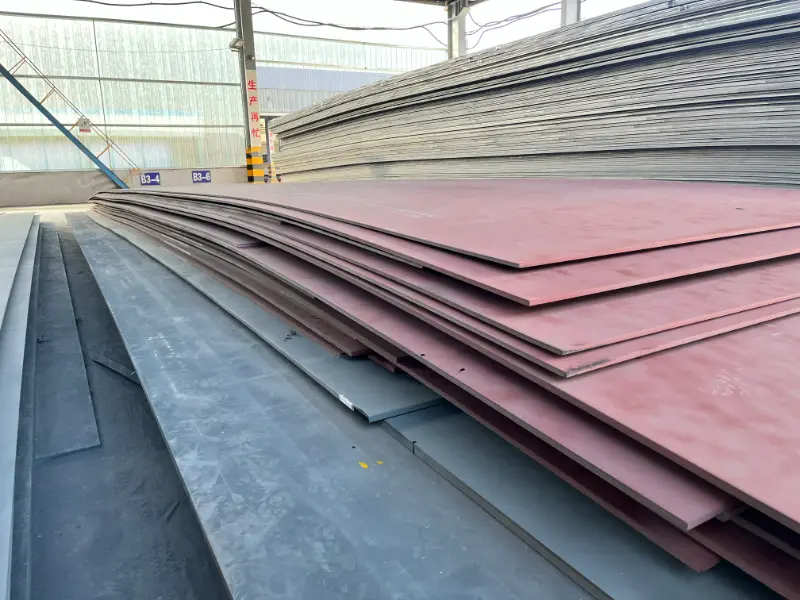
TStE500 (DIN 17102) High-Strength Fine-Grain Structural Steel
TStE500 (DIN 17102) High-Strength Fine-Grain Structural Steel - Complete Material Guide
Detailed material data for TStE500 according to DIN 17102, including chemical composition, mechanical and physical properties, equivalent grades, and application guidance for welded structures.
Hot rolling, thermomechanical rolling (TMCP), welding, cold forming (limited), cutting, bending, machining
- Phone : +8618037372205
- Email : [email protected]
- WhatsApp: Contact via Whtsapp
- WeChat: +8618037372205
TStE500 High-Strength Fine-Grain Structural Steel Introduction
TStE500 is a weldable fine-grain structural steel with a minimum yield strength of 500 MPa, originally specified in DIN 17102 (now superseded by EN 10025-4). It is produced through a thermomechanical rolling (TMCP) process that refines the grain structure, ensuring both high strength and excellent toughness at low temperatures. The steel offers good weldability and cold formability for its strength level, making it suitable for heavily loaded structures in civil engineering, transportation, and machinery.
- Minimum yield strength of 500 MPa, enabling weight reduction through thinner sections.
- Guaranteed impact energy values at temperatures down to -20 °C (or -50 °C for the 'L' variant).
- Good weldability due to a low carbon equivalent (CEV) and controlled alloying elements.
- Available as heavy plates, hot-rolled strips, and wide flats in thicknesses up to approx. 80 mm.
TStE500 High-Strength Fine-Grain Structural Steel Chemical Composition
The composition limits reflect the requirements for a fine-grain thermomechanical rolled steel with 500 MPa yield strength, ensuring good weldability and toughness. Values are based on EN 10025-4:2019 for grade S500M, which is the direct successor to TStE500.
- Carbon is kept low (≤ 0.16 %) to preserve weldability and toughness.
- Manganese provides solid-solution strengthening; silicon acts as a deoxidizer.
- Microalloying elements (Nb, V, Ti) contribute to grain refinement and precipitation hardening.
- Low phosphorus and sulfur contents ensure excellent through-thickness properties and resistance to brittle fracture.
- The carbon equivalent value (CEV) is typically ≤ 0.47 % for thicknesses ≤ 40 mm, slightly higher for thicker products.
| Element | Value (max or range, %) | Remarks |
|---|---|---|
| C (Carbon) | ≤ 0.16 | For thickness > 100 mm, max. 0.18 % |
| Si (Silicon) | ≤ 0.55 | Typical range 0.10–0.50 % |
| Mn (Manganese) | ≤ 1.70 | For improved hardenability control |
| P (Phosphorus) | ≤ 0.030 | For 'ML' option ≤ 0.025 % |
| S (Sulfur) | ≤ 0.025 | For 'ML' option ≤ 0.020 % |
| Nb (Niobium) | ≤ 0.09 | Microalloying for grain refinement |
| V (Vanadium) | ≤ 0.12 | Contributes to precipitation hardening |
| Ti (Titanium) | ≤ 0.20 | Used for nitrogen fixation and grain refinement |
| Al total (Aluminum) | ≥ 0.020 | Grain refining and deoxidation |
| Cr (Chromium) | ≤ 0.30 | Residual element |
| Ni (Nickel) | ≤ 0.30 | Residual element |
| Mo (Molybdenum) | ≤ 0.10 | Residual element |
| Cu (Copper) | ≤ 0.40 | Residual element |
| N (Nitrogen) | ≤ 0.015 | Combined with Ti to avoid free N |
| CEV (Carbon equivalent) | ≤ 0.47 (typical) | CEV = C + Mn/6 + (Cr+Mo+V)/5 + (Ni+Cu)/15 |
TStE500 High-Strength Fine-Grain Structural Steel Thermal and Electrical Physical Properties
The physical properties listed are typical for fine-grain structural steels with similar composition and density. They are not specified in the product standard but are essential for design calculations, heating/cooling processes, and welding.
- Density is assumed to be 7850 kg/m³ for all practical calculations.
- Thermal conductivity and specific heat capacity are temperature dependent; the tables provide room temperature values and coefficients up to 200 °C.
- Electrical resistivity is given at room temperature and may increase with temperature.
| Property | Typical Value | Unit | Condition / Temperature |
|---|---|---|---|
| Density (ρ) | 7.85 | g/cm³ | At 20 °C |
| Modulus of elasticity (E) | 210 | GPa | At 20 °C |
| Shear modulus (G) | 81 | GPa | At 20 °C (calculated from E and ν) |
| Poisson's ratio (ν) | 0.3 | – | At 20 °C |
| Thermal expansion coefficient (α) | 12.5 × 10⁻⁶ | K⁻¹ | 20 – 100 °C |
| Thermal expansion coefficient (α) | 13.5 × 10⁻⁶ | K⁻¹ | 20 – 200 °C |
| Thermal conductivity (λ) | 48 | W/(m·K) | At 20 °C |
| Thermal conductivity (λ) | 45 | W/(m·K) | At 200 °C |
| Specific heat capacity (cₚ) | 460 | J/(kg·K) | At 20 – 100 °C |
| Electrical resistivity (ρₑ) | 0.25 | Ω·mm²/m | At 20 °C |
TStE500 High-Strength Fine-Grain Structural Steel Mechanical Properties
The mechanical properties are specified for the thermomechanical rolled condition. Values depend on product thickness. Minimum yield strength is 500 MPa for thicknesses ≤ 16 mm; decreases for thicker sections. Tensile strength is typically 610–770 MPa. Impact energy is guaranteed at -20 °C for the basic S500M and at -50 °C for S500ML.
- Tests are performed in accordance with EN ISO 6892-1 for tensile testing and EN ISO 148-1 for Charpy impact tests.
- Bend tests (transverse specimens) show the steel can be cold-formed to tight radii without cracking.
- Elongation values decrease slightly with increasing thickness.
| Property | Value | Unit | Test Condition / Remarks |
|---|---|---|---|
| Yield strength (ReH) | ≥ 500 | MPa | Thickness ≤ 16 mm |
| Yield strength (ReH) | ≥ 480 | MPa | Thickness > 16 mm to ≤ 40 mm |
| Yield strength (ReH) | ≥ 470 | MPa | Thickness > 40 mm to ≤ 63 mm |
| Yield strength (ReH) | ≥ 450 | MPa | Thickness > 63 mm to ≤ 80 mm |
| Yield strength (ReH) | ≥ 440 | MPa | Thickness > 80 mm to ≤ 100 mm |
| Tensile strength (Rm) | 610 – 770 | MPa | Thickness ≤ 40 mm |
| Tensile strength (Rm) | 580 – 740 | MPa | Thickness > 40 mm to ≤ 63 mm |
| Tensile strength (Rm) | 560 – 720 | MPa | Thickness > 63 mm to ≤ 80 mm |
| Tensile strength (Rm) | 540 – 700 | MPa | Thickness > 80 mm to ≤ 100 mm |
| Elongation (A5) | ≥ 17 | % | Thickness ≤ 40 mm, transverse specimen |
| Elongation (A5) | ≥ 16 | % | Thickness > 40 mm to ≤ 63 mm |
| Elongation (A5) | ≥ 15 | % | Thickness > 63 mm to ≤ 80 mm |
| Elongation (A5) | ≥ 14 | % | Thickness > 80 mm to ≤ 100 mm |
| Charpy impact (KV₂) | ≥ 40 (average) | J | at -20 °C (for S500M basis) – longitudinal |
| Charpy impact (KV₂) | ≥ 27 (average) / ≥ 19 (single) | J | at -50 °C (for S500ML option) – longitudinal |
| Bend test | No cracks | — | Mandrel diameter = 3a (thickness a), 180° bend, transverse specimen, thickness ≤ 16 mm |
| Bend test | No cracks | — | Mandrel diameter = 4a, for thicknesses > 16 mm |
TStE500 High-Strength Fine-Grain Structural Steel Fully Equivalent Material Standards & Substitute Grades
| Country/Region | Standard | Grade | Remarks |
|---|---|---|---|
| Europe (EU) | EN 10025-4:2019 | S500M / S500ML | Direct successor to TStE500. 'M' for thermomechanical rolled, 'ML' for enhanced low-temperature toughness. |
| International (ISO) | ISO 4951-2:2023 | S500M / S500ML | Identical technical requirements to EN 10025-4. |
| Germany | DIN EN 10025-4:2019 | S500M / S500ML | National adoption of European standard, replaces DIN 17102. |
TStE500 High-Strength Fine-Grain Structural Steel Application Introduction
TStE500 is chosen for weight-sensitive, welded structures that demand high strength and good toughness. Its thermomechanical processing ensures a fine grain size, which provides an excellent balance of strength and ductility. The steel is suitable for both shop and site welding using standard procedures, provided preheat and heat input are controlled. Typical applications range from mobile crane booms and heavy machinery frames to long-span bridges and offshore platform components.
- Ideal for parts subjected to dynamic loading, such as bridges and wind towers.
- Can be cold-formed to tight radii despite its high strength, facilitating the production of closed profiles.
- Commonly supplied in thicknesses from 6 mm to 80 mm, but thicker plates are also available under agreement.
Product Applications: Welded bridge girders and box sections, Crane booms (mobile, crawler, tower cranes), Heavy-duty truck and trailer chassis, Mining dump truck bodies and excavator booms, Offshore drilling rig structures and subsea frames, Wind turbine tower shells and adapter rings, Hydraulic cylinders and piston rods (from thick plates), Cold-formed hollow sections for architectural structures
Processed into products: Flanges and webs for plate girders, Gusset plates, stiffeners, and end plates in steel frames, Boom segments and luffing frames for mobile cranes, Buckets and cutting edges for excavators and loaders, Jacket legs, braces, and nodes for offshore platforms, Base rings and nacelle beds for wind turbines, Reinforcement plates in pressure vessels, Welded H-beams and columns for high-rise construction
Application industries: Heavy machinery and equipment manufacturing, Bridge and structural engineering, Offshore and marine engineering, Mining and earthmoving equipment, Wind energy (tower sections, flanges), Transportation (rail wagons, heavy vehicles), Pressure vessel and storage tank (for moderate pressure and low-temperature service), Civil engineering (high-rise buildings, stadiums)
TStE500 High-Strength Fine-Grain Structural Steel Similar / Comparable Material Recommendations
| Country/Region | Standard | Grade | Remarks |
|---|---|---|---|
| Europe | EN 10025-3 | S500N / S500NL | Normalised (N) or normalised rolled fine-grain steel. Slightly lower yield strength for some thicknesses, better toughness in thick sections. Suitable substitute if normalised condition is acceptable. |
| Europe | EN 10025-6 | S500Q / S500QL | Quenched and tempered steel with similar strength; better toughness but higher alloy content. Used when superior resistance to brittle fracture is needed. |
| Germany | DIN 17102 (withdrawn) | TStE460 | Previous lower strength grade (460 MPa min. yield). Can be considered if 500 MPa strength is not fully required. |
| USA / International | ASTM A913 / A913M | Grade 70 [500] | Thermomechanical rolled structural steel with min. yield of 500 MPa. Similar concept but slight differences in chemical composition and impact test temperatures. |
| China | GB/T 1591-2018 | Q500D / Q500E | High-strength low-alloy structural steel, D for -20 °C impact, E for -40 °C. Not identical in fine-grain control but comparable for many applications. |
Notes:
Welding recommendations: Due to the thermomechanical production, the heat-affected zone (HAZ) can soften slightly. Welding consumables should match the base metal strength (e.g., E 50xx or ER70S-6 with appropriate strength). Preheating is usually not required for thicknesses up to 30 mm, but a low hydrogen process and proper heat input control are essential.
Cold forming: The minimum bending radius should generally be 3t–4t depending on the thickness and direction relative to rolling. For high edge elongation, intermediate annealing is not typically required.
Surface condition: Plates are supplied as-rolled, shot-blasted, or primed as per customer request.
Testing and certification: Inspection documents 3.1 or 3.2 according to EN 10204 are standard. Additional testing (e.g., ultrasonic testing for internal soundness, Z-quality for through-thickness properties) can be agreed upon.
- Share



