
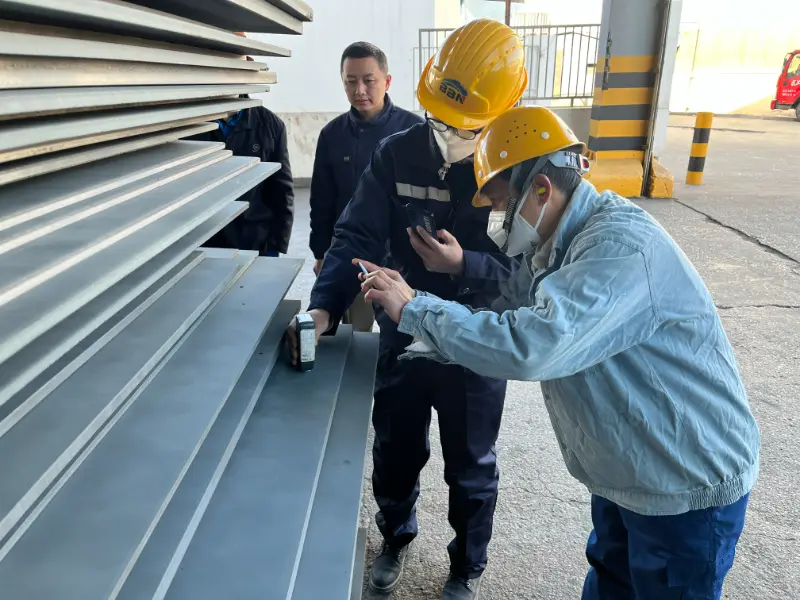
DIN 17102 EStE500 Carbon and Low-alloy High-strength Steel Plate
DIN 17102 EStE500 Carbon and Low-alloy High-strength Steel Plate - Properties & Alternatives
Comprehensive datasheet for EStE500 according to DIN 17102: carbon and low-alloy high-strength weldable normalized fine grain structural steel plate with minimum yield strength 500 MPa. Includes chemistry, mechanical properties, physical data, equivalent grades and applications.
Hot rolling, normalizing, cutting, welding, cold forming (limited), machining
- Phone : +8618037372205
- Email : [email protected]
- WhatsApp: Contact via Whtsapp
- WeChat: +8618037372205
DIN 17102 EStE500 Carbon and Low-alloy High-strength Steel Plate Introduction
EStE500 is a weldable normalized fine-grain structural steel defined in the German standard DIN 17102. It belongs to the low-alloy high-strength steel family, delivering a minimum yield strength of 500 MPa in thicknesses up to 16 mm. The steel is supplied in the normalized condition and is characterised by:
- Excellent combination of high strength and good toughness down to low temperatures
- Fine-grain microstructure achieved through controlled aluminium and microalloy additions (Nb, V, Ti)
- Good weldability using conventional methods with suitable heat input
- Typical applications in heavy-duty welded structures such as bridges, cranes, offshore components and pressure vessels
EStE500 offers reliable mechanical performance and is often selected where high load-bearing capacity and safety are critical.
DIN 17102 EStE500 Carbon and Low-alloy High-strength Steel Plate Chemical Composition
The ladle analysis according to DIN 17102 for steel grade EStE500. Fine grain practice is ensured by aluminium content or other grain-refining elements. Microalloying elements like niobium, vanadium and titanium may be used singly or in combination to achieve the required strength.
- Maximum carbon equivalent (CEV) may be specified for improved weldability.
- Residual elements Cr, Ni, Cu, Mo are limited to control hardenability.
| Element | Value (%) | Remarks |
|---|---|---|
| Carbon (C) | ≤ 0.20 | Depending on thickness; lower C improves weldability |
| Silicon (Si) | ≤ 0.50 | Deoxidation; higher values allowed if Al is not used |
| Manganese (Mn) | 0.90 – 1.70 | Primary strengthening and toughness element |
| Phosphorus (P) | ≤ 0.035 | Max value |
| Sulfur (S) | ≤ 0.030 | Max value for plate; for strip ≤0.025 |
| Aluminium (total Al) | ≥ 0.020 | Required for fine grain practice; min soluble Al may be specified |
| Niobium (Nb) | ≤ 0.05 | Optional microalloy; grain refinement |
| Vanadium (V) | ≤ 0.12 | Optional microalloy; precipitation strengthening |
| Titanium (Ti) | ≤ 0.05 | Optional microalloy; grain refinement |
| Nickel (Ni) | ≤ 0.80 | Residual element; may be higher by agreement |
| Chromium (Cr) | ≤ 0.30 | Residual element |
| Copper (Cu) | ≤ 0.70 | Residual element; may be higher by agreement |
| Molybdenum (Mo) | ≤ 0.20 | Residual element |
| Nitrogen (N) | ≤ 0.015 | For Al-treated steel; higher if sufficient nitride formers present |
| CEV max | ~0.45 – 0.47 | Typical for thickness ≤63 mm; depends on product analysis |
DIN 17102 EStE500 Carbon and Low-alloy High-strength Steel Plate Thermal and Electrical Physical Properties
Physical properties are not part of DIN 17102 but are representative for carbon-manganese microalloyed steels of similar composition. Values are valid at room temperature except where noted.
- Thermal expansion coefficient is average over the stated temperature range.
- Thermal conductivity decreases with rising temperature.
- Electrical resistivity increases with temperature for metals.
| Property | Typical Value | Unit | Condition / Temperature |
|---|---|---|---|
| Density (ρ) | 7.85 | g/cm³ | 20 °C |
| Elastic modulus (E) | 210 | GPa | 20 °C, static |
| Shear modulus (G) | 81 | GPa | 20 °C, calculated from E and ν |
| Poisson's ratio (ν) | 0.3 | – | Elastic range, room temperature |
| Thermal expansion coefficient (α) | 12.0 | ×10⁻⁶ /K | 20 – 100 °C |
| Thermal expansion coefficient (α) | 12.5 | ×10⁻⁶ /K | 20 – 200 °C |
| Thermal expansion coefficient (α) | 13.0 | ×10⁻⁶ /K | 20 – 300 °C |
| Thermal conductivity (λ) | 50 | W/(m·K) | 20 °C |
| Thermal conductivity (λ) | 45 | W/(m·K) | 100 °C |
| Specific heat capacity | 460 | J/(kg·K) | 20 °C |
| Electrical resistivity (ρ_e) | 0.25 | ×10⁻⁶ Ω·m | 20 °C |
DIN 17102 EStE500 Carbon and Low-alloy High-strength Steel Plate Mechanical Properties
Mechanical properties at room temperature according to DIN 17102 for EStE500 in normalized condition. Longitudinal test pieces unless indicated otherwise.
- Tensile test specimens are taken transverse to rolling direction for plates (by agreement).
- Impact energy values apply for Charpy-V longitudinal specimens at -20 °C.
- Bend test requirement: no cracks after bending through 180°.
| Property | Specified Value | Unit | Test Condition |
|---|---|---|---|
| Upper yield strength (ReH) | ≥ 500 | MPa | Thickness ≤ 16 mm |
| Upper yield strength (ReH) | ≥ 480 | MPa | Thickness 16 < t ≤ 35 mm |
| Upper yield strength (ReH) | ≥ 460 | MPa | Thickness 35 < t ≤ 50 mm |
| Upper yield strength (ReH) | ≥ 430 | MPa | Thickness 50 < t ≤ 70 mm |
| Tensile strength (Rm) | 610 – 770 | MPa | Thickness ≤ 50 mm |
| Tensile strength (Rm) | 570 – 730 | MPa | Thickness 50 < t ≤ 70 mm |
| Elongation after fracture (A) | ≥ 17 | % | Longitudinal, gauge length 5.65√So, t ≤ 16 mm |
| Elongation after fracture (A) | ≥ 17 | % | Longitudinal, t > 16 mm |
| Elongation after fracture (A) | ≥ 15 | % | Transverse, all thicknesses |
| Impact energy (KV) at -20 °C | ≥ 27 | J | Longitudinal, average of 3 specimens |
| Impact energy (KV) at -20 °C | ≥ 21 | J | Longitudinal, individual min value |
| Bend test (mandrel diameter) | 2a (no cracks) | – | Thickness ≤ 16 mm, bend angle 180° |
| Bend test (mandrel diameter) | 3a (no cracks) | – | Thickness 16 < t ≤ 50 mm, bend angle 180° |
| Bend test (mandrel diameter) | 4a (no cracks) | – | Thickness 50 < t ≤ 70 mm, bend angle 180° |
DIN 17102 EStE500 Carbon and Low-alloy High-strength Steel Plate Fully Equivalent Material Standards and Substitutable Grades
| Country/Region | Standard | Grade | Remarks |
|---|---|---|---|
| International | ISO 4950-2 | E500 DD / E500 C | High yield strength flat products, normalized; closest chemical and mechanical match |
| Europe | EN 10025-3 | S460N | Similar normalized fine-grain steel, but yield strength 460 MPa (40 MPa lower); acceptable substitute for many applications |
| United Kingdom | BS 4360 | 50E / 50EE | Former British standard, comparable mechanical properties (withdrawn, but reference) |
| Russia | GOST 19281 | 16G2AF / 10G2FB | Approximate high-strength low-alloy grades, normalized |
DIN 17102 EStE500 Carbon and Low-alloy High-strength Steel Plate Application Introduction
EStE500 is engineered for demanding welded steel structures where high static and dynamic loads are present. Its fine-grain microstructure guarantees excellent toughness at low temperatures and allows reductions in section thickness compared to mild steel.
- Preheating and interpass temperature control are essential to avoid cold cracking.
- Suitable for all conventional arc welding processes (SMAW, GMAW, SAW) with low-hydrogen consumables.
- Normalizing after hot forming is recommended to restore mechanical properties if the original heat treatment condition is altered.
Product Applications: Welded plate girders, Box-section columns, Offshore platform components (deck beams, legs), Crane booms and chassis, Penstocks and water turbines, Heavy-duty vehicle frames
Processed into products: Bridged deck plates and cross-beams, Crane main chords and end carriages, Offshore topside modules and flare booms, Pressure vessel shells and heads, Excavator arms and buckets, Welded hollow sections for high-load columns
Application industries: Bridge construction, Crane and heavy lifting equipment, Offshore and marine engineering, Pressure vessel and storage tank manufacturing, Mining and earthmoving machinery, Structural steelwork for high-rise buildings
DIN 17102 EStE500 Carbon and Low-alloy High-strength Steel Plate Similar / Alternative Materials for Comparison
| Country/Region | Standard | Grade | Remarks |
|---|---|---|---|
| Europe | EN 10149-2 | S500MC | Thermomechanically rolled (M), high yield 500 MPa; better formability, but different delivery condition and toughness behaviour |
| USA | ASTM A656/A656M | Grade 80 | Hot-rolled HSLA with min YS 550 MPa (80 ksi); not normalized; may require qualification for welded structures |
| USA | ASTM A572/A572M | Grade 65 | HSLA Nb-V, 450 MPa YS; lower strength, widely available |
| Japan | JIS G 3106 | SM570 | Rolled steel for welded structure, 570 MPa tensile; YS typically 460 MPa, lower than EStE500 |
| China | GB/T 1591 | Q500D | HSLA steel, min YS 500 MPa for t≤16mm; similar concept but different microalloy approach |
Notes:
Welding guidelines: Preheating temperature typically 100–200 °C depending on thickness and heat input. Low hydrogen electrodes (≤5 ml/100g) are strongly recommended. Post-weld heat treatment (PWHT) is generally not required but may be applied for thickness >50 mm to relieve residual stresses (soaking at 550–600 °C). Forming: Cold forming should be limited to mild radii because of high strength; hot forming at 850–1050 °C followed by normalizing is the preferred route. Inspection: Ultrasonic testing to EN 10160 or equivalent is commonly specified for plates used in critical applications. CEV formula: CEV = C + Mn/6 + (Cr+Mo+V)/5 + (Ni+Cu)/15, typically 0.42–0.48 for EStE500 depending on thickness.
- Share



