
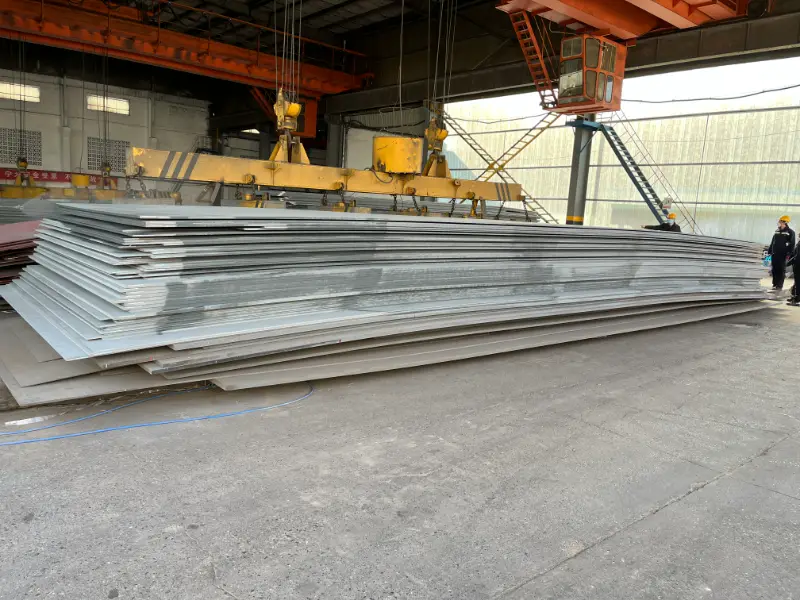
GB/T 700 Q235A Carbon Structural Steel
GB/T 700 Q235A Carbon Structural Steel: Chemical, Mechanical & Physical Properties and International Equivalents
Comprehensive material data for Q235A carbon structural steel according to GB/T 700, including chemical composition, mechanical properties, thermal and electrical performance, equivalent standards, and typical applications.
Welding, gas cutting, plasma cutting, cold bending, roll forming, stamping, forging, hot rolling, normalizing, machining, drilling, and galvanizing.
- Phone : +8618037372205
- Email : [email protected]
- WhatsApp: Contact via Whtsapp
- WeChat: +8618037372205
GB/T 700 Q235A Carbon Structural Steel Introduction
Q235A is a Chinese standard carbon structural steel grade defined in GB/T 700-2006. It belongs to the ordinary carbon steel series, characterized by a minimum yield strength of 235 MPa and good overall mechanical properties. Key features include:
- Low carbon content (≤0.22%) providing excellent weldability and cold formability.
- Moderate tensile strength (370–500 MPa) and satisfactory ductility (elongation ≥26% for thinner sections).
- Widely available in hot-rolled plates, strips, sections, bars, and tubes.
- Predominantly used in general structural engineering, construction, bridges, vehicles, and pressure vessels.
- Quality grade A has no impact test requirement, making it suitable for static or non-critical dynamic loads.
- Can be delivered in as-rolled or normalized condition, with boiling steel (F) or killed steel (Z) options.
Due to its cost-effectiveness and balanced strength-ductility profile, Q235A serves as a workhorse material in heavy industries across China and is globally comparable to grades like S235JR (EN/ISO) and SS400 (JIS).
GB/T 700 Q235A Carbon Structural Steel Chemical Composition
The chemical composition complies with GB/T 700-2006 for grade Q235A. Carbon content is specified by product thickness. Sulfur and phosphorus limits are higher than for grades B, C, D, reflecting the basic quality level. Residual elements (Cr, Ni, Cu) are typically ≤0.30% each but are not specifically restricted for this grade unless required by the purchaser.
| Element | Standard Value (wt%) | Remarks |
|---|---|---|
| Carbon (C) | ≤0.22 | Applicable to product thickness ≤16 mm |
| Carbon (C) | ≤0.20 | Applicable to product thickness >16 mm to ≤40 mm (for thickness >40 mm by agreement) |
| Silicon (Si) | ≤0.35 | Unless otherwise specified for killed steel |
| Manganese (Mn) | ≤1.40 | For thickness >40 mm, Mn content may be increased by agreement |
| Phosphorus (P) | ≤0.045 | |
| Sulfur (S) | ≤0.050 | |
| Nitrogen (N) | ≤0.008 (if Al added) | Applicable only to aluminum-killed or aluminum-silicon killed fine-grain steel, not a general requirement for Q235A |
GB/T 700 Q235A Carbon Structural Steel Thermal and Electrical Physical Properties
The following values are typical for carbon structural steel of this grade at room temperature, unless otherwise indicated. They are not mandatory requirements of GB/T 700 but serve as engineering design guides. Variations may occur depending on exact composition, microstructure, and processing history. Temperature-dependent properties are given for common conditions.
| Property | Typical Value | Unit | Test Condition / Remarks |
|---|---|---|---|
| Density (ρ) | 7.85 | g/cm³ | At 20 °C |
| Modulus of elasticity (E) | 200–210 | GPa | Room temperature |
| Shear modulus (G) | ~80 | GPa | Estimated from E and ν |
| Poisson's ratio (ν) | 0.30–0.31 | — | Ambient temperature |
| Thermal expansion coefficient (α) | 12.0 | 10⁻⁶/K | 20 °C to 100 °C |
| Thermal expansion coefficient (α) | 12.5 | 10⁻⁶/K | 20 °C to 200 °C |
| Thermal expansion coefficient (α) | 13.0 | 10⁻⁶/K | 20 °C to 300 °C |
| Thermal conductivity (λ) | 53 | W/(m·K) | At 20 °C |
| Thermal conductivity (λ) | 50 | W/(m·K) | At 100 °C |
| Thermal conductivity (λ) | 45 | W/(m·K) | At 300 °C |
| Specific heat capacity (cₚ) | ~460 | J/(kg·K) | Room temperature |
| Electrical resistivity (ρₑ) | ~0.15 | 10⁻⁶ Ω·m | At 20 °C |
GB/T 700 Q235A Carbon Structural Steel Mechanical Properties
Mechanical properties are determined on test samples taken from the delivery condition. Yield strength decreases with increasing thickness, while tensile strength remains constant across the thickness range. Elongation is measured on a gauge length of 5.65√S₀ (A). Bending test is performed at room temperature; the mandrel diameter is expressed as a multiple of specimen thickness (a). Impact testing is not required for grade Q235A. Where multiple conditions exist, values are shown in separate rows.
| Property | Requirement | Unit | Test Condition / Thickness |
|---|---|---|---|
| Yield strength (ReH) | ≥235 | MPa | Thickness ≤16 mm |
| Yield strength (ReH) | ≥225 | MPa | 16 mm < Thickness ≤40 mm |
| Yield strength (ReH) | ≥215 | MPa | 40 mm < Thickness ≤60 mm |
| Yield strength (ReH) | ≥205 | MPa | 60 mm < Thickness ≤100 mm |
| Yield strength (ReH) | ≥195 | MPa | 100 mm < Thickness ≤150 mm |
| Yield strength (ReH) | ≥185 | MPa | 150 mm < Thickness ≤200 mm |
| Tensile strength (Rm) | 370–500 | MPa | All thicknesses |
| Elongation after fracture (A) | ≥26 | % | Thickness ≤40 mm |
| Elongation after fracture (A) | ≥25 | % | 40 mm < Thickness ≤60 mm |
| Elongation after fracture (A) | ≥24 | % | 60 mm < Thickness ≤100 mm |
| Elongation after fracture (A) | ≥22 | % | 100 mm < Thickness ≤150 mm |
| Elongation after fracture (A) | ≥21 | % | 150 mm < Thickness ≤200 mm |
| Bend test (mandrel diameter) | d = a | — | Longitudinal specimen, thickness ≤60 mm |
| Bend test (mandrel diameter) | d = 1.5a | — | Transverse specimen, thickness ≤60 mm |
| Bend test (mandrel diameter) | d = 2a | — | Thickness >60 mm to 100 mm |
| Bend test (mandrel diameter) | By agreement | — | Thickness >100 mm to 200 mm |
| Impact energy (KV₂) | Not required | J | Grade A – no impact test specified |
GB/T 700 Q235A Carbon Structural Steel Completely Equivalent Material Standards and Replaceable Grades
| Country/Region | Standard | Grade | Remarks |
|---|---|---|---|
| China | GB/T 700-2006 | Q235A | Original grade; base of comparison |
| International (ISO) | ISO 630-2:2011 | S235JR | Closest international match; identical yield class, similar C/Mn/P/S |
| Europe (EU) | EN 10025-2:2019 | S235JR | Harmonized with ISO; optional impact at +20 °C (JR) not mandated for Q235A but may be ordered |
| Japan | JIS G3101:2020 | SS400 | Yield ≥245 MPa for t≤16 mm; chemical composition less restrictive; accepted substitute in many projects |
| USA | ASTM A283/A283M-18 | Grade D | Yield 230 MPa (t≤20 mm); tensile 415–530 MPa; P max 0.035, S max 0.040 – slightly stricter chemistry |
| Australia / New Zealand | AS/NZS 3678:2016 | G250 | Yield 250 MPa; comparable in structural applications; verify P/S limits |
GB/T 700 Q235A Carbon Structural Steel Application Introduction
Q235A is a versatile low-carbon structural steel widely employed in general construction and engineering. Its good weldability, machinability, and cold forming characteristics allow it to be fabricated into a broad range of products for both indoor and outdoor applications. Typical uses are outlined below.
Product Applications: Hot-rolled steel plates and sheets (used for base plates, gussets, stiffeners), Structural sections: I-beams, H-beams, channels, angles, flat bars, Welded and seamless steel pipes, Cold-formed hollow sections (square, rectangular, circular), Reinforcing bars (non-prestressed, general purpose), Steel strips for tube making and roll forming, Forged parts (simple shapes, not high fatigue demand)
Processed into products: Steel frames and columns in multi-story buildings, Bridge girders, trusses, and bracing members, Ship hull plates and stiffeners, Vehicle chassis and body-in-white structural members, Railway wagon underframes, Tank shells and roofs for oil and water storage, Electrical tower lattice legs, Conveyor rollers, brackets, and supports, Welded machine bases and frames
Application industries: Civil engineering and building construction, Bridge and highway infrastructure, Shipbuilding and marine engineering, Railway rolling stock and wagon manufacturing, Automotive and heavy vehicle industries, Storage tank and vessel fabrication, Power transmission and telecommunication towers, Agricultural and mining machinery, General mechanical engineering
GB/T 700 Q235A Carbon Structural Steel Similar / Closely Related Alternative Material Recommendations
| Country/Region | Standard | Grade | Remarks |
|---|---|---|---|
| China | GB/T 700-2006 | Q235B | Higher quality with guaranteed 20 °C impact energy (≥27 J); otherwise same mechanical properties |
| China | GB/T 700-2006 | Q235C | 0 °C impact requirement; suitable for cold regions |
| China | GB/T 700-2006 | Q235D | -20 °C impact requirement; best low-temperature toughness in Q235 series |
| International | ISO 630-2 | S235J0 | Impact test at 0 °C; otherwise equivalent strength; more restrictive chemistry |
| Europe | EN 10025-2 | S235J2 | Impact at -20 °C; suitable where higher toughness is needed; chemistry similar to Q235D |
| USA | ASTM A36/A36M | A36 | Yield 250 MPa; often directly substituted for Q235 in non-critical applications; lower Mn and tighter P/S |
Notes:
Additional notes on Q235A:
- Deoxidation method (F – rimmed, Z – killed, TZ – special killed) shall be specified at the time of order; rimmed steel cannot be used for thickness >25 mm in welded structures subjected to dynamic loading.
- If the steel is to be galvanized, the silicon content should be controlled (≤0.03% or 0.15–0.25%) to ensure coating quality.
- Q235A is not recommended for low-temperature service or primary members requiring guaranteed impact toughness – consider Q235B/C/D in such cases.
- Ultrasonic testing, normalizing, or other supplementary requirements must be agreed upon at the time of enquiry and order.
- International material certification (e.g., CE marking or JIS mark) may require additional testing to demonstrate equivalence.
- Share



