
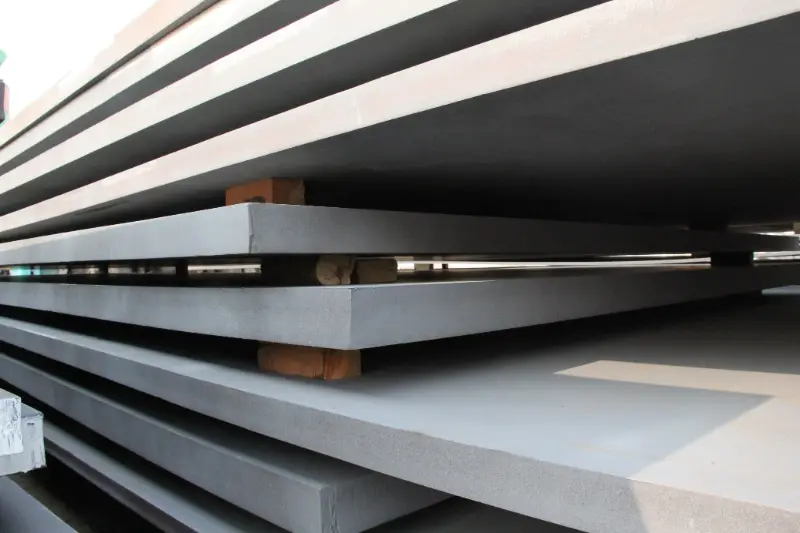
Q235B Carbon Structural Steel Plate per GB/T 700
GB/T 700 Q235B Carbon Structural Steel Plate – Composition, Properties & Equivalents
Comprehensive technical data for Q235B carbon structural steel under GB/T 700-2006: chemical composition, mechanical and physical properties, thermal and electrical performance, international equivalents, and application guidance.
Hot rolling, cold forming, shearing, flame cutting, welding, bending, machining
- Phone : +8618037372205
- Email : [email protected]
- WhatsApp: Contact via Whtsapp
- WeChat: +8618037372205
Q235B Carbon Structural Steel Plate per GB/T 700 Introduction
Q235B is a Chinese standard carbon structural steel grade defined in GB/T 700-2006. It is widely used for general structural purposes due to its good combination of strength, ductility, and weldability. The letter 'Q' stands for yield strength, '235' indicates the minimum yield strength of 235 MPa for thicknesses up to 16 mm, 'B' denotes quality grade with a guaranteed Charpy impact energy of 27 J at 20°C. This steel is typically supplied in hot-rolled condition and can be formed, welded, and machined with conventional methods. It serves as a fundamental material in construction, machinery, and transportation industries.
Q235B Carbon Structural Steel Plate per GB/T 700 Chemical Composition
Chemical composition according to GB/T 700-2006 for the cast analysis. Residual elements (Cr, Ni, Cu) are not specified but may be present up to 0.30% each without intentional addition and do not invalidate the grade. The values below are the maximum limits for Q235B unless a range is given.
| Element | Standard Value (%) | Note |
|---|---|---|
| Carbon (C) | ≤ 0.20 | Applicable for product thickness ≤ 40 mm; for thickness > 40 mm, C ≤ 0.20 is also maintained per GB/T 700. |
| Silicon (Si) | ≤ 0.35 | |
| Manganese (Mn) | ≤ 1.40 | For thickness ≤ 40 mm fused analysis; for > 40 mm, Mn may be adjusted by agreement. |
| Phosphorus (P) | ≤ 0.045 | |
| Sulfur (S) | ≤ 0.045 |
Q235B Carbon Structural Steel Plate per GB/T 700 Thermal and Electrical Physical Properties
The following physical properties are typical for low-carbon steel in hot-rolled condition and are not specified by GB/T 700. They serve as engineering reference values for general calculations and may vary slightly with composition and processing.
| Property | Typical Value | Unit | Test Condition / Remarks |
|---|---|---|---|
| Density (ρ) | 7.85 | g/cm³ | At room temperature |
| Elastic Modulus (E) | 200 – 210 | GPa | Room temperature |
| Shear Modulus (G) | 79.3 | GPa | Calculated from E and ν |
| Poisson's Ratio (ν) | 0.3 | - | In elastic range |
| Thermal Expansion Coefficient (α) | ≈ 12 × 10⁻⁶ | /°C | Between 20 °C and 100 °C |
| Thermal Conductivity (λ) | ≈ 50 | W/(m·K) | At 100 °C |
| Specific Heat Capacity (c) | ≈ 460 | J/(kg·K) | Room temperature |
| Electrical Resistivity (ρₑ) | 0.15 – 0.30 | µΩ·m | At 20 °C |
Q235B Carbon Structural Steel Plate per GB/T 700 Mechanical Properties
Mechanical properties of Q235B are tested at room temperature on transverse specimens from hot-rolled products according to GB/T 700-2006. The yield strength, tensile strength, elongation, and bend diameter depend on product thickness. Charpy impact is guaranteed at 20 °C.
| Property | Standard Requirement Value | Unit | Test Condition / Thickness Range |
|---|---|---|---|
| Yield Strength (ReH) | ≥ 235 | MPa | Thickness ≤ 16 mm |
| Yield Strength (ReH) | ≥ 225 | MPa | Thickness > 16 to ≤ 40 mm |
| Yield Strength (ReH) | ≥ 215 | MPa | Thickness > 40 to ≤ 60 mm |
| Yield Strength (ReH) | ≥ 195 | MPa | Thickness > 60 to ≤ 100 mm |
| Tensile Strength (Rm) | 370 – 500 | MPa | All thicknesses |
| Elongation after fracture (A) | ≥ 26 | % | Thickness ≤ 40 mm, gauge length 5.65√S₀ |
| Elongation after fracture (A) | ≥ 25 | % | Thickness > 40 to ≤ 60 mm |
| Elongation after fracture (A) | ≥ 24 | % | Thickness > 60 to ≤ 100 mm |
| Bend Test (bend angle) | 180° | degree | Bending diameter = 1.5a, for thickness ≤ 60 mm (a=specimen thickness) |
| Bend Test (bend angle) | 180° | degree | Bending diameter = 2a, for thickness > 60 to 100 mm |
| Charpy Impact Energy (KV) | ≥ 27 | J | Longitudinal test, 20 °C, V-notch |
Q235B Carbon Structural Steel Plate per GB/T 700 Fully Equivalent Materials – Direct Substitution Grades
| Country / Region | Standard | Grade | Remarks |
|---|---|---|---|
| USA | ASTM A36/A36M | A36 | Very close chemical and mechanical requirements; CVN impact usually specified at 21 J at -18 °C by order. Commonly substituted. |
| Japan | JIS G3101 | SS400 | Tensile strength 400-510 MPa, yield ≥ 245 MPa (t≤16 mm). No mandatory impact requirement in standard, but can be specified. |
| European Union | EN 10025-2 | S235JR | Yield strength ≥ 235 MPa (t≤16 mm), impact 27 J at 20 °C. Direct equivalence in structural applications. |
| International | ISO 630-2 | S235B | Designed to align with EN grades; impact 27 J at 20 °C. Recognized as equivalent. |
| Germany (historical) | DIN 17100 | St37-2 (S235JR) | Obsoleted but still referenced; similar mechanical properties. Modern replacement is EN S235JR. |
| UK (historical) | BS 4360 | Grade 43B | Obsoleted; comparable to S235JR with 20 °C impact. Replacement grade is S235JR. |
Q235B Carbon Structural Steel Plate per GB/T 700 Application Introduction
Q235B is one of the most versatile carbon structural steels in China. Its balanced strength and ductility make it suitable for a wide range of general engineering and construction applications. It can be readily welded, bolted, and riveted, and is available in various forms to meet different manufacturing needs.
Product Applications: Hot-rolled steel plates and sheets for structural fabrications, Hot-rolled sections: I-beams, H-beams, channels, angles, and flat bars, Welded steel pipes and square/rectangular hollow sections for construction and light fluid transport, Forged or cast components like flanges and simple machinery parts (when specified), Steel wire rods for nails, woven mesh, and low-stress reinforcement
Processed into products: Beam-to-column connections in steel building frames, Bridge girder webs and stiffeners, Tower legs and bracing members for power transmission, Automotive chassis frames and cross members, Storage tank shells and roofs (ambient temperature, non-corrosive service), Brackets, cleats, and base plates for machinery installations, Simplified formwork and support structures for concrete construction
Application industries: Construction and civil engineering (buildings, bridges, transmission towers, scaffolding), Transportation (railway vehicles, truck frames, ship repair parts, container bodies), Machinery manufacturing (frames, brackets, supports, light-duty machine bases), Energy and utilities (low-pressure pipelines, storage tanks, simple pressure vessels with limitations), General fabrication (workshop structures, fences, signboards, agricultural equipment)
Q235B Carbon Structural Steel Plate per GB/T 700 Similar or Alternative Materials for Reference
| Country / Region | Standard | Grade | Remarks |
|---|---|---|---|
| China | GB/T 700 | Q235A | Lower quality grade; no impact test guaranteed. Can replace Q235B only in non-critical, static applications. |
| China | GB/T 700 | Q235C | Higher quality grade; impact guaranteed at 0 °C (27 J). Suitable when low-temperature toughness is required. |
| China | GB/T 700 | Q235D | Highest Q235 quality; impact at -20 °C. For demanding cold-environment structures. |
| China | GB/T 1591 | Q345B | Low-alloy high-strength steel (yield ≥ 345 MPa). Offers higher strength than Q235B; often used in weight-saving designs. |
| USA | ASTM A283/A283M | Grade C | Carbon steel with yield ≥ 205 MPa, tensile 380-515 MPa. Slightly lower strength than Q235B; still used for structural plates. |
| Japan | JIS G3101 | SS330 | Yield ≥ 205 MPa, tensile 330-430 MPa. Weaker than Q235B but may serve in light-duty structures. |
Notes:
- Q235B is not intended for use in heavily loaded pressure vessels (typically require Q345R or equivalent), nor for highly corrosive environments without protective coating.
- When cold forming, the minimum bending radius should comply with the bend test requirements or be verified by a shop trial.
- Welding consumables should be selected to match the tensile strength; preheating may be necessary for thick sections or low ambient temperatures.
- The chemical composition limits for the product analysis may be slightly higher due to method tolerances, as defined by the standard.
- For structural applications under dynamic loading, a suitable quality grade (such as Q235C or Q235D) should be considered to ensure notch toughness.
- Share



