
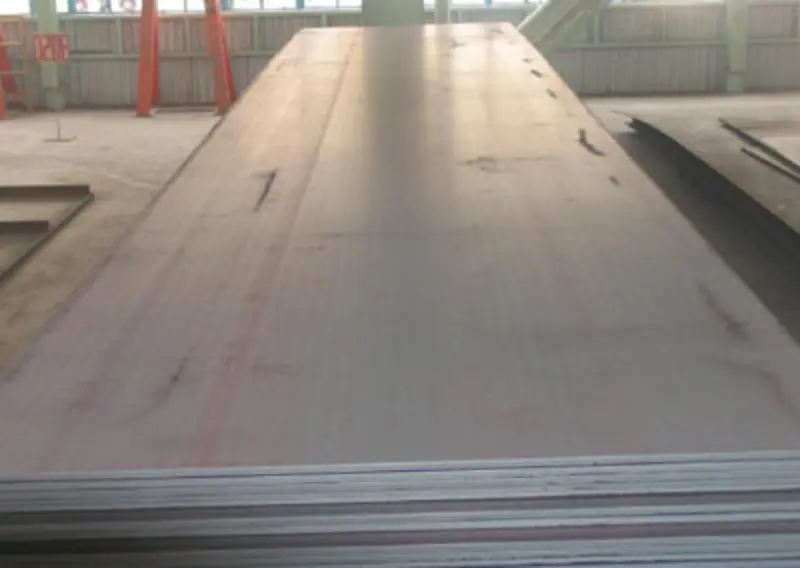
Q235C Carbon Structural Steel Plate: Composition, Properties & Equivalents
Q235C Carbon Structural Steel Plate – GB/T 700 Standard Hot Rolled Ideal for Welded Structures with 0°C Impact Toughness
Q235C is a Chinese standard carbon structural steel grade defined in GB/T 700, featuring good weldability, 0°C impact toughness (min 27 J) and typical tensile strength 370–500 MPa. Available as hot-rolled plates, sheets and sections, it is widely used in general construction and machinery.
Hot rolling, cold forming, welding, shearing, flame cutting, drilling, machining
- Phone : +8618037372205
- Email : [email protected]
- WhatsApp: Contact via Whtsapp
- WeChat: +8618037372205
Q235C Carbon Structural Steel Plate: Composition, Properties & Equivalents Introduction
Q235C is a low-cost carbon structural steel grade specified in Chinese standard GB/T 700. It offers a minimum yield strength of 235 MPa (for thickness ≤16 mm) and guaranteed impact energy of at least 27 J at 0°C (longitudinal), making it suitable for moderate low-temperature environments where ordinary Q235A or Q235B would not meet the toughness requirement. The chemical composition is controlled with low carbon content (≤0.17%) to ensure good weldability and formability. Typical applications include:
- Building and bridge structural components
- Vehicle frames and beams
- Machinery parts and welded structures
- General fabrication requiring reliable notch toughness at 0°C
The material is usually delivered in the hot-rolled condition and can be further processed by cutting, bending, welding and drilling without major difficulties.
Q235C Carbon Structural Steel Plate: Composition, Properties & Equivalents Chemical Composition
The chemical composition of Q235C is according to GB/T 700-2006. All values are maximum limits unless a range is shown. Residual elements Cr, Ni, Cu are allowed up to 0.30% each; their total amount is not specified but individually limited. Nitrogen content is not explicitly defined in the standard; however, if fine grain practice is used, the total Al or other grain refiners may be agreed. No intentional addition of microalloying elements is required.
| Element | Standard Value (max, %) | Remarks |
|---|---|---|
| Carbon (C) | 0.17 | |
| Silicon (Si) | 0.35 | |
| Manganese (Mn) | 1.40 | |
| Phosphorus (P) | 0.035 | |
| Sulfur (S) | 0.035 | |
| Chromium (Cr) | 0.30 | Residual element |
| Nickel (Ni) | 0.30 | Residual element |
| Copper (Cu) | 0.30 | Residual element |
Q235C Carbon Structural Steel Plate: Composition, Properties & Equivalents Thermal and Electrical Physical Properties
The following physical properties are typical values for carbon structural steel similar to Q235C at room temperature (20°C) unless otherwise noted. These are not mandatory specifications but are widely accepted engineering data. Variations may occur depending on exact composition and processing history. Thermal expansion coefficient is given for the range 20–100°C; thermal conductivity decreases with increasing temperature.
| Property | Typical Value | Unit | Test Condition / Remarks |
|---|---|---|---|
| Density (ρ) | 7.85 | g/cm³ | At 20°C |
| Elastic modulus (E) | 200–210 | GPa | At 20°C, static |
| Shear modulus (G) | 80–81 | GPa | Calculated from E and ν |
| Poisson's ratio (ν) | 0.28–0.30 | – | Elastic range, 20°C |
| Thermal expansion coefficient (α) | 12.0 | 10⁻⁶/K | 20 – 100°C |
| Thermal conductivity (λ) | 50 – 52 | W/(m·K) | At 20°C |
| Specific heat capacity (c) | 460 | J/(kg·K) | At 20°C |
| Electrical resistivity (ρₑ) | 0.15 – 0.17 | 10⁻⁶ Ω·m | At 20°C |
Q235C Carbon Structural Steel Plate: Composition, Properties & Equivalents Mechanical Properties
Mechanical properties are specified in GB/T 700-2006, Table 2, for longitudinal test pieces. Yield strength ReH and elongation A vary with product thickness. Tensile strength Rm is in the range 370–500 MPa for thicknesses ≤100 mm, and reduced slightly for greater thickness. Impact energy KV₂ at 0°C applies to standard Charpy V-notch specimens (10×10 mm) in longitudinal direction. Bending test is required with a = specimen thickness and bend angle 180°; larger bend diameters are used for thicker products.
| Property | Value | Unit | Test Condition / Thickness |
|---|---|---|---|
| Yield strength (ReH) | ≥ 235 | MPa | Thickness ≤ 16 mm |
| Yield strength (ReH) | ≥ 225 | MPa | Thickness 16 < t ≤ 40 mm |
| Yield strength (ReH) | ≥ 215 | MPa | Thickness 40 < t ≤ 60 mm |
| Yield strength (ReH) | ≥ 205 | MPa | Thickness 60 < t ≤ 100 mm |
| Yield strength (ReH) | ≥ 195 | MPa | Thickness 100 < t ≤ 150 mm |
| Yield strength (ReH) | ≥ 185 | MPa | Thickness 150 < t ≤ 200 mm |
| Tensile strength (Rm) | 370 – 500 | MPa | Thickness ≤ 100 mm |
| Tensile strength (Rm) | 360 – 500 | MPa | Thickness 100 < t ≤ 150 mm |
| Tensile strength (Rm) | 350 – 500 | MPa | Thickness 150 < t ≤ 200 mm |
| Elongation (A) | ≥ 26 | % | Thickness ≤ 16 mm, gauge length 5.65√S₀ |
| Elongation (A) | ≥ 25 | % | 16 < t ≤ 40 mm |
| Elongation (A) | ≥ 24 | % | 40 < t ≤ 60 mm |
| Elongation (A) | ≥ 23 | % | 60 < t ≤ 100 mm |
| Elongation (A) | ≥ 22 | % | 100 < t ≤ 150 mm |
| Elongation (A) | ≥ 21 | % | 150 < t ≤ 200 mm |
| Bending test (180°) | d = a | – | a ≤ 16 mm, b = 2a |
| Bending test (180°) | d = 2a | – | 16 < a ≤ 100 mm |
| Bending test (180°) | d = 2.5a | – | a > 100 mm |
| Impact energy (KV₂, 0°C) | ≥ 27 | J | Longitudinal Charpy V-notch, 10×10 mm specimen |
Q235C Carbon Structural Steel Plate: Composition, Properties & Equivalents Complete Equivalent Material Standards and Substitute Grades
| Country / Region | Standard | Grade | Remarks |
|---|---|---|---|
| International (ISO) | ISO 630-2 | S235C | 0°C impact, yield 235 MPa (t≤16 mm), directly equivalent |
| European Union | EN 10025-2 | S235J0 | 0°C impact, 27 J, chemical composition slightly different but interchangeable |
| China | GB/T 700 | Q235C | Original standard grade |
| United States | ASTM A283/A283M | Grade C | Tensile 380–515 MPa, yield 205 MPa, no impact guarantee, approximate match |
Q235C Carbon Structural Steel Plate: Composition, Properties & Equivalents Application Introduction
Q235C is suited for structural applications requiring moderate toughness at 0°C. It is not intended for severe sub-zero service but performs reliably in cold regions where the lowest ambient temperature stays above –10°C to –20°C combined with static or mildly dynamic loads. Key processing advantages:
- Good weldability with common methods (SMAW, GMAW, SAW) – low carbon equivalent typically below 0.35
- Can be hot or cold formed; limited cold bending radius should respect the recommended values
- Machining characteristics similar to mild steel
Typical parts are beam and column sections, welded frames, brackets, stiffeners, base plates and machinery supports.
Product Applications: Steel structures for industrial halls and warehouses, Pedestrian and light-duty bridges, Storage racks and shelving systems, Chassis and underframes of wagons, Pressure-less tanks and silos (not for pressure vessels), Scaffolding and formwork components
Processed into products: I-beams, H-beams and channel sections, Welded box girders, Gusset plates and splice plates, Machine bases and engine mounts, Connecting rods and levers (low dynamic stress), Guardrails and highway barriers, Pins, bushings, and wear plates (mild service)
Application industries: Building and civil engineering, Bridge construction, Railway vehicle manufacturing, Container and tank fabrication, Agricultural machinery, General mechanical engineering
Q235C Carbon Structural Steel Plate: Composition, Properties & Equivalents Similar / Alternative Materials Recommendation
| Country / Region | Standard | Grade | Remarks |
|---|---|---|---|
| China | GB/T 700 | Q235B | 20°C impact, otherwise identical chemistry and strength; suitable for less severe cold conditions |
| China | GB/T 700 | Q235D | -20°C impact, better low-temperature toughness than Q235C |
| Japan | JIS G3101 | SS400 | No impact requirement, similar strength and chemistry for general structural use |
| United States | ASTM A36/A36M | A36 | Yield 250 MPa (≤20 mm), tensile 400–550 MPa, no impact, widely used general structural steel |
Notes:
- When ordering Q235C, the impact test temperature (0°C) and minimum absorbed energy (27 J) shall be clearly specified, otherwise the supplier may not perform the test.
- For welded structures, preheating might be considered for thick sections (>40 mm) or in cold weather to avoid hydrogen cracking, though the low carbon content minimizes the risk.
- Surface quality class is usually A or B according to GB/T 700, requiring no laminations or harmful imperfections.
- Tolerances on thickness, width and flatness follow GB/T 709 for plates and GB/T 706 for sections.
- Share



