
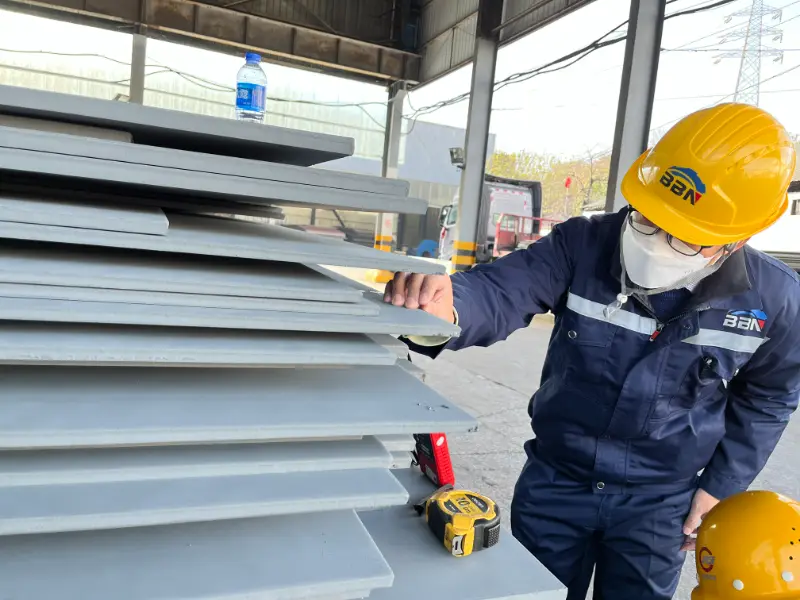
GB/T700 Q235D Carbon Structural Steel Plate
GB/T700 Q235D Carbon Structural Steel Plate: Properties, Equivalents & Application Data
Comprehensive technical data sheet for Q235D carbon structural steel plate per GB/T 700, including chemical composition, mechanical and thermal properties, international cross-references, and processing guidelines.
Suitable for hot rolling, cold forming, cutting, welding (all common processes including SMAW, GMAW, SAW), machining, drilling, punching, and bending. Pre‑heating is generally not required for thicknesses up to 50 mm, but low‑hydrogen practices are recommended for heavy sections.
- Phone : +8618037372205
- Email : [email protected]
- WhatsApp: Contact via Whtsapp
- WeChat: +8618037372205
GB/T700 Q235D Carbon Structural Steel Plate Introduction
Q235D is a Chinese carbon structural steel grade defined in GB/T 700–2006, representing the highest quality level (D) within the Q235 series. This low‑carbon steel is characterized by a minimum yield strength of 235 MPa and ensures ductile behaviour at low temperature by requiring a minimum impact energy of 27 J at –20 °C. The controlled sulphur and phosphorus content provides good weldability, formability, and toughness, making the material suitable for general structural applications in building, bridge, and machinery manufacturing. The plate form is widely used in welded structures, pressure‑vessel components (non‑code), and engineering parts that operate under moderate loads and ambient to sub‑zero conditions.
GB/T700 Q235D Carbon Structural Steel Plate Chemical Composition
The chemical composition complies with GB/T 700–2006 for Q235D. Low carbon equivalent ensures good weldability. The maximum limits for phosphorus and sulphur are strictly controlled to enhance toughness and avoid hot shortness. No intentional addition of microalloying elements (Nb, V, Ti) is required; however, residual contents from the steelmaking process must not exceed the specified maxima.
| Element | Standard Value (max unless range) | Remarks |
|---|---|---|
| C (Carbon) | ≤ 0.17 % | Ladle analysis; CEV typically ≤ 0.40 % for good weldability |
| Si (Silicon) | ≤ 0.35 % | Deoxidation element |
| Mn (Manganese) | ≤ 1.40 % | Increases strength and toughness |
| P (Phosphorus) | ≤ 0.035 % | Strict limit for improved cold formability and low‑temperature toughness |
| S (Sulphur) | ≤ 0.035 % | Controlled to avoid hot cracking during welding |
| Cr (Chromium) (residual) | ≤ 0.30 % (permitted residual) | Not intentionally added; may be present from scrap |
| Ni (Nickel) (residual) | ≤ 0.30 % (permitted residual) | Residual element; no specific requirement |
| Cu (Copper) (residual) | ≤ 0.30 % (permitted residual) | Residual element; may improve atmospheric corrosion resistance slightly |
| N (Nitrogen) | ≤ 0.012 % (if applicable) | Not always specified; controlled in modern steelmaking |
| CEV (Carbon Equivalent) | Typically ≤ 0.40 % | Calculated as C + Mn/6 + (Cr+Mo+V)/5 + (Ni+Cu)/15; ensures weldability without preheat for normal thicknesses |
GB/T700 Q235D Carbon Structural Steel Plate Thermal and Electrical Physical Properties
The following physical properties are typical for carbon‑manganese structural steel in the as‑rolled condition at ambient temperature. They are not part of the mandatory verification in GB/T 700 but are widely accepted references for design calculations. Slight variations may occur depending on the exact composition and processing route.
| Property | Typical Value | Unit | Test Condition / Remarks |
|---|---|---|---|
| Density (ρ) | 7.85 | g/cm³ | At 20 °C |
| Modulus of elasticity (E) | 210 | GPa | At 20 °C, static test |
| Shear modulus (G) | 81 | GPa | Calculated from E and ν |
| Poisson's ratio (ν) | 0.3 | – | In the elastic range |
| Coefficient of thermal expansion (α) ambient to 100 °C | 11.1 × 10⁻⁶ | K⁻¹ | Mean linear expansion coefficient |
| Coefficient of thermal expansion (α) ambient to 300 °C | 12.9 × 10⁻⁶ | K⁻¹ | Mean linear expansion coefficient |
| Thermal conductivity (λ) at 20 °C | 53 | W/(m·K) | Typical for 0.15 % C steel |
| Specific heat capacity (cp) at 20 °C | 461 | J/(kg·K) | Ambient temperature |
| Electrical resistivity (ρₑ) at 20 °C | 0.16 | Ω·mm²/m | Approximate for mild steel |
| Melting point (range) | 1470 – 1520 | °C | Solidus – liquidus |
GB/T700 Q235D Carbon Structural Steel Plate Mechanical Properties
Mechanical properties are guaranteed for the as‑rolled delivery condition. The minimum yield strength and tensile strength depend on the nominal thickness. Elongation is measured on a gauge length of 5.65√So (proportional test piece). The impact energy requirement is the primary characteristic distinguishing Q235D from lower quality grades (A, B, C). All tests are performed on transverse specimens unless otherwise agreed.
| Property | Specified Value | Unit | Test Condition / Remarks |
|---|---|---|---|
| Upper yield strength (ReH) for thickness ≤ 16 mm | ≥ 235 | MPa | Room temperature |
| Upper yield strength (ReH) for thickness > 16 mm and ≤ 40 mm | ≥ 225 | MPa | Room temperature |
| Upper yield strength (ReH) for thickness > 40 mm and ≤ 60 mm | ≥ 215 | MPa | Room temperature |
| Upper yield strength (ReH) for thickness > 60 mm and ≤ 100 mm | ≥ 205 | MPa | Room temperature |
| Upper yield strength (ReH) for thickness > 100 mm and ≤ 150 mm | ≥ 195 | MPa | Room temperature |
| Tensile strength (Rm) thickness ≤ 100 mm | 370 – 500 | MPa | Room temperature |
| Tensile strength (Rm) thickness > 100 mm and ≤ 150 mm | 360 – 480 | MPa | Room temperature |
| Elongation after fracture (A) thickness ≤ 40 mm | ≥ 26 | % | Gauge length Lo = 5.65√So |
| Elongation after fracture (A) thickness > 40 mm and ≤ 60 mm | ≥ 25 | % | Gauge length Lo = 5.65√So |
| Elongation after fracture (A) thickness > 60 mm and ≤ 100 mm | ≥ 24 | % | Gauge length Lo = 5.65√So |
| Elongation after fracture (A) thickness > 100 mm and ≤ 150 mm | ≥ 22 | % | Gauge length Lo = 5.65√So |
| Charpy V‑notch impact energy (KV₂) longitudinal at –20 °C | ≥ 27 (average of three tests, one individual minimum 70 % of average) | J | Charpy V‑notch specimen; transverse testing may be agreed |
| Bend test (mandrel diameter) thickness ≤ 60 mm, 180° bend | d = a (mandrel diameter = specimen thickness) | – | No cracks on the tension side |
| Bend test (mandrel diameter) thickness > 60 mm and ≤ 100 mm | d = 2a | – | 180° cold bend, no cracks |
GB/T700 Q235D Carbon Structural Steel Plate Equivalent Material Standards and Substitutable Grades
| Country / Region | Standard | Grade / Designation | Remarks |
|---|---|---|---|
| European Union | EN 10025‑2:2019 | S235J2 (1.0117) | Comparable strength and toughness at –20 °C (minimum 27 J). Chemical composition and thickness‑dependent properties should be cross‑checked. |
| United States | ASTM A36 / A36M | A36 (with supplementary Charpy requirement) | Yield strength 250 MPa (36 ksi) typically; does not mandate impact testing unless specified. May be used as alternative if toughness is qualified. |
| International | ISO 630‑2:2011 | S235D | Structural steel with minimum 235 MPa yield and 27 J at –20 °C. Direct equivalent in terms of mechanical requirements. |
| Japan | JIS G3101:2015 | SS400 (with additional agreement for impact properties) | SS400 tensile strength 400‑510 MPa; impact properties not required by base standard. For Q235D direct substitution, Charpy requirement must be ensured. |
| China | GB/T 1591‑2018 | Q235D (identical to GB/T 700) | The same grade also appears in the structural steel standard for low‑alloy high‑strength steels. The requirements are harmonized. |
GB/T700 Q235D Carbon Structural Steel Plate Application Introduction
Q235D plate is designed for general structural applications with moderate strength requirements where guaranteed toughness at –20 °C is essential. Typical processing includes flame cutting, cold forming, and welding. Because of its low carbon equivalent, pre‑heating is usually unnecessary for thicknesses below 30 mm, simplifying fabrication. For severe forming or cold bending, minimum bend radii of 1.0–1.5 times the plate thickness are recommended to avoid cracking. The material is often supplied in blast‑cleaned and primed condition for immediate use in outdoor structures.
Product Applications: Welded H‑beams, box columns, and built‑up sections, Bridge deck plates and stiffening ribs, Flanges and webs for plate girders, Wind turbine tower internal platforms and flanges (non‑fatigue critical), Heavy‑duty shelving and racking systems, Excavator and crane booms (structural parts), Modular building panels and container frames
Processed into products: Base plates and anchor plates for steel columns, Gusset plates and splice plates in truss connections, Flange plates for welded beams and crane runway beams, End plates for moment‑resisting connections, Stiffeners and diaphragm plates in box girders, Support brackets and cantilever arms, Mounting plates for heavy machinery and equipment
Application industries: Building and civil infrastructure (columns, beams, trusses), Bridge engineering (main girders, cross‑frames, stiffeners), Transmission towers and telecommunication masts, Railway vehicle underframes and wagon components, Agricultural and forestry machinery frames, General mechanical engineering (machine bases, supports, brackets), Storage and silo fabrication (non‑pressurized tanks), Shipbuilding (secondary structures, non‑classified parts)
GB/T700 Q235D Carbon Structural Steel Plate Similar / Analogue Materials with Close Performance
| Country / Region | Standard | Grade | Remarks / Comparison |
|---|---|---|---|
| European Union | EN 10025‑2:2019 | S235JR (1.0038) | Similar strength but lower toughness (only +20 °C impact). Suitable for ambient‑temperature applications only; not a substitute for Q235D at low temperature. |
| United States | ASTM A572 / A572M | Grade 42 (Type 1) | Minimum yield 290 MPa; higher strength, but impact toughness must be specified separately. May be used for heavier sections where strength governs. |
| Russian Federation | GOST 380‑2005 | St3sp (Ст3сп) | Quiet steel with similar carbon content; typical yield ~245 MPa. Impact toughness at –20 °C is often available and comparable to Q235D when properly deoxidized. |
| India | IS 2062:2011 | E250 Grade C (Fe 410 W C) | 250 MPa minimum yield, 410 MPa tensile; Charpy at 0 °C standard, can be produced for –20 °C by agreement. Close match with slight yield advantage. |
| Germany (historical) | DIN 17100:1980 (withdrawn) | St37‑2 (RSt37‑2) | Older designation; replaced by S235JR/J2. RSt37‑2 represents rimmed or capped steel, not recommended for low‑temperature service. |
Notes:
- Weldability: Excellent. All common arc welding processes are applicable. For thick plates (>50 mm), a preheat of 100–150 °C and low‑hydrogen consumables are recommended to avoid hydrogen cracking.
- Corrosion protection: Q235D has no inherent atmospheric corrosion resistance; therefore, protective coatings (paint, galvanizing, metallization) are necessary for outdoor exposure.
- Cold forming: Suitable for cold bending with a minimum inside radius of 1.0 t up to 20 mm thickness. For greater thicknesses, 1.5 t is advised to prevent cracking.
- Ordering remarks: When placing an order to GB/T 700 for Q235D, the impact test temperature (–20 °C) and test direction (longitudinal or transverse) should be explicitly stated if different from the standard default. Dimensional tolerances should refer to GB/T 709 or agreed specification.
- Documentation: Inspection certificate type 3.1 according to EN 10204 is typically provided, including chemical analysis, tensile, and Charpy impact results.
- Share



