
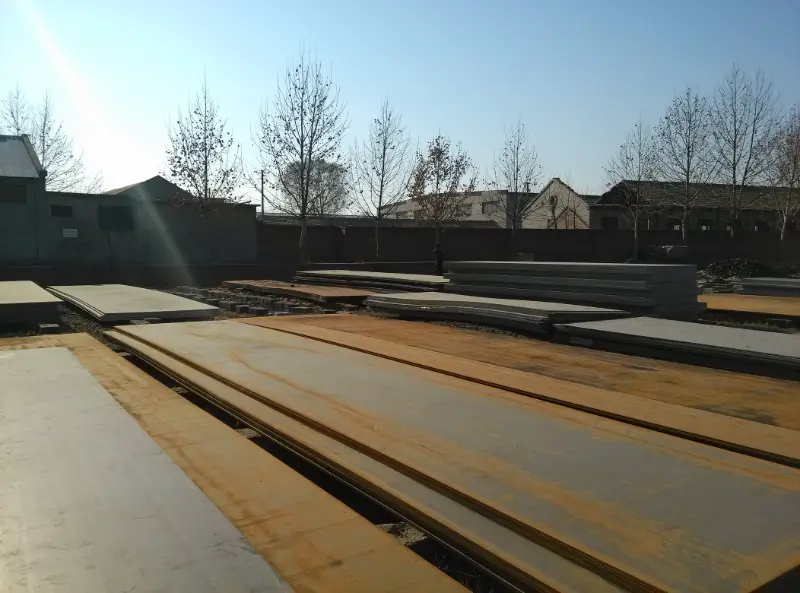
Comprehensive Guide to GB/T 700 Q275 Carbon Structural Steel Plate
Comprehensive Guide to GB/T 700 Q275 Carbon Structural Steel Plate: Properties, Equivalents & Applications
In-depth technical reference for Q275 carbon structural steel plate under Chinese standard GB/T 700. Includes chemical composition, mechanical and physical properties, international equivalents, and application guidance.
Hot rolling, cold bending, welding, machining, stamping (for thin gauges), drilling, gas cutting
- Phone : +8618037372205
- Email : [email protected]
- WhatsApp: Contact via Whtsapp
- WeChat: +8618037372205
Comprehensive Guide to GB/T 700 Q275 Carbon Structural Steel Plate Introduction
Q275 is a carbon structural steel grade defined in the Chinese standard GB/T 700. It is characterized by a minimum yield strength of 275 MPa and offers a good balance of strength, ductility, and weldability. This steel is widely used in building structures, bridges, vehicles, and general engineering parts that do not require heat treatment. With a relatively higher carbon content compared to Q235, Q275 provides increased strength and hardness, suitable for components subjected to moderate loads. The material is typically supplied in hot-rolled condition, either as plates, strips, sections, or bars. It can be readily processed by cutting, forming, and welding, although preheating may be recommended for thicker sections to avoid cold cracking.
- Moderate strength with good toughness
- Good machinability and cold formability
- Cost-effective for general structural applications
Comprehensive Guide to GB/T 700 Q275 Carbon Structural Steel Plate Chemical Composition
The following table lists the specified chemical composition of Q275 steel according to GB/T 700-2006. The limits apply to ladle analysis. Trace elements such as chromium, nickel, and copper may be present as residuals from scrap, but their combined content is restricted to ensure consistent properties.
- Elements not listed are intentionally kept low to maintain weldability and formability.
- Values in parentheses indicate maximum permitted residual content.
| Element | Specified Value (max %) | Remarks |
|---|---|---|
| Carbon (C) | 0.24 | For thickness ≤16mm; up to 0.28 for thicker sections |
| Silicon (Si) | 0.35 | |
| Manganese (Mn) | 1.50 | For thickness ≤16mm; up to 1.60 for >16mm |
| Phosphorus (P) | 0.035 | Residual element control |
| Sulfur (S) | 0.035 | Residual element control |
| Nitrogen (N) | 0.012 | If not killed with aluminum |
| Chromium (Cr) | ≤0.30 (residual) | Copper (Cu) ≤0.30; Nickel (Ni) ≤0.30; each combined residual ≤0.60 |
Comprehensive Guide to GB/T 700 Q275 Carbon Structural Steel Plate Thermal and Electrical Physical Properties
The physical properties listed below are typical for carbon structural steels of this type at room temperature, unless otherwise noted. These values are not part of the standard specification but are widely accepted for engineering design. Actual values may vary slightly depending on exact composition and processing history.
- These data correspond to low-alloy carbon steel with about 0.20% carbon content.
| Property | Standard Reference Value | Unit | Test Condition / Remarks |
|---|---|---|---|
| Density (ρ) | 7.85 | g/cm³ | At 20°C |
| Elastic Modulus (E) | 210 | GPa | At 20°C; in tension |
| Shear Modulus (G) | 81 | GPa | At 20°C |
| Poisson's Ratio (ν) | 0.3 | Elastic range | |
| Thermal Expansion Coefficient (α) | 12.0 × 10⁻⁶ | K⁻¹ | Between 20°C and 200°C |
| Thermal Expansion Coefficient (α) | 13.0 × 10⁻⁶ | K⁻¹ | Between 20°C and 400°C |
| Thermal Conductivity (λ) | 50 | W/(m·K) | At 20°C |
| Specific Heat Capacity (c) | 460 | J/(kg·K) | At 20°C |
| Electrical Resistivity (ρ_e) | 0.15 – 0.20 | µΩ·m | At 20°C |
Comprehensive Guide to GB/T 700 Q275 Carbon Structural Steel Plate Mechanical Properties
The mechanical properties of Q275 steel plate are determined at room temperature on samples taken in the transverse direction, according to GB/T 700-2006. The properties depend on the product thickness. Minimum values are guaranteed; the table below provides the standard requirements for tensile and impact properties. For bending tests, the material must withstand a 180° bend without cracking.
- Impact test is performed on Charpy V-notch specimens at a specified temperature (if required by the suffix quality level). Q275 is available in quality A, B, C, D with varying impact requirements.
| Property | Standard Requirement Value | Unit | Test Condition / Thickness |
|---|---|---|---|
| Yield Strength (ReH) | ≥275 | MPa | Thickness ≤16 mm |
| Yield Strength (ReH) | ≥265 | MPa | Thickness >16 mm to ≤40 mm |
| Yield Strength (ReH) | ≥255 | MPa | Thickness >40 mm to ≤63 mm |
| Yield Strength (ReH) | ≥245 | MPa | Thickness >63 mm to ≤80 mm |
| Tensile Strength (Rm) | 410 – 540 | MPa | Thickness ≤100 mm |
| Elongation (A) | ≥22 | % | Thickness ≤40 mm; gauge length 5.65√S0 |
| Elongation (A) | ≥20 | % | Thickness >40 mm to ≤63 mm; gauge length 5.65√S0 |
| Elongation (A) | ≥19 | % | Thickness >63 mm to ≤100 mm; gauge length 5.65√S0 |
| Bend Test (180°) | d = 1.5a (for L0=5.65√S0) | Bend diameter d, specimen thickness a, transverse specimen | |
| Bend Test (180°) | d = 2a | For thickness >60 mm, as agreed | |
| Impact Energy (KV₂) | (Quality B) ≥27 J at +20°C | J | Longitudinal Charpy V-notch; for quality B |
| Impact Energy (KV₂) | (Quality C) ≥27 J at 0°C | J | For quality C |
| Impact Energy (KV₂) | (Quality D) ≥27 J at -20°C | J | For quality D |
Comprehensive Guide to GB/T 700 Q275 Carbon Structural Steel Plate Exactly Equivalent Material Standards and Replaceable Grades
| Country/Region | Standard | Grade | Remarks |
|---|---|---|---|
| China | GB/T 700 | Q275 | Original grade |
| International | ISO 630-2 | E275 (Fe430) | Equivalent for quality B; similar mechanical properties; confirm impact requirements |
| European Union | EN 10025-2 | S275JR (1.0044) | Chemical and mechanical close; JR quality has impact at +20°C |
| European Union | EN 10025-2 | S275J0 (1.0143) | Impact at 0°C, comparable to Q275C |
| European Union | EN 10025-2 | S275J2 (1.0145) | Impact at -20°C, comparable to Q275D |
| Japan | JIS G3101 | SS490 | Tensile strength comparable; yield not guaranteed; check for structural requirement |
| USA | ASTM A283/A283M | Grade D | Slightly lower yield (230 MPa min) but similar tensile; not fully equivalent |
| USA | ASTM A36/A36M | A36 | Yield 250 MPa min; widely used substitute with careful design adjustment |
Comprehensive Guide to GB/T 700 Q275 Carbon Structural Steel Plate Application Introduction
Q275 carbon structural steel is well-suited for general fabrication and construction where good strength and moderate toughness are required. Its combination of mechanical properties and relative low cost makes it a common choice across multiple industries.
- Typical service temperature down to -20°C for quality D variants.
- Surface can be galvanized or painted for corrosion protection.
Product Applications: Building frameworks, beams, columns, Bridge girders and trusses, Vehicle chassis and frames, Transmission towers and poles, Agricultural machinery bodies, Welded pipes and hollow sections, Industrial floors and platforms
Processed into products: Gusset plates, stiffeners, splice plates, Angle cleats and connecting brackets, Anchor bolts and base plates, Machined parts such as bushings and spacers, Brackets, arms, and levers in construction equipment, Steel gratings and steps, Flanges and flanged fittings
Application industries: Building and construction, Bridge engineering, Automotive and transportation, General machinery manufacturing, Energy and power transmission, Shipping and marine (non-critical structural parts), Storage tanks and containers
Comprehensive Guide to GB/T 700 Q275 Carbon Structural Steel Plate Similar or Substitute Materials with Comparable Performance
| Country/Region | Standard | Grade | Remarks |
|---|---|---|---|
| China | GB/T 700 | Q235 | Lower strength (yield 235 MPa), better cold formability, more ductile |
| China | GB/T 1591 | Q345 | Higher strength low-alloy steel (yield 345 MPa), used for heavier loads |
| European Union | EN 10025-2 | S235JR | Lower strength, corresponds to Q235 |
| European Union | EN 10025-2 | S355JR | Higher strength, corresponds to Q345 |
| Japan | JIS G3101 | SS400 | Tensile 400-510 MPa, no guaranteed yield, similar general structural steel |
| Japan | JIS G3106 | SM490A | Higher strength weldable structural steel |
| USA | ASTM A572/A572M | Grade 50 (Type 1) | Minimum yield 345 MPa, higher strength substitute |
Notes:
Welding Considerations: Q275 can be welded using all common processes (SMAW, GMAW, SAW). For thicknesses above 30 mm and low ambient temperatures, preheating to 50-100°C is recommended to reduce the risk of hydrogen-induced cracking. Forming: Cold bending radii should follow standard guidelines; typical minimum inside radius = 1.5t for plate up to 16 mm. Heat treatment: This grade is normally used in the as-rolled condition; normalizing may improve toughness for thicker sections. Corrosion resistance: As a plain carbon steel, Q275 has poor atmospheric corrosion resistance and requires protective coatings for outdoor use.
- Share



