
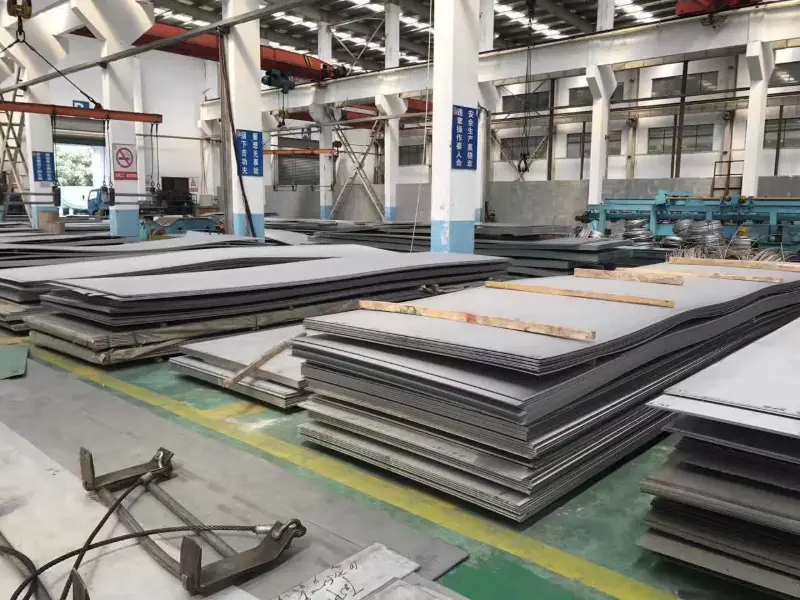
GB/T 1591 Q345A Carbon
GB/T 1591 Q345A Carbon & Low-Alloy High-Strength Structural Steel Plate – Properties & Applications
Explore the chemical composition, mechanical and physical properties of Q345A structural steel under GB/T 1591. Includes international equivalents, similar materials, and application guide.
Hot rolling, controlled rolling, normalizing, cold forming, welding, cutting, machining
- Phone : +8618037372205
- Email : [email protected]
- WhatsApp: Contact via Whtsapp
- WeChat: +8618037372205
GB/T 1591 Q345A Carbon Introduction
Q345A is a carbon and low-alloy high-strength structural steel grade defined in Chinese standard GB/T 1591. It belongs to the quality grade A of the Q345 series, offering a minimum yield strength of 345 MPa. The steel exhibits good weldability, moderate cold forming capability, and satisfactory low-temperature toughness when specified. It is widely used in welded, bolted, and riveted structures such as buildings, bridges, ships, and vehicles. Key features:
- Minimum yield strength 345 MPa for thickness ≤ 16 mm
- Excellent balance between strength and ductility
- Good weldability for various structural fabrications
- Available in plates, strips, sections, and bars
GB/T 1591 Q345A Carbon Chemical Composition
The chemical composition of Q345A according to GB/T 1591-2008 is designed to achieve the required mechanical properties while maintaining good weldability. Impurity elements P and S are strictly controlled. Micro-alloying elements such as Nb, V, and Ti may be added singly or in combination to refine grain size and improve strength. Key points:
- Carbon equivalent (CEV) typically ≤ 0.45 for good weldability
- Optional addition of Nb+V+Ti ≤ 0.22%
- If Cu > 0.40%, precautions for hot shortness may be required
| Element | Standard Value (≤, unless specified) | Remarks |
|---|---|---|
| C (Carbon) | 0.20 | |
| Si (Silicon) | 0.50 | |
| Mn (Manganese) | 1.70 | |
| P (Phosphorus) | 0.035 | Maximum allowed |
| S (Sulfur) | 0.035 | Maximum allowed |
| Nb (Niobium) | 0.07 | Optional, content not required to be reported if not added |
| V (Vanadium) | 0.15 | Optional |
| Ti (Titanium) | 0.20 | Optional |
| Cr (Chromium) | 0.30 | Residual element |
| Ni (Nickel) | 0.50 | Residual element |
| Cu (Copper) | 0.30 | Residual element; if >0.40% may cause hot shortness |
| N (Nitrogen) | 0.012 | If Al or other strong nitride-forming elements are present, N content analysis is not required |
| Mo (Molybdenum) | 0.10 | Residual element, not specified in standard but may appear as impurity |
| Al (Aluminum) | ≥0.015 (total Al) or ≥0.020 (acid-soluble Al) | When used for grain refinement, minimum content to be agreed |
GB/T 1591 Q345A Carbon Thermal and Electrical Physical Properties
The physical properties listed below are typical for low-alloy structural steel and can be used for engineering calculations. Actual values may vary slightly depending on exact composition and heat treatment condition. As Q345A is a generic designation, these values are representative of similar C-Mn structural steels. General characteristics:
- Density: approximately 7.85 g/cm³
- Young's modulus: about 200 GPa at ambient temperature
- Poisson's ratio: about 0.3
| Property | Standard / Typical Value | Unit | Test Condition / Remarks |
|---|---|---|---|
| Density (ρ) | 7.85 | g/cm³ | At 20 °C |
| Modulus of elasticity (E) | 200 - 210 | GPa | At 20 °C, static |
| Shear modulus (G) | 79.3 - 81 | GPa | At 20 °C, calculated from E and ν |
| Poisson ratio (ν) | 0.27 - 0.30 | — | At 20 °C |
| Thermal expansion coefficient (α) | 11.5 - 12.5 | 10⁻⁶/K | Between 20 °C and 100 °C |
| Thermal expansion coefficient (α) | 12.5 - 13.5 | 10⁻⁶/K | Between 20 °C and 200 °C |
| Thermal expansion coefficient (α) | 13.5 - 14.5 | 10⁻⁶/K | Between 20 °C and 300 °C |
| Thermal conductivity (λ) | 50 - 55 | W/(m·K) | At 20 °C |
| Thermal conductivity (λ) | 45 - 50 | W/(m·K) | At 100 °C |
| Specific heat capacity | 450 - 510 | J/(kg·K) | At 20 °C to 100 °C |
| Electrical resistivity (ρ_e) | 0.15 - 0.25 | 10⁻⁶ Ω·m | At 20 °C |
GB/T 1591 Q345A Carbon Mechanical Properties
The mechanical properties of Q345A depend on the product form and thickness, as specified in GB/T 1591-2008. The table below summarizes the minimum requirements. Impact test is not mandatory for grade A in the base specification, but when agreed, the impact energy at 20 °C is usually ≥ 34 J (longitudinal). Bending test with 180° bend is required. Note:
- All values are for the as-delivered condition.
- For thicknesses outside the ranges given, the supplier and purchaser should agree on values.
| Property | Standard Requirement Value | Unit | Test Condition / Thickness (t) |
|---|---|---|---|
| Yield Strength (ReH) | ≥ 345 | MPa | t ≤ 16 mm |
| Yield Strength (ReH) | ≥ 335 | MPa | 16 mm < t ≤ 40 mm |
| Yield Strength (ReH) | ≥ 325 | MPa | 40 mm < t ≤ 63 mm |
| Yield Strength (ReH) | ≥ 315 | MPa | 63 mm < t ≤ 80 mm |
| Yield Strength (ReH) | ≥ 305 | MPa | 80 mm < t ≤ 100 mm |
| Yield Strength (ReH) | ≥ 295 | MPa | 100 mm < t ≤ 150 mm |
| Tensile Strength (Rm) | 470 - 630 | MPa | t ≤ 100 mm |
| Tensile Strength (Rm) | 450 - 600 | MPa | 100 mm < t ≤ 150 mm |
| Elongation after fracture (A) | ≥ 20 | % | t ≤ 40 mm, gauge length 5.65√So (proportional) |
| Elongation after fracture (A) | ≥ 19 | % | 40 mm < t ≤ 100 mm |
| Elongation after fracture (A) | ≥ 18 | % | 100 mm < t ≤ 150 mm |
| Bending test (180°) | d = 2a | — | t ≤ 16 mm (bend diameter d, specimen thickness a) |
| Bending test (180°) | d = 3a | — | 16 mm < t ≤ 100 mm |
| Impact energy (KV2) | ≥ 34 (longitudinal) | J | At 20 °C, when impact test is required by agreement (grade A is not mandatory) |
| Impact energy (KV2) | ≥ 27 (transverse) | J | At 20 °C, when impact test agreed |
GB/T 1591 Q345A Carbon Completely Equivalent Material Standards and Alternative Grades
| Country / Region | Standard | Grade | Remarks |
|---|---|---|---|
| China | GB/T 1591 | Q345A | Original specification |
| European Union | EN 10025-2 | S355JR | JR - impact 27J at 20°C; similar chemistry, comparable mechanical properties |
| International | ISO 4950-2 | E355DD | DD - impact 27J at -20°C, slightly better toughness; strength equivalent |
| United States | ASTM A572/A572M | Grade 50 | Yield 345 MPa; tensile ≥ 450 MPa; for thickness ≤ 100 mm |
| Japan | JIS G3106 | SM490A | For welded structures; tensile 490-610 MPa, yield ≥ 325 MPa for t≤16 mm; impact test optional |
| India | IS 2062 | E350A | Fe 490, similar to Q345A but Brinell hardness requirement may differ |
GB/T 1591 Q345A Carbon Application Introduction
Q345A steel is extensively utilized in general structural engineering due to its cost-effectiveness and reliable performance. It is suitable for static loading and can be used in low-temperature environments only when impact properties are specifically requested. Typical application areas include:
- Heavy steel structures in industrial and civil construction
- Machinery parts requiring moderate wear resistance
- Transportation and infrastructure projects
Product Applications: Multi-story building frames and columns, Highway and railway bridges, Offshore platform topsides (auxiliary structures), Pressure vessel shells (when impact properties are guaranteed), Excavator booms and buckets, Railway wagon underframes, Truck chassis and trailer beams, Wind turbine tower sections (internal platforms, ladders), Conveyor systems and crane runways, Pipe piles and steel sheet piling
Processed into products: Welded H-beams and box columns, Flanges and webs of plate girders, Stiffened panels and diaphragms, Bolted and welded trusses, Machine bases and support structures, Lifting lugs and brackets, Storage tank bottom plates and shell courses (moderate pressure), Off-highway vehicle frames, Silos, hoppers, and bunkers
Application industries: Construction & Civil Engineering, Bridge Engineering, Shipbuilding (general structures, not for hull primary members unless impact tested), Railway Vehicles, Automotive and Heavy Truck Manufacturing, Mining and Earthmoving Equipment, Petrochemical and Power Generation, Container and Storage Tank Manufacturing, Agricultural Machinery, Transmission Line Towers and Telecommunication Structures
GB/T 1591 Q345A Carbon Recommended Similar or Alternative Materials
| Country / Region | Standard | Grade | Remarks |
|---|---|---|---|
| China | GB/T 1591 | Q345B | Grade B with guaranteed impact 34J at 20°C; otherwise same strength; more commonly used when toughness is needed |
| China | GB/T 1591 | Q345C | Impact 34J at 0°C, suitable for lower temperature structural applications |
| China | GB/T 1591 | Q345D | Impact 34J at -20°C, for even more demanding low-temperature service |
| China | GB/T 19879 | Q345GJ | High-performance structural steel for building structures, with improved Z-direction properties and better weldability |
| European Union | EN 10025-2 | S355J0 | Similar strength, guaranteed impact 27J at 0°C; may replace Q345A when low-temperature toughness is required |
| United States | ASTM A709/A709M | Grade 50 | For bridge construction; similar strength, additional toughness requirements |
| Russia/CIS | GOST 19281 | 09G2S (09Г2С) | Low-alloy structural steel comparable to Q345; widely used in welded structures |
Notes:
When ordering Q345A, it is recommended to specify whether impact testing at 20°C is required, as it is optional in GB/T 1591 for grade A. For improved weldability, a maximum carbon equivalent (CEV) can be agreed upon, typically 0.45. For thicknesses above 150 mm, the mechanical properties should be negotiated. The steel can be supplied as hot-rolled, controlled rolled, or normalized, depending on the end-use requirements. Special cautions:
- For dynamic loading or fatigue-critical applications, higher grades such as Q345C or Q345D are often preferred.
- In environments with risk of lamellar tearing, through-thickness (Z-direction) properties should be specified per GB/T 5313.
- Surface conditions and flatness tolerances should be clarified at the time of inquiry.
- Share



