
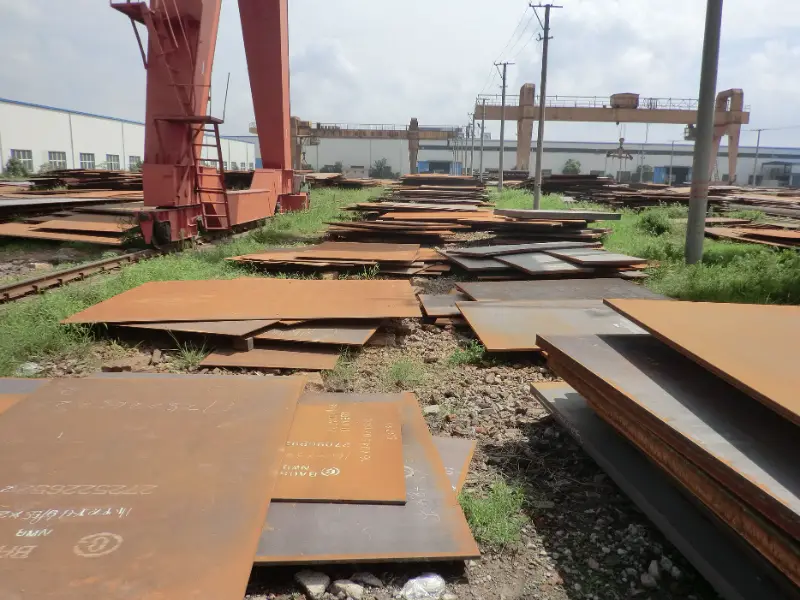
Q345B Carbon and Low-alloy High-strength Steel Plate
Q345B Carbon and Low-alloy High-strength Steel Plate: Properties, Equivalents, and Applications
Q345B is a low-alloy high-strength structural steel per GB/T 1591 standard, widely used in construction, bridges, and machinery due to its good weldability and mechanical properties.
Hot rolling, cold forming, welding, machining, flame cutting
- Phone : +8618037372205
- Email : [email protected]
- WhatsApp: Contact via Whtsapp
- WeChat: +8618037372205
Q345B Carbon and Low-alloy High-strength Steel Plate Introduction
Q345B is a low-alloy high-strength structural steel defined in Chinese standard GB/T 1591. It belongs to the Q345 series, where 'Q' stands for yield strength and '345' indicates a minimum yield strength of 345 MPa. The suffix 'B' denotes a quality grade with impact testing required at 0°C. This steel offers a good balance of strength, ductility, and weldability, making it one of the most widely used structural steels in China. Its primary alloying elements, manganese and silicon, contribute to improved mechanical properties without significantly affecting carbon content, thus preserving good welding characteristics. Q345B is usually supplied in hot-rolled or as-rolled condition and can be used for welded, bolted, and riveted structures. It finds extensive application in buildings, bridges, vehicles, ships, pressure vessels, and various machinery components. With the 2018 revision of GB/T 1591, the grade is gradually being superseded by Q355B to align with international standards, but Q345B remains in common use.
Q345B Carbon and Low-alloy High-strength Steel Plate Chemical Composition
Chemical composition according to GB/T 1591-2008 for Q345B. Values are maximum unless a range or minimum is specified. The steel is designed to provide high strength while maintaining good weldability and toughness. Alloying elements such as Mn, Si, and micro-alloying elements (Nb, V, Ti) contribute to grain refinement and precipitation strengthening.
| Element | Standard Value (%) | Remarks |
|---|---|---|
| Carbon (C) | ≤0.20 | |
| Silicon (Si) | ≤0.50 | |
| Manganese (Mn) | ≤1.70 | |
| Phosphorus (P) | ≤0.035 | |
| Sulfur (S) | ≤0.035 | |
| Niobium (Nb) | ≤0.07 | |
| Vanadium (V) | ≤0.15 | |
| Titanium (Ti) | ≤0.20 | |
| Aluminium (Als) | ≥0.015 | Acid-soluble aluminum |
| Chromium (Cr) | ≤0.30 | |
| Nickel (Ni) | ≤0.50 | |
| Copper (Cu) | ≤0.30 | |
| Molybdenum (Mo) | ≤0.10 | |
| Nitrogen (N) | ≤0.012 |
Q345B Carbon and Low-alloy High-strength Steel Plate Thermal and Electrical Physical Properties
Physical properties of Q345B low-alloy steel at room temperature unless otherwise indicated. These values are typical for the grade and may vary slightly depending on specific processing and heat treatment. Thermal conductivity and specific heat are given at 20°C; thermal expansion coefficient is the mean value for the temperature range 20–200°C.
| Property | Standard Requirement | Unit | Test Condition |
|---|---|---|---|
| Density (ρ) | 7.85 | g/cm³ | at 20°C |
| Modulus of Elasticity (E) | 200 | GPa | at 20°C |
| Shear Modulus (G) | 80 | GPa | calculated from E and ν |
| Poisson's Ratio (ν) | 0.3 | - | at 20°C |
| Thermal Expansion Coefficient (α) | 12.2 | 10⁻⁶/°C | 20°C to 200°C |
| Thermal Conductivity (λ) | 50 | W/(m·K) | at 20°C |
| Specific Heat Capacity (cp) | 460 | J/(kg·K) | at 20°C |
| Electrical Resistivity (ρe) | 0.22 | μΩ·m | at 20°C |
Q345B Carbon and Low-alloy High-strength Steel Plate Mechanical Properties
Mechanical properties as per GB/T 1591-2008 for Q345B in as-supplied condition. Yield strength (ReH) varies with product thickness. Tensile test is performed on longitudinal specimens. Impact energy (KV2) is the minimum average for three full-size Charpy V-notch specimens at 0°C. Elongation (A) is measured on a gauge length of 5.65√S0 for proportional specimens.
| Property | Standard Requirement | Unit | Test Condition |
|---|---|---|---|
| Yield Strength (ReH) | ≥345 | MPa | t ≤ 16 mm |
| Yield Strength (ReH) | ≥335 | MPa | 16 mm < t ≤ 40 mm |
| Yield Strength (ReH) | ≥325 | MPa | 40 mm < t ≤ 63 mm |
| Yield Strength (ReH) | ≥315 | MPa | 63 mm < t ≤ 80 mm |
| Yield Strength (ReH) | ≥295 | MPa | 80 mm < t ≤ 100 mm |
| Tensile Strength (Rm) | 470 – 630 | MPa | t ≤ 100 mm |
| Elongation after Fracture (A) | ≥20 | % | Longitudinal, t ≤ 40 mm |
| Elongation after Fracture (A) | ≥19 | % | 40 mm < t ≤ 63 mm |
| Elongation after Fracture (A) | ≥19 | % | 63 mm < t ≤ 100 mm |
| Impact Energy (KV2) | ≥34 | J | 0°C, longitudinal |
| Bend Test (d=mandrel diam., a=specimen thickness) | d=3a | 180° bending, a ≤ 16 mm |
Q345B Carbon and Low-alloy High-strength Steel Plate Completely Equivalent Material Standards and Substitutable Grades
| Country/Region | Standard | Grade | Remarks |
|---|---|---|---|
| China | GB/T 1591-2008 | Q345B | Original standard; widely used |
| China | GB/T 1591-2018 | Q355B | New standard replacement; min. ReH 355 MPa, same impact temperature |
| European Union | EN 10025-2:2019 | S355J0 | Comparable yield strength (355 MPa) and 0°C impact requirement |
| USA | ASTM A572/A572M | Grade 50 [345] | Similar min. yield strength (345 MPa); impact testing by supplementary requirement |
| Japan | JIS G3106 | SM490B | Min. 325-365 MPa yield, 0°C impact; close equivalent |
| International | ISO 4950-2 | E355CC | High yield strength steel with 0°C impact, suitable substitute |
Q345B Carbon and Low-alloy High-strength Steel Plate Application Introduction
Q345B steel is designed for welded structures requiring high strength and good toughness. It is easily fabricated and widely adopted across multiple industries. Typical applications include:
Product Applications: High-rise building frames and columns, Bridge girders, box girders, and trusses, Offshore platform decks and modules, Petrochemical storage tanks and silos, Crane booms and heavy lifting equipment, Trailer and chassis frames for trucks, Wind turbine tower sections
Processed into products: Welded H-beams, I-beams, and box columns, Steel pipe piles and hollow sections, Boiler drums and pressure vessel shells, Flanges, fittings, and forged parts, Machine beds and support structures, Guardrails, barriers, and structural brackets, Excavator buckets and wear plates (with hardfacing)
Application industries: Construction and civil engineering, Bridge and highway infrastructure, Shipbuilding and marine structures, Pressure vessels and boilers, Railway and automotive manufacturing, Mining and earthmoving equipment, Wind power tower and support structures
Q345B Carbon and Low-alloy High-strength Steel Plate Similar or Alternative Material Recommendations
| Country/Region | Standard | Grade | Remarks |
|---|---|---|---|
| China | GB/T 700 | Q235B | Lower strength carbon structural steel; for less demanding applications |
| European Union | EN 10025-2 | S355JR | Similar strength but impact test at +20°C, not 0°C |
| USA | ASTM A36/A36M | A36 | Widely used carbon steel; lower yield strength (250 MPa) |
| Japan | JIS G3101 | SS490 | Ordinary structural steel; lower toughness guarantees |
| India | IS 2062 | E350BR | Comparable 350 MPa yield with 0°C impact; BIS equivalent |
Notes:
Welding considerations: Q345B has good weldability; low-hydrogen processes are recommended. Preheat (typically 100–150°C) may be required for thick sections above 30 mm to avoid cold cracking. Corrosion resistance: It is not inherently corrosion-resistant; protective coatings or painting is required in aggressive environments. Forming: Can be cold bent to radii ≥ 1.5t; hot forming should be followed by normalizing if properties are critical. When ordering to the newer GB/T 1591-2018 standard, specify Q355B for equivalent performance with slightly higher strength.
- Share



