
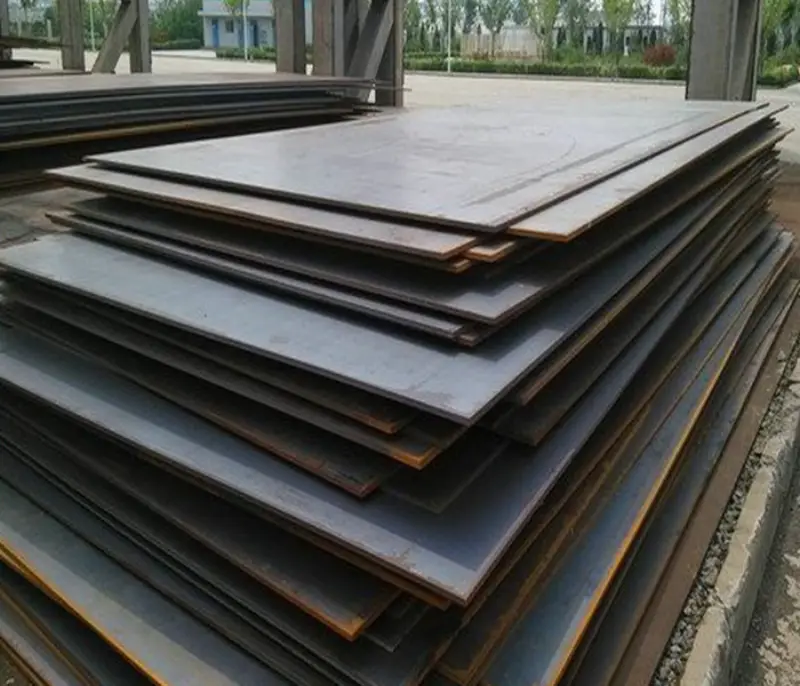
Q345C Low-Alloy High-Strength Structural Steel Plate
Q345C Low-Alloy High-Strength Structural Steel Plate - GB/T 1591 Standard Data
Comprehensive data for Q345C carbon and low-alloy high-strength steel plate according to GB/T 1591, including chemical composition, mechanical properties, thermal and electrical physical properties, equivalents, and applications.
Hot rolling, controlled rolling, normalizing, welding, cutting, bending, cold forming, machining
- Phone : +8618037372205
- Email : [email protected]
- WhatsApp: Contact via Whtsapp
- WeChat: +8618037372205
Q345C Low-Alloy High-Strength Structural Steel Plate Introduction
Q345C is a low-alloy high-strength structural steel grade specified in Chinese standard GB/T 1591. It provides a minimum yield strength of 345 MPa for thicknesses up to 16 mm and guarantees impact toughness at 0°C. Compared to Q235 series, it offers significantly higher strength while maintaining good weldability and formability. The steel is widely used in welded, bolted, and riveted structures for buildings, bridges, vehicles, and machinery. Typical delivery conditions are hot rolled, normalized, or controlled rolled. Key characteristics include:
- High strength, excellent weldability
- Good low-temperature toughness (0°C impact ≥34 J)
- Versatile for structural applications in various climates
Q345C Low-Alloy High-Strength Structural Steel Plate Chemical Composition
The table lists the required chemical composition for Q345C according to GB/T 1591-2008. Grain refining elements such as Nb, V, Ti may be added singly or in combination. If only one of these elements is added, the minimum content must meet the specified value; if combined, the sum is adjusted accordingly.
- For improving resistance to atmospheric corrosion, ≤0.30% Cu may be present.
- Nitrogen content is limited to 0.012% max; if nitrogen-binding elements are used, it may be higher.
| Chemical Element | Standard Value (wt%) | Remarks |
|---|---|---|
| Carbon (C) | ≤ 0.20 | Limits ensure weldability |
| Silicon (Si) | ≤ 0.50 | Deoxidizer; may be max 0.60 if Al ≥0.015 |
| Manganese (Mn) | ≤ 1.70 | Increases strength and hardenability |
| Phosphorus (P) | ≤ 0.035 | Impurity; controlled for toughness |
| Sulfur (S) | ≤ 0.035 | Impurity; controlled for toughness |
| Niobium (Nb) | ≤ 0.07 | Grain refiner; min 0.015 if used singly |
| Vanadium (V) | ≤ 0.15 | Grain refiner; min 0.02 if used singly |
| Titanium (Ti) | ≤ 0.20 | Grain refiner; min 0.02 if used singly |
| Chromium (Cr) | ≤ 0.30 | Residual element; may improve corrosion resistance |
| Nickel (Ni) | ≤ 0.50 | Residual element |
| Copper (Cu) | ≤ 0.30 | Residual element, beneficial for weathering |
| Nitrogen (N) | ≤ 0.012 | Must be kept low unless combined with Al or other nitride formers |
| Molybdenum (Mo) | ≤ 0.10 | Residual element |
| Aluminium (Als) | ≥ 0.015 | Acid soluble aluminium for deoxidation and grain refinement |
Q345C Low-Alloy High-Strength Structural Steel Plate Thermal and Electrical Physical Properties
The following physical properties are typical for Q345C steel at room temperature and elevated temperatures, provided for design heat transfer and electrical calculations. These values are not standardized requirements but derived from literature for similar low-alloy carbon steel grades.
- Density is used for weight estimation.
- The elastic modulus decreases with rising temperature.
- Thermal expansion and conductivity are essential for welding distortion analysis and fire resistance design.
| Property | Typical Value | Unit | Test Condition / Remarks |
|---|---|---|---|
| Density (ρ) | 7.85 | g/cm³ | At 20°C |
| Elastic modulus (E) | 210 | GPa | At 20°C |
| Elastic modulus (E) | ~205 | GPa | At 200°C, approximate |
| Shear modulus (G) | ~80 | GPa | Calculated from E and ν |
| Poisson's ratio (ν) | 0.3 | — | At room temperature |
| Thermal expansion coefficient (α) | 11.5 – 12.0 | 10⁻⁶/°C | Temperature range 20–100°C |
| Thermal expansion coefficient (α) | 12.8 – 13.2 | 10⁻⁶/°C | Temperature range 20–300°C |
| Thermal conductivity (λ) | ~50 | W/(m·K) | At 20°C |
| Thermal conductivity (λ) | ~45 | W/(m·K) | At 200°C |
| Specific heat capacity (c) | ~460 | J/(kg·K) | At 20°C |
| Specific heat capacity (c) | ~520 | J/(kg·K) | At 300°C |
| Electrical resistivity (ρe) | ~0.22 | µΩ·m | At 20°C |
Q345C Low-Alloy High-Strength Structural Steel Plate Mechanical Properties
The following mechanical properties are guaranteed for Q345C plate supplied in normalized or controlled rolled condition. Tests are performed on transverse specimens.
- Yield strength values are for thickness ranges as indicated.
- Tensile strength range applies to all thicknesses up to 100 mm.
- Impact energy (KV2) is measured on longitudinal Charpy-V specimens at 0°C.
- Bend test requirement: for bend angle 180°, no cracks shall occur on the outer surface.
| Property | Standard Requirement | Unit | Test Condition |
|---|---|---|---|
| Yield Strength (ReH) | ≥ 345 | MPa | Thickness ≤ 16 mm |
| Yield Strength (ReH) | ≥ 335 | MPa | Thickness > 16 mm to 35 mm |
| Yield Strength (ReH) | ≥ 325 | MPa | Thickness > 35 mm to 50 mm |
| Yield Strength (ReH) | ≥ 315 | MPa | Thickness > 50 mm to 100 mm |
| Tensile Strength (Rm) | 470 – 630 | MPa | All thicknesses ≤ 100 mm |
| Elongation after fracture (A) | ≥ 21 | % | Thickness ≤ 16 mm, gauge length 5.65√S₀ |
| Elongation after fracture (A) | ≥ 20 | % | Thickness > 16 mm to 50 mm |
| Elongation after fracture (A) | ≥ 19 | % | Thickness > 50 mm to 100 mm |
| Impact Energy (KV2) | ≥ 34 | J | Longitudinal, 0°C, 10×10×55 mm specimen |
| Impact Energy (KV2) | ≥ 34 | J | Longitudinal, 0°C, 7.5×10×55 mm subset (if thickness < 10 mm) |
| Bend Test | Bend angle 180°, no cracks | — | D=2a for thickness ≤ 16 mm; D=3a for >16–100 mm |
Q345C Low-Alloy High-Strength Structural Steel Plate Full Equivalent Material Standards and Substitutable Grades
| Country/Region | Standard | Grade | Remarks |
|---|---|---|---|
| International | ISO 4951 | E355C | Same strength class, 0°C impact; very close match |
| EU | EN 10025-2 | S355J0 | Yield ≥355 MPa, impact 0°C (27J), widely considered equivalent |
| Japan | JIS G 3106 | SM490A | Yield ≥325 MPa, impact 0°C optional, overall mechanics similar |
| Japan | JIS G 3136 | SN490B | Yield ≥325 MPa, impact 0°C (27J), used in building structures |
| USA | ASTM A572/A572M | Grade 50 [345] | Yield ≥345 MPa, impact not mandatory; need supplementary requirement S5 for 0°C |
| Germany (former) | DIN 17100 | St52-3 (also 1.0570) | Similar strength, typically 0°C impact (old standard, now replaced by EN 10025) |
Q345C Low-Alloy High-Strength Structural Steel Plate Application Introduction
Q345C steel is designed for heavy-duty structural applications where good weldability, high strength, and moderate low-temperature toughness are required. It can be formed, punched, and cut with conventional methods. The 0°C impact guarantee makes it suitable for structures exposed to cold but not extremely frigid environments.
- Typical fabrication includes welded built-up sections, bolted connections, and riveted assemblies.
- Preheating for welding may be required for thicker sections (above 30 mm) to avoid cold cracking.
- Hot-dip galvanizing and painting are standard corrosion protection methods.
Product Applications: Welded H-beams and columns for steel structures, Bridge girders and orthotropic decks, Shipbuilding plates and stiffeners, Wind turbine tower segments, Hydraulic support components in mining, Offshore platform substructures
Processed into products: Main beams and columns in multi-story buildings, Bottom and side plates of heavy-duty vehicles, Flange and web plates of crane girders, Pedestrian and road bridge plates, End plates for pressure vessels, Boom sections for crawler cranes, Mine roof support structural parts
Application industries: Building and construction (high-rise frames, industrial sheds, bridges), Offshore and marine engineering (deck plates, structural frames, port facilities), Heavy machinery and equipment (crane booms, excavator arms, mining dump trucks), Pressure vessel and tank manufacturing (medium size, with proper design code), Railway and transportation (wagons, chassis, structural parts)
Q345C Low-Alloy High-Strength Structural Steel Plate Similar / Alternative Materials
| Country/Region | Standard | Grade | Remarks |
|---|---|---|---|
| China | GB/T 1591-2008 | Q345B | Lower impact test temperature (20°C), same strength; less suitable for cold environment |
| China | GB/T 1591-2008 | Q345D | Impact -20°C, better toughness, can replace Q345C in severer cold |
| China | GB/T 1591-2018 | Q355C | New standard successor, similar strength with yield 355 MPa, impact 0°C |
| EU | EN 10025-2 | S355J2 | Impact -20°C, better toughness, common alternative |
| USA | ASTM A709/A709M | Grade 50W [345W] | Weathering steel variant with similar strength, impact optional |
| Russia | GOST 19281 | 14G2AF (14Г2АФ) | Similar low-alloy concept, yield about 345 MPa, nitrogen-vanadium microalloyed |
Notes:
Q345C has been officially superseded by Q355C in GB/T 1591-2018 with slightly higher minimum yield (355 MPa for ≤16 mm thickness) and adjusted chemical composition. However, many existing projects still reference Q345C. When ordering to GB/T 1591-2008, supplementary requirements such as ultrasonic testing (UT), improved surface quality, or restricted harmful elements may be agreed.
- The material is not intended for applications requiring significant post-weld heat treatment (PWHT) unless specially qualified.
- For thicknesses above 100 mm, mechanical properties shall be agreed upon between purchaser and manufacturer.
- Share



