
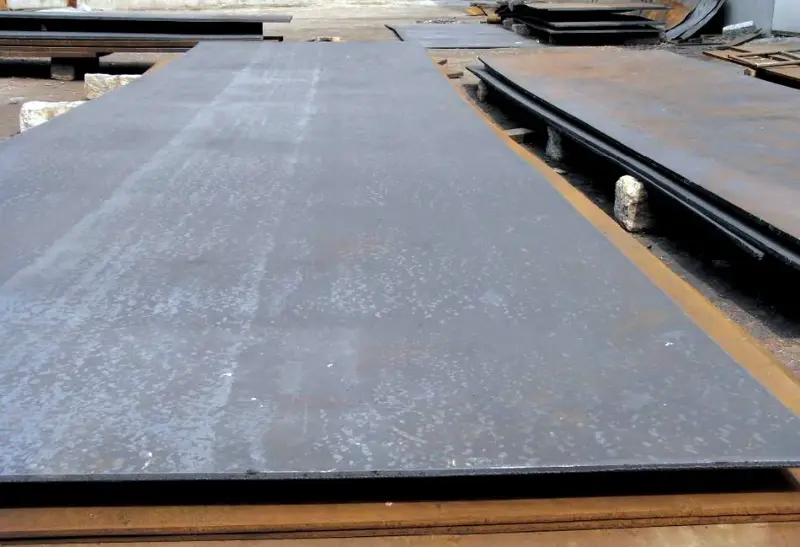
Q345D Carbon & Low-Alloy High-Strength Structural Steel Plate
Q345D Carbon & Low-Alloy High-Strength Structural Steel Plate - GB/T 1591
Q345D steel plate is a Chinese standard low-alloy high-strength structural steel with guaranteed impact properties at -20°C, widely used in welded structures, bridges, and heavy machinery.
Cutting, welding, bending, cold forming, machining, hot forging, normalising, stress relieving
- Phone : +8618037372205
- Email : [email protected]
- WhatsApp: Contact via Whtsapp
- WeChat: +8618037372205
Q345D Carbon & Low-Alloy High-Strength Structural Steel Plate Introduction
Q345D is a low-alloy high-strength structural steel defined in GB/T 1591-2008 (superseded by GB/T 1591-2018 in which Q355D replaces Q345D). It offers a minimum yield strength of 345 MPa for thicknesses ≤16 mm and excellent weldability. The "D" designation indicates that the steel is fully killed, fine-grain treated, and guarantees a minimum Charpy V‑notch impact energy of 34 J at -20°C. Compared to common carbon steels, Q345D provides higher strength, good ductility, and improved notch toughness, making it suitable for heavy welded structures operating in moderately low-temperature environments. Typical applications include bridges, pressure vessels, building structures, offshore platforms, and heavy-duty machinery. The steel is usually supplied in hot-rolled or normalised condition and can be further processed by cold forming, machining, and welding.
Q345D Carbon & Low-Alloy High-Strength Structural Steel Plate Chemical Composition according to GB/T 1591-2008
The ladle analysis of Q345D must comply with the following limits. The steel is fully killed and contains fine-grain elements such as Al, Nb, V, and Ti. The low permissible content of phosphorus and sulfur ensures good weldability and mechanical properties. Equivalent carbon (CEV) is typically controlled for weldability.
| Element | Specified Value (wt%) | Remarks |
|---|---|---|
| Carbon (C) | ≤ 0.18 | Ladle analysis |
| Silicon (Si) | ≤ 0.50 | |
| Manganese (Mn) | 1.00 – 1.60 | |
| Phosphorus (P) | ≤ 0.030 | |
| Sulfur (S) | ≤ 0.025 | |
| Niobium (Nb) | ≤ 0.07 | Optional grain-refining element |
| Vanadium (V) | ≤ 0.15 | Optional, may be present |
| Titanium (Ti) | ≤ 0.20 | Optional, may be present |
| Chromium (Cr) | ≤ 0.30 | Residual element |
| Nickel (Ni) | ≤ 0.50 | Residual element |
| Copper (Cu) | ≤ 0.30 | Residual element |
| Nitrogen (N) | ≤ 0.012 | For acid-soluble Al treated |
| Aluminium (Alₛ) | ≥ 0.015 | Acid-soluble, for fine-grain practice |
Q345D Carbon & Low-Alloy High-Strength Structural Steel Plate Thermal and Electrical Physical Properties
The physical properties given below are typical values for Q345D (similar to C‑Mn low-alloy steels) at room temperature and ambient conditions. These values are suitable for design calculations involving thermal loading, heat transfer, and electromagnetic applications. Actual properties may vary slightly with heat treatment and exact chemical composition.
| Property | Typical Value | Unit | Test Condition / Remarks |
|---|---|---|---|
| Density (ρ) | 7.85 | g/cm³ | at 20 °C |
| Modulus of elasticity (E) | 210 | GPa | at 20 °C, tensile |
| Shear modulus (G) | approx. 80 | GPa | at 20 °C |
| Poisson's ratio (ν) | 0.3 | - | at 20 °C |
| Thermal expansion coefficient (α) | 1.2 × 10⁻⁵ | K⁻¹ | 20–100 °C |
| Thermal conductivity (λ) | approx. 50 | W/(m·K) | at 20 °C |
| Specific heat capacity (c) | approx. 460 | J/(kg·K) | at 20 °C |
| Electrical resistivity (ρₑ) | approx. 0.17 | μΩ·m | at 20 °C |
Q345D Carbon & Low-Alloy High-Strength Structural Steel Plate Mechanical Properties – Q345D Steel Plate
The mechanical properties are determined on longitudinal test specimens taken from plates of different thickness ranges. The values below represent the minimum requirements according to GB/T 1591-2008. A tensile test and Charpy V‑notch impact test at -20°C are mandatory. Bend test is performed to evaluate ductility without cracking.
| Property | Specified Minimum Value | Unit | Test Condition |
|---|---|---|---|
| Upper yield strength (ReH) | 345 | MPa | Thickness ≤ 16 mm |
| Upper yield strength (ReH) | 335 | MPa | 16 mm < thickness ≤ 40 mm |
| Upper yield strength (ReH) | 325 | MPa | 40 mm < thickness ≤ 63 mm |
| Upper yield strength (ReH) | 315 | MPa | 63 mm < thickness ≤ 80 mm |
| Upper yield strength (ReH) | 305 | MPa | 80 mm < thickness ≤ 100 mm |
| Upper yield strength (ReH) | 285 | MPa | 100 mm < thickness ≤ 150 mm |
| Upper yield strength (ReH) | 275 | MPa | 150 mm < thickness ≤ 200 mm |
| Tensile strength (Rm) | 470 – 630 | MPa | All thicknesses |
| Elongation after fracture (A) | ≥ 20 | % | Thickness ≤ 40 mm, L₀=5.65√S₀ |
| Elongation after fracture (A) | ≥ 19 | % | 40 mm < thickness ≤ 63 mm |
| Elongation after fracture (A) | ≥ 18 | % | 63 mm < thickness ≤ 100 mm |
| Elongation after fracture (A) | ≥ 17 | % | 100 mm < thickness ≤ 150 mm |
| Elongation after fracture (A) | ≥ 16 | % | 150 mm < thickness ≤ 200 mm |
| Charpy V‑notch impact energy (KV₂) | ≥ 34 | J | Longitudinal, -20 °C |
| Bend test (bending angle 180°) | d = 2a | Thickness ≤ 16 mm | |
| Bend test (bending angle 180°) | d = 3a | Thickness > 16 mm |
Q345D Carbon & Low-Alloy High-Strength Structural Steel Plate Completely Equivalent Material Standards and Replaceable Grades
| Country / Region | Standard | Grade | Remarks |
|---|---|---|---|
| China | GB/T 1591-2018 | Q355D | Direct successor, identical properties except increased min. yield strength (355 MPa) |
| European Union | EN 10025-2:2019 | S355J2 (+N or +M) | Same -20°C impact requirement, CEV controlled for welding |
| International | ISO 4950-2 | Fe 355 D | Yield 355 MPa, impact 47 J at -20°C (optional) |
| Germany | DIN EN 10025-2 | S355J2+N | Identical to EN; widely used globally |
| Japan | JIS G 3106:2015 | SM490YB | Must be ordered with -20°C impact requirement to match |
| USA | ASTM A572/A572M | Grade 50 [345] | Must specify supplementary S5 impact test at -20°F (-29°C) for comparable toughness |
Q345D Carbon & Low-Alloy High-Strength Structural Steel Plate Application Introduction
Q345D steel combines high strength, good weldability, and reliable low‑temperature toughness. It is extensively used in welded structures where weight savings, durability, and safety under dynamic loads are critical. Below are typical application areas and components:
Product Applications: Welded plate girders and box girders, Steel building frameworks and columns, Offshore module structures and flare booms, Crane booms, excavator arms, and shovel buckets, Lorry frames and railway carriage underframes, High‑pressure piping and penstocks, Wind turbine tubular towers
Processed into products: Flanges and webs of fabricated beams, Base plates and bearing plates, Welded joints and gusset plates, Stiffeners and diaphragms in steel bridges, Seamless or welded hollow sections, Machined pins, bushings, and structural connectors, Flame‑cut parts for machinery frames
Application industries: Construction and civil infrastructure, Bridge engineering and highway structures, Shipbuilding and marine engineering (offshore platforms, deck structures), Pressure vessel and storage tank manufacturing, Heavy machinery and mining equipment, Railway vehicles and transportation, Wind power towers and renewable energy structures
Q345D Carbon & Low-Alloy High-Strength Structural Steel Plate Similar / Alternative Material Recommendations with Comparable Performance
| Country / Region | Standard | Grade | Remarks |
|---|---|---|---|
| China | GB/T 1591-2008 | Q345B | Same strength, impact at +20°C (lower toughness) |
| China | GB/T 1591-2008 | Q345E | Higher toughness, impact at -40°C |
| European Union | EN 10025-2 | S355J0 | Impact at 0°C, less suitable for cold environments |
| USA | ASTM A36/A36M | – | Lower yield strength (min. 250 MPa), more ductile |
| USA | ASTM A709/A709M | Grade 50T | Structural steel for bridges, impact toughness similar if class T |
| Russia / CIS | ГОСТ 19281 | 09Г2С (09G2S) | Yield ~325 MPa, impact -40°C, used in cryogenic applications |
Notes:
Weldability: Q345D is generally weldable with low-hydrogen processes. Preheating may be recommended for thicker sections (> 30 mm) or when carbon equivalent exceeds 0.45%. Post-weld heat treatment: Stress relieving may be applied according to fabrication codes. Delivery condition: Commonly normalised (N) or normalised rolled (+N) to guarantee toughness. Test certificates to EN 10204 type 3.1 are standard. Surface condition: Typically supplied with mill scale; blasted and primed options available. Design codes: Applicable design codes include Eurocode 3, AISC 360, GB 50017, etc.
- Share



