
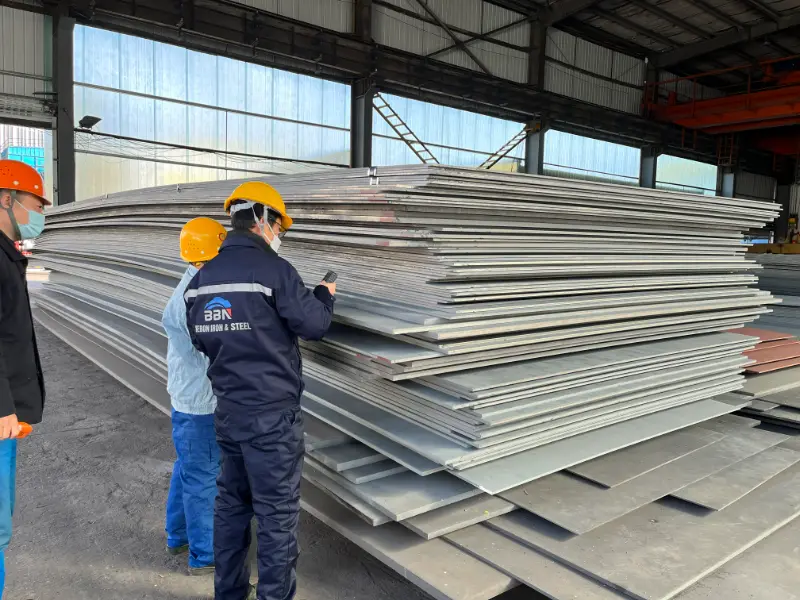
GB/T 16270 Q500C High-Strength Quenched and Tempered Steel Plate
Q500C Quenched & Tempered Steel Plate – GB/T 16270 High-Strength Structural Steel
Q500C is a high-strength quenched and tempered structural steel plate under Chinese standard GB/T 16270, offering a minimum yield strength of 500 MPa and guaranteed impact toughness at 0°C. Ideal for heavy-duty structures.
Cutting, cold forming (limited), machining, welding (with preheat and low hydrogen practice), plasma/laser cutting
- Phone : +8618037372205
- Email : [email protected]
- WhatsApp: Contact via Whtsapp
- WeChat: +8618037372205
GB/T 16270 Q500C High-Strength Quenched and Tempered Steel Plate Introduction
Q500C is a high-strength low-alloy structural steel grade specified in China standard GB/T 16270 – High Strength Structural Steel Plates in the Quenched and Tempered Condition. It belongs to the Q500 series with a minimum yield strength of 500 MPa for thicknesses up to 50 mm. The suffix 'C' denotes impact energy guarantee at 0°C (≥47 J longitudinal). This steel is produced by water quenching followed by tempering, achieving a fine tempered martensite/bainite microstructure with an excellent combination of high strength, good toughness, and weldability. Typical applications include bridges, shipbuilding, offshore structures, pressure vessels, heavy machinery, and crane booms. Q500C offers a cost-effective alternative to higher-alloyed grades while maintaining reliable mechanical performance in harsh environments.
GB/T 16270 Q500C High-Strength Quenched and Tempered Steel Plate Chemical Composition
The table below lists the maximum limits for chemical elements in Q500C according to GB/T 16270. The actual composition is adjusted by the manufacturer to achieve the required mechanical properties and carbon equivalent (CEV/CE) values. The steel is grain-refined with additions of Nb, V, Ti, and may contain Cr, Ni, Mo, Cu for hardenability. A strict control of P and S ensures good toughness.
| Element | Max % (Heat Analysis) | Remarks |
|---|---|---|
| Carbon (C) | 0.20 | Improves hardenability; Ceq/Pcm shall be agreed upon |
| Silicon (Si) | 0.80 | Deoxidizer; contributes to solid solution strengthening |
| Manganese (Mn) | 1.70 | Enhances hardenability and strength |
| Phosphorus (P) | 0.025 | Controlled for low-temperature toughness |
| Sulfur (S) | 0.015 | Very low to ensure cleanliness and through-thickness properties |
| Chromium (Cr) | 1.50 | Optional; added for hardenability |
| Nickel (Ni) | 2.00 | Optional; improves toughness especially at low temperatures |
| Molybdenum (Mo) | 0.70 | Optional; increases hardenability and temper resistance |
| Copper (Cu) | 0.50 | Residual; can be used for limited atmospheric corrosion resistance |
| Niobium (Nb) | 0.06 | Microalloying element for grain refinement and precipitation strengthening |
| Vanadium (V) | 0.12 | Microalloying; contributes to precipitation and solid solution strengthening |
| Titanium (Ti) | 0.05 | Grain refiner and nitrogen scavenger |
| Boron (B) | 0.005 | Optional; even in ppm range strongly increases hardenability |
GB/T 16270 Q500C High-Strength Quenched and Tempered Steel Plate Thermal and Electrical Physical Properties
The following values are typical for low-alloy quenched and tempered steels of this strength level. They may vary slightly depending on exact composition and heat treatment. These properties are suitable for design calculations and process engineering.
| Property | Typical Value | Unit | Test Condition |
|---|---|---|---|
| Density (ρ) | 7.85 | g/cm³ | At 20°C |
| Elastic modulus (E) | 206 | GPa | At 20°C, dynamic method |
| Shear modulus (G) | 79 | GPa | At 20°C |
| Poisson's ratio (ν) | 0.3 | – | In elastic range |
| Thermal expansion coefficient (α) | 12.0 | 10⁻⁶/K | Between 20°C and 100°C |
| Thermal conductivity (λ) | 52 | W/(m·K) | At 100°C |
| Specific heat capacity (c) | 460 | J/(kg·K) | At 20°C |
| Electrical resistivity (ρₑ) | 0.22 | μΩ·m | At 20°C |
GB/T 16270 Q500C High-Strength Quenched and Tempered Steel Plate Mechanical Properties
Mechanical properties are for quenched and tempered condition tested in longitudinal direction. Thickness ranges affect the minimum yield and tensile requirements. Charpy V-notch impact energy is guaranteed at 0°C for grade Q500C. Bend test is normally required as per agreement; typical values are indicated.
| Property | Requirement | Unit | Test Condition / Thickness |
|---|---|---|---|
| Yield strength (ReH/Rp0.2) | ≥ 500 ≥ 480 | MPa | ≤ 50 mm > 50 mm to 100 mm |
| Tensile strength (Rm) | 610 – 770 600 – 750 | MPa | ≤ 50 mm > 50 mm to 100 mm |
| Elongation after fracture (A) | ≥ 15 ≥ 15 | % | Gauge length 5.65√So, ≤50 mm Gauge length 5.65√So, >50-100 mm |
| Charpy-V impact energy (KV2) | ≥ 47 (longitudinal) | J | At 0°C, average of 3 specimens (single min. 70% of average) |
| Bend test (180°) | d = 3a d = 4a | – | Mandrel diameter (a=thickness); ≤50 mm Mandrel diameter >50-100 mm, no cracks |
GB/T 16270 Q500C High-Strength Quenched and Tempered Steel Plate Exact Equivalent Standards & Replaceable Grades
| Country/Region | Standard | Grade | Remarks |
|---|---|---|---|
| Europe / EU | EN 10025-6 | S500Q | Quenched & tempered; impact 0°C ≥47J; CEV ≤ 0.43% (≤50 mm) which mirrors Q500C principal requirements |
| International | ISO 630-6 | S500Q | High yield strength structural steel, Q+T; impact at 0°C or lower by agreement; directly exchangeable with GB/T 16270 Q500C |
GB/T 16270 Q500C High-Strength Quenched and Tempered Steel Plate Application Introduction
Q500C steel is designed for heavy structural applications where high strength-to-weight ratio and reliable low-temperature toughness are critical. It is widely used in welded constructions after proper preheat and interpass temperature control. Typical applications include:
Product Applications: Crane and mobile crane telescopic booms, Offshore subsea structures and platform beams, Railway bridge main girders, Military bridging equipment, Armored civil engineering vehicle cabins, Large storage tanks for cryogenic liquids (by agreement)
Processed into products: Welded girders and box sections, Reinforcement ribs and stiffeners for heavy steel structures, Boom segments and luffing frames for crawler cranes, Bottom plates and side plates for mining dump bodies, Pressure shell segments for hydro-power penstocks, Fatigue-critical welded assemblies in suspension bridges
Application industries: Bridge construction (box girders, arch bridges), Shipbuilding and marine structures (hull reinforcement, decks), Offshore oil & gas platforms (jackets, topsides, heavy-lift cranes), Pressure vessels and penstocks (hoop stress applications), Heavy machinery and mining equipment (excavator booms, dump truck bodies, bulldozer blades), Wind turbine towers and foundations (high fatigue resistance sections)
GB/T 16270 Q500C High-Strength Quenched and Tempered Steel Plate Similar / Substitute Materials Recommendations
| Country/Region | Standard | Grade | Remarks |
|---|---|---|---|
| China | GB/T 16270 | Q550C | Higher strength (≥550 MPa) quenched & tempered grade with same 0°C impact toughness; can be used for weight reduction or more demanding designs |
| Europe | EN 10025-6 | S460Q | Lower strength (≥460 MPa) Q+T grade; suitable where design allows reduced strength but similar toughness and weldability |
| Europe | EN 10025-6 | S500QL | Improved low-temperature toughness (-20°C or -40°C) while maintaining 500 MPa strength; a direct upgrade for more severe service conditions |
| China | GB/T 1591 | Q460C | Non-quenched high-strength structural steel (TMCP/ normalized); lower strength but easier welding; substitute only if as-welded properties acceptable |
Notes:
- Carbon Equivalent (CEV) and/or Pcm values shall be agreed upon at the time of enquiry and order to ensure adequate weldability. Typical CEV for Q500C is ~0.42–0.47 for thickness ≤50 mm.
- Ultrasonic testing per GB/T 2970 (or EN 10160, ASTM A578) is normally specified. Class II or higher is common.
- Post-weld heat treatment (PWHT) is generally not required when welding procedures are qualified; however, for stress relief the temperature must stay below the tempering temperature (typically ≤ 30°C below original tempering).
- Where through-thickness properties are required (Z-quality), steel shall be ordered as Q500C-Z15/Z25/Z35 according to GB/T 5313, requiring very low sulfur content and controlled rolling or vacuum degassing.
- Forming operations after quenching and tempering may require a stress relief treatment to restore mechanical properties if severe cold deformation is applied.
- Share



