
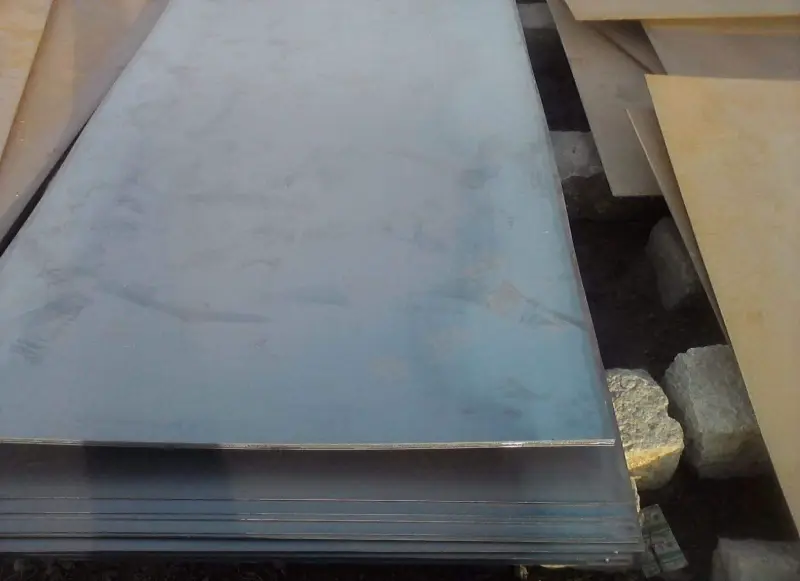
Q460F High-Strength Quenched and Tempered Steel Plate
Q460F High-Strength Quenched and Tempered Steel Plate for Structural Applications
In-depth technical data for Q460F steel according to GB/T 16270. Covers chemical composition, mechanical properties, thermal and electrical characteristics, equivalent international grades, and practical application guidance.
Hot rolling, quenching and tempering, cold forming, welding, machining
- Phone : +8618037372205
- Email : [email protected]
- WhatsApp: Contact via Whtsapp
- WeChat: +8618037372205
Q460F High-Strength Quenched and Tempered Steel Plate Introduction
Q460F is a carbon and low-alloy high-strength structural steel plate produced in accordance with Chinese standard GB/T 16270. It is supplied in the quenched and tempered (Q+T) condition, guaranteeing a minimum yield strength of 460 MPa for thicknesses up to 50 mm. The suffix 'F' designates a quality level with guaranteed Charpy V‑notch impact toughness down to −60 °C. This grade offers a fine balance of high strength, good weldability (with controlled carbon equivalent), and excellent low-temperature notch toughness, making it suitable for heavy-duty structural applications in harsh environments.
Q460F High-Strength Quenched and Tempered Steel Plate Chemical Composition for Q460F
The table below specifies the maximum limits for alloying elements and residual elements as required by GB/T 16270. Grain-refining elements such as Al, Nb, V, and Ti are added to achieve fine grain size and improve mechanical properties. The carbon equivalent (CEV) is controlled to ensure good weldability and typically does not exceed 0.47% for thicknesses ≤ 50 mm. The low sulfur and phosphorus contents guarantee high cleanliness and superior toughness.
| Element | Maximum or Range (wt%) | Remarks |
|---|---|---|
| C | ≤ 0.18 | Carbon |
| Si | ≤ 0.50 | Silicon |
| Mn | ≤ 1.70 | Manganese |
| P | ≤ 0.020 | Phosphorus |
| S | ≤ 0.010 | Sulfur |
| Cr | ≤ 0.70 | Chromium |
| Ni | ≤ 0.80 | Nickel |
| Cu | ≤ 0.30 | Copper |
| Mo | ≤ 0.20 | Molybdenum |
| V | ≤ 0.08 | Vanadium |
| Nb | ≤ 0.06 | Niobium |
| Ti | ≤ 0.05 | Titanium |
| B | ≤ 0.0040 | Boron (if added for hardenability) |
| Al(tot) | ≥ 0.015 | Total aluminium, as grain refiner |
| CEV | ≤ 0.47* | Carbon equivalent for t ≤ 50 mm |
Q460F High-Strength Quenched and Tempered Steel Plate Thermal and Electrical Physical Properties
The following physical constants are typical reference values for low‑alloy quenched and tempered structural steel and are not part of GB/T 16270. These properties are temperature dependent; values are given for room temperature unless otherwise stated. They are useful for thermal and structural analysis in design.
| Property | Typical Value | Unit | Test Condition / Remarks |
|---|---|---|---|
| Density (ρ) | 7.85 | g/cm³ | At 20 °C |
| Elastic Modulus (E) | 205 | GPa | At 20 °C |
| Shear Modulus (G) | 80 | GPa | At 20 °C |
| Poissonʼs Ratio (ν) | 0.30 | — | At 20 °C |
| Thermal Expansion Coeff. (α) | 11.7 | 10⁻⁶/K | 20–100 °C |
| Thermal Expansion Coeff. (α) | 12.6 | 10⁻⁶/K | 20–200 °C |
| Thermal Expansion Coeff. (α) | 13.5 | 10⁻⁶/K | 20–400 °C |
| Thermal Conductivity (λ) | 42 | W/(m·K) | At 20 °C |
| Thermal Conductivity (λ) | 39 | W/(m·K) | At 200 °C |
| Thermal Conductivity (λ) | 35 | W/(m·K) | At 400 °C |
| Specific Heat Capacity (cp) | 460 | J/(kg·K) | At 20 °C |
| Specific Heat Capacity (cp) | 515 | J/(kg·K) | At 200 °C |
| Specific Heat Capacity (cp) | 605 | J/(kg·K) | At 400 °C |
| Electrical Resistivity (ρₑ) | 0.22 | μΩ·m | At 20 °C |
Q460F High-Strength Quenched and Tempered Steel Plate Mechanical Properties for Q460F
The mechanical properties are guaranteed in the quenched and tempered condition as per GB/T 16270. Values vary with plate thickness; the table lists the most common thickness ranges. Charpy V‑notch impact energy is measured on longitudinal specimens. The bending test is performed at 180° without cracking. All values are minimum unless a range is given.
| Property | Specified Value | Unit | Test Condition / Remarks |
|---|---|---|---|
| Yield Strength, ReH | ≥ 460 | MPa | Thickness ≤ 50 mm |
| Yield Strength, ReH | ≥ 440 | MPa | Thickness >50–100 mm |
| Yield Strength, ReH | ≥ 400 | MPa | Thickness >100–150 mm |
| Tensile Strength, Rm | 550 – 720 | MPa | All thicknesses |
| Elongation, A (L₀=5.65√S₀) | ≥ 17 | % | Longitudinal, thickness ≤ 50 mm |
| Elongation, A (L₀=5.65√S₀) | ≥ 17 | % | Longitudinal, thickness >50–100 mm |
| Elongation, A (L₀=5.65√S₀) | ≥ 17 | % | Longitudinal, thickness >100–150 mm |
| Charpy Impact Energy, KV₂ (−60 °C) | ≥ 34 | J | Longitudinal, V‑notch |
| Charpy Impact Energy, KV₂ (−60 °C) | ≥ 22 | J | Transverse, V‑notch (upon agreement) |
| Bend Test (180°) at d=a | No cracks | – | Thickness ≤ 16 mm |
| Bend Test (180°) at d=2a | No cracks | – | Thickness >16–50 mm |
| Bend Test (180°) at d=3a | No cracks | – | Thickness >50–100 mm |
Q460F High-Strength Quenched and Tempered Steel Plate Fully Equivalent Material Standards and Replaceable Grades
| Country / Region | Standard | Grade | Remarks |
|---|---|---|---|
| Europe | EN 10025-6 | S460QL1 (1.8912) | Quenched and tempered, guaranteed impact at −60 °C; direct equivalent |
| International | ISO 4950-3 | E460E | High yield strength flat products; impact energy at −60 °C |
| China | GB/T 16270 | Q460E | Same strength level but impact test at −40 °C; for −60 °C choose F |
Q460F High-Strength Quenched and Tempered Steel Plate Application Introduction
Owing to its high strength, excellent low‑temperature toughness, and good weldability, Q460F is extensively used in demanding welded structures subjected to dynamic loading and low ambient temperatures. It is particularly well suited for heavy‑section components where weight reduction and reliability are critical.
Product Applications: Welded bridge girders and box sections, Offshore platform legs and nodes, Heavy‑duty truck chassis and crane booms, Mining dump truck bodies and excavator buckets, Penstocks and spiral casings for hydropower stations, Pressure vessels for low‑temperature service, Heavy‑duty jigs and fixtures in manufacturing
Processed into products: Structural plates cut and welded to form beams, columns, and trusses, Flitch plates and reinforcing plates for concrete foundations, Crane outriggers and slew rings, Wind turbine tower flanges and base plates, Bearing pads and support frames, Spreader bars and lifting eyes, High‑strength bolted splice plates
Application industries: Heavy machinery manufacturing, Mining and earthmoving equipment, Bridge and infrastructure construction, Offshore and marine engineering, Pressure vessel and storage tank fabrication, Crane and lifting device production, Shipbuilding (as structural member)
Q460F High-Strength Quenched and Tempered Steel Plate Close / Similar Alternative Grades to Q460F
| Country / Region | Standard | Grade | Remarks |
|---|---|---|---|
| Europe | EN 10025-6 | S460Q (1.8908) | Quenched and tempered, impact at −20 °C; suitable if lowered toughness requirement |
| Europe | EN 10025-3 | S460N / S460NL | Normalised / normalised rolled; lower strength and toughness levels |
| Europe | EN 10025-4 | S460M / S460ML | Thermomechanical rolled; comparable strength, different delivery condition |
| USA | ASTM A709 | HPS 70W | High‑performance structural steel; minimum yield 485 MPa, weathering |
| USA | ASTM A514 | Grade B / H / F | Quenched and tempered alloy steel; minimum yield 690 MPa, higher strength |
| Japan | JIS G3128 | SHY685N | High yield strength quenched and tempered plate; min 685 MPa, overmatching |
| China | GB/T 1591 | Q460D | Hot‑rolled or normalised; not quenched, impact at −20 °C |
Notes:
When ordering, the desired impact test temperature and orientation (longitudinal/transverse) must be specified. The indicated chemical composition is based on ladle analysis; product analysis tolerances apply according to GB/T 222. For thicknesses above 150 mm, mechanical properties and heat treatment should be negotiated with the manufacturer. The typical physical properties are for general guidance only and should be verified for critical design cases.
- Share



