
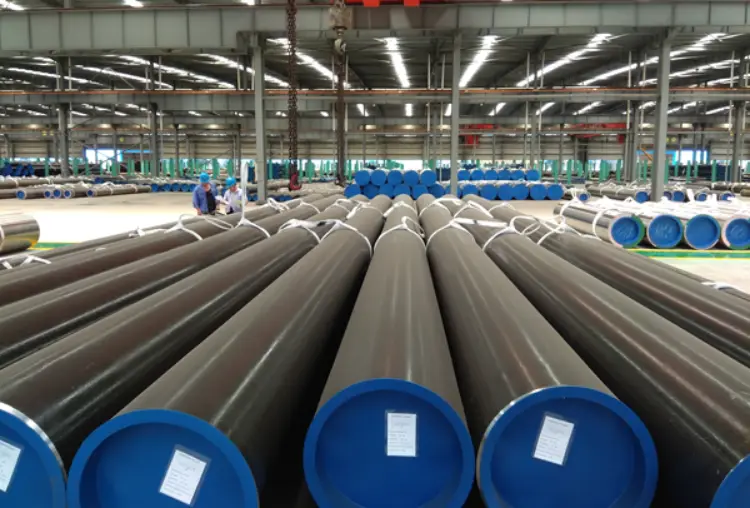
DIN 17175 15Mo3 Boiler Steel Pipe
DIN 17175 15Mo3 Boiler Steel Pipe: High-Temperature Seamless Tube for Pressure Parts
Detailed technical data for 15Mo3 steel according to DIN 17175, including chemical composition, mechanical properties, thermal properties, international equivalents, and application guidance.
Hot rolled, cold drawn, normalised, annealed, welded (with matching filler metal)
- Phone : +8618037372205
- Email : [email protected]
- WhatsApp: Contact via Whtsapp
- WeChat: +8618037372205
DIN 17175 15Mo3 Boiler Steel Pipe Introduction
15Mo3 is a low-alloy molybdenum steel seamless tube specified in the withdrawn German standard DIN 17175, designed for elevated temperature service in steam boilers, pressure vessels, and power generating equipment. It contains nominally 0.25–0.35% molybdenum, which enhances creep strength and resistance to hydrogen attack at temperatures up to approximately 500°C. The material exhibits good weldability and toughness, with typical room-temperature tensile strength of 440–590 MPa and yield strength above 265 MPa. Its well-balanced carbon and manganese content ensures adequate formability and machinability for tube bending, swaging, and expanding operations. Although superseded by EN 10216-2 grade 16Mo3, the 15Mo3 designation is still widely referenced in international engineering specifications, particularly for replacement parts in legacy boiler plants. Equivalent grades include ASTM A209 grade T1 and BS 3059-2 243, which share similar chemical and mechanical limits and can often be directly substituted under appropriate procedural approvals.
DIN 17175 15Mo3 Boiler Steel Pipe Chemical Composition
The chemical composition conforms to the limits specified in DIN 17175 for grade 15Mo3. Molybdenum is the principal alloying element, providing elevated-temperature strength. The phosphorus and sulfur contents are tightly controlled to ensure good hot workability and weldability. Trace elements not explicitly limited by the standard are typically reported for reference only in actual mill certificates.
| Element | Standard Value | Remarks |
|---|---|---|
| Carbon (C) | 0.12 - 0.20 | Provides strength and hardenability |
| Silicon (Si) | 0.10 - 0.35 | Deoxidizer, improves oxidation resistance |
| Manganese (Mn) | 0.40 - 0.80 | Contributes to strength and toughness |
| Phosphorus (P) | ≤ 0.035 | Max limit for ductility and cleanliness |
| Sulfur (S) | ≤ 0.035 | Max limit for machinability and avoidance of hot shortness |
| Molybdenum (Mo) | 0.25 - 0.35 | Primary alloying element for creep resistance |
| Chromium (Cr) | ≤ 0.30 | Residual, not intentionally added |
| Nickel (Ni) | ≤ 0.30 | Residual, not intentionally added |
| Copper (Cu) | ≤ 0.30 | Residual, may be present |
| Total of Cr+Cu+Ni | ≤ 0.70 | Combined limit for residuals |
DIN 17175 15Mo3 Boiler Steel Pipe Thermal and Electrical Physical Properties
Physical properties are based on data for low-carbon Mo-alloy steel at ambient and elevated temperatures. Accurate values may vary slightly depending on exact heat composition and heat treatment condition. These properties are essential for thermal stress analysis, heat transfer calculations, and electrical resistivity estimates in boiler tube applications. Thermal conductivity decreases moderately with increasing temperature, while thermal expansion increases.
| Property | Typical Value | Unit | Test Condition / Temperature |
|---|---|---|---|
| Density (ρ) | 7.85 | g/cm³ | At 20°C |
| Elastic Modulus (E) | 210 | GPa | At 20°C |
| Elastic Modulus (E) | 205 | GPa | At 100°C |
| Elastic Modulus (E) | 195 | GPa | At 200°C |
| Elastic Modulus (E) | 185 | GPa | At 300°C |
| Elastic Modulus (E) | 175 | GPa | At 400°C |
| Shear Modulus (G) | 81 | GPa | At 20°C (calculated from E and ν) |
| Poisson's Ratio (ν) | 0.3 | − | Typical for steel |
| Thermal Expansion Coefficient (α) | 11.5 | 10^-6/K | Between 20°C and 100°C |
| Thermal Expansion Coefficient (α) | 12.5 | 10^-6/K | Between 20°C and 200°C |
| Thermal Expansion Coefficient (α) | 13.0 | 10^-6/K | Between 20°C and 300°C |
| Thermal Expansion Coefficient (α) | 13.5 | 10^-6/K | Between 20°C and 400°C |
| Thermal Expansion Coefficient (α) | 14.0 | 10^-6/K | Between 20°C and 500°C |
| Thermal Conductivity (λ) | 42 | W/(m·K) | At 20°C |
| Thermal Conductivity (λ) | 41 | W/(m·K) | At 100°C |
| Thermal Conductivity (λ) | 39 | W/(m·K) | At 200°C |
| Thermal Conductivity (λ) | 37 | W/(m·K) | At 300°C |
| Thermal Conductivity (λ) | 35 | W/(m·K) | At 400°C |
| Specific Heat Capacity | 460 | J/(kg·K) | At 20°C |
| Specific Heat Capacity | 500 | J/(kg·K) | At 200°C |
| Specific Heat Capacity | 540 | J/(kg·K) | At 400°C |
| Electrical Resistivity (ρe) | 0.22 | μΩ·m | At 20°C |
DIN 17175 15Mo3 Boiler Steel Pipe Mechanical Properties
Mechanical properties are specified for room temperature longitudinal tensile test and impact test, as required by DIN 17175. The material is normally supplied in the normalised condition, which develops a fine ferritic-pearlitic microstructure. Yield strength and tensile strength decrease gradually at elevated temperatures, and the design stresses should follow the applicable pressure vessel codes (e.g. EN 12952). The impact energy values are guaranteed down to 20°C.
| Property | Standard Requirement | Unit | Test Condition / Note |
|---|---|---|---|
| Yield Strength (ReH), min. | 265 | MPa | Room temperature, longitudinal, wall thickness ≤ 16 mm |
| Yield Strength (ReH), min. | 255 | MPa | Room temperature, longitudinal, wall thickness 16 < t ≤ 40 mm |
| Yield Strength (ReH), min. | 235 | MPa | Room temperature, longitudinal, wall thickness 40 < t ≤ 60 mm |
| Tensile Strength (Rm) | 440 - 590 | MPa | Room temperature, longitudinal, all thicknesses |
| Elongation (A), min. | 22 | % | Longitudinal, gauge length 5.65√S0, t ≤ 40 mm |
| Elongation (A), min. | 20 | % | Longitudinal, gauge length 5.65√S0, 40 < t ≤ 60 mm |
| Impact Energy (KV), min. | 34 | J | Charpy V-notch, transverse, at 20°C |
| Bend Test (Mandrel Diameter) | 180° without cracking | − | Mandrel diameter = 3 × wall thickness (t) for t ≤ 12.5 mm; 5 × t for t > 12.5 mm |
| Hardness, max. | 170 | HB | For information, not a mandatory requirement |
DIN 17175 15Mo3 Boiler Steel Pipe Equivalent Material Standards and Designations
| Country/Region | Standard | Grade | Remarks |
|---|---|---|---|
| European Union | EN 10216-2 | 16Mo3 | Direct replacement; slightly higher Mo (0.15-0.35), other limits nearly identical |
| Germany | DIN 17175 (withdrawn) | 15Mo3 | Original standard; normalized condition |
| United States | ASTM A209 / A209M | Grade T1 | C 0.09-0.18, Mn 0.50-0.81, Mo 0.44-0.65; somewhat higher Mo, higher tensile strength range; suitable for same temperature range |
| United Kingdom | BS 3059-2:1990 | 243 | Boiler and superheater tubes; C 0.12-0.20, Mn 0.40-0.80, Mo 0.25-0.35; essentially identical |
| Japan | JIS G3462 | STBA12 | Alloy steel boiler and heat exchanger tubes; C ≤0.15, Mn 0.30-0.60, Mo 0.45-0.65; somewhat different chemistry but interchangeable in many applications |
| China | GB 5310 | 15MoG | C 0.12-0.20, Mn 0.40-0.80, Mo 0.25-0.35; seamless tubes for high-pressure boiler |
DIN 17175 15Mo3 Boiler Steel Pipe Application Introduction
15Mo3 seamless tubes were developed for elevated-temperature and pressure service, particularly in fossil-fuel-fired boilers. Their molybdenum addition improves resistance to graphitization and hydrogen attack compared to carbon steel, making them reliable for long-term operation at metal temperatures between 450°C and 500°C. The material is easily fabricated by bending, welding, and expanding, and it is commonly used to construct entire wall panels, convection passes, and headers. When replacing with the newer EN 10216-2 16Mo3 grade, all engineering calculations should be rechecked because of the slightly modified allowed stress values.
Product Applications: Waterwall and roof tubes, Superheater and reheater sections (up to ~510°C), Economizer tubes, Steam headers and connecting pipes, Heat exchanger tube bundles, Oil and gas process heater coils, Drying cylinders and calender rolls (paper industry)
Processed into products: Boiler bank tubing sections (straight and bent), Tube-to-header stub connections, Forged tube fittings and elbows, Swaged and expanded tube joints, Laser-welded composite tube panels, Tube shields and protective cladding (for erosion protection), Pressure gauge and thermometer wells (machined from thick-walled tube)
Application industries: Thermal power plants (coal, oil, gas), Combined heat and power (CHP) stations, Waste incineration plants, Petrochemical and refinery process heaters, Industrial boiler manufacturing, Heat exchanger and air preheater OEMs, Steam distribution networks
DIN 17175 15Mo3 Boiler Steel Pipe Similar or Nearby Alternative Materials
| Country/Region | Standard | Grade | Remarks |
|---|---|---|---|
| European Union | EN 10216-2 | 13CrMo4-5 | Contains 0.7-1.25% Cr and 0.40-0.60% Mo; higher creep strength, suitable up to 560°C; can replace 15Mo3 in higher-temperature sections, but requires PWHT control |
| United States | ASTM A213 / A213M | T11 | 1.00-1.50% Cr, 0.44-0.65% Mo; popular boiler tube grade with improved oxidation and hydrogen resistance; a step upgrade from plain Mo steel |
| United States | ASTM A335 | P1 | Seamless ferritic alloy-steel pipe; C 0.10-0.20, Mo 0.44-0.65; similar temperature range but distinct thickness limits |
| Japan | JIS G3462 | STBA13 | 0.5Cr-0.5Mo grade; enhanced creep resistance; often used when slight increase in alloy content is acceptable |
| China | GB 5310 | 20G | Plain carbon steel boiler tube; lower cost for lower temperature sections; no Mo; upper service limit around 450°C |
Notes:
DIN 17175 has been officially replaced by EN 10216-2:2013 for pressure purposes. However, 15Mo3 is still widely encountered in maintenance and retrofit projects. Important considerations:
- Hydrogen service: 15Mo3 tubes can resist hydrogen attack below the Nelson curve limits for 0.5 Mo steel, but for hydrogen partial pressures above 5 MPa at 450°C, Cr-Mo grades like 13CrMo4-5 are recommended.
- Welding: Use filler metal matching the 16Mo3 or T1 chemistry, typically ER80S-G (AWS A5.28) or similar. Preheat to 150–250°C for thick sections and perform post-weld heat treatment at 620–660°C for 1 hour per 25 mm of thickness.
- Cold bending: Should be followed by stress-relief annealing at 580–620°C if elongation exceeds 5% to restore ductility.
- Corrosion resistance: The atmospheric corrosion resistance of 15Mo3 is similar to that of mild steel; protective coatings or paints are needed for outdoor storage and application.
- Share



