
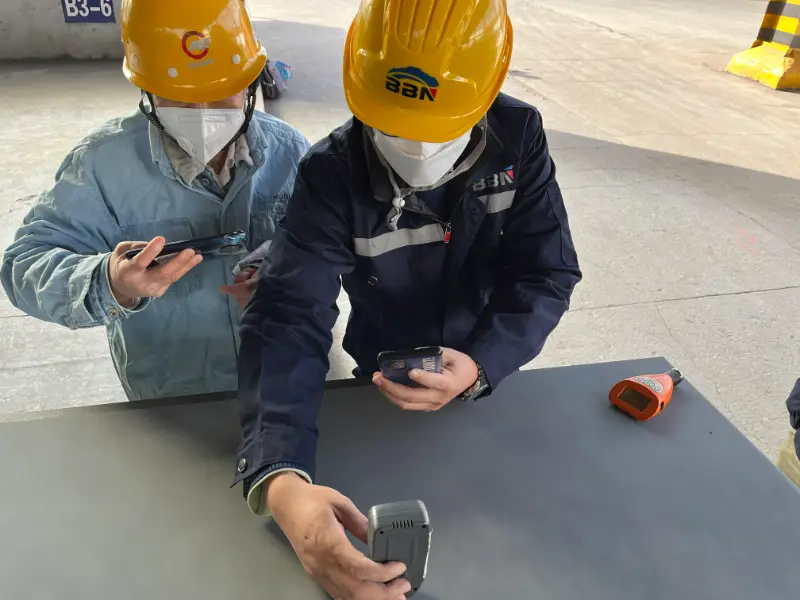
ASTM A514/A514M Grade J
ASTM A514/A514M Grade J: High-Strength Quenched & Tempered Alloy Steel for Structural Applications
Comprehensive material data for ASTM A514 Grade J carbon and low-alloy high-strength steel coil/plate, including chemical composition, mechanical and thermal properties, international equivalents, and application guide.
Hot-rolled, Quenched and Tempered (Q&T)
- Phone : +8618037372205
- Email : [email protected]
- WhatsApp: Contact via Whtsapp
- WeChat: +8618037372205
ASTM A514/A514M Grade J Introduction
ASTM A514/A514M Grade J is a quenched and tempered (Q&T) high-strength low-alloy steel designed for structural applications requiring excellent strength, weldability, and low-temperature toughness. With a minimum yield strength of 690 MPa (100 ksi), it offers outstanding load-bearing capacity and is frequently used in heavy machinery, bridges, pressure vessels, and offshore structures. Grade J contains nickel, chromium, molybdenum, and controlled boron additions to enhance hardenability and ensure consistent mechanical properties throughout thick sections. It is supplied in the quenched and tempered condition and exhibits good notch toughness at sub-zero temperatures, making it suitable for demanding environments. The material can be formed, welded, and machined using conventional methods when appropriate precautions are observed.
ASTM A514/A514M Grade J Chemical Composition
The chemical composition of ASTM A514 Grade J is carefully controlled to achieve high hardenability and excellent mechanical properties. Nickel and chromium provide deep hardening, while molybdenum and boron further enhance through-thickness strength after quenching and tempering. The low carbon content ensures good weldability. Residual elements are tightly restricted to avoid adverse effects on toughness.
| Element | Nominal Value (%) | Remarks |
|---|---|---|
| Carbon (C) | 0.12 - 0.21 | Heat analysis, range |
| Manganese (Mn) | 0.45 - 0.70 | Heat analysis, range |
| Phosphorus (P) | ≤ 0.025 | Maximum |
| Sulfur (S) | ≤ 0.025 | Maximum |
| Silicon (Si) | 0.15 - 0.35 | Heat analysis, range |
| Nickel (Ni) | 1.00 - 1.50 | Heat analysis, range |
| Chromium (Cr) | 0.80 - 1.20 | Heat analysis, range |
| Molybdenum (Mo) | 0.15 - 0.30 | Heat analysis, range |
| Boron (B) | 0.0005 - 0.005 | Heat analysis, range |
| Copper (Cu) | ≤ 0.50 | If specified (optional) |
| Vanadium (V) | ≤ 0.08 | If specified (optional) |
| Titanium (Ti) | ≤ 0.05 | If specified (optional) |
ASTM A514/A514M Grade J Thermal and Electrical Physical Properties
The following physical properties are typical values for quenched and tempered low-alloy steel. They are not part of the standard specification but are provided for engineering calculations. Actual values may vary slightly depending on the exact heat treatment and composition. Thermal expansion and conductivity influence welding and service performance.
| Property | Typical Value | Unit | Test Conditions |
|---|---|---|---|
| Density (ρ) | 7.85 | g/cm³ | At 20 °C |
| Elastic Modulus (E) | 205 | GPa | At 20 °C, tension |
| Shear Modulus (G) | 80 | GPa | At 20 °C |
| Poisson's Ratio (ν) | 0.29 | — | At 20 °C |
| Thermal Expansion Coefficient (α) | 11.7 | 10⁻⁶/K | Between 20 °C and 100 °C |
| Thermal Expansion Coefficient (α) | 12.5 | 10⁻⁶/K | Between 20 °C and 300 °C |
| Thermal Conductivity (λ) | 48 | W/(m·K) | At 20 °C |
| Specific Heat Capacity | 480 | J/(kg·K) | At 20 °C |
| Electrical Resistivity (ρ_e) | 0.22 | µΩ·m | At 20 °C |
ASTM A514/A514M Grade J Mechanical Properties
The mechanical properties are guaranteed for plates in the quenched and tempered condition. Tensile testing is performed in the transverse direction. Minimum elongation varies with plate thickness; thicker sections require a longer gauge length. Charpy V-notch impact tests are required at -51 °C (-60 °F) to guarantee low-temperature toughness. Bend tests are performed to verify ductility and freedom from cracking.
| Property | Specified Value | Unit | Test Conditions |
|---|---|---|---|
| Yield Strength (ReH, 0.2% offset) | ≥ 690 | MPa | Transverse, all thicknesses ≤ 63.5 mm (2.5 in) |
| Tensile Strength (Rm) | 760 - 895 | MPa | Transverse, all thicknesses ≤ 63.5 mm |
| Elongation (A) | ≥ 18 | % | Gauge length 50 mm (2 in), thickness ≤ 19 mm (3/4 in) |
| Elongation (A) | ≥ 16 | % | Gauge length 200 mm (8 in), thickness 19-63.5 mm (3/4-2.5 in) |
| Bend Test (180°) | Bend diameter = plate thickness | Thickness ≤ 19 mm (3/4 in) | |
| Bend Test (180°) | Bend diameter = 1.5 × plate thickness | Thickness 19-63.5 mm (3/4-2.5 in) | |
| Charpy V-notch Impact (KV) | ≥ 27 | J | Transverse, at -51 °C (-60 °F) |
ASTM A514/A514M Grade J Fully Equivalent Material Standards and Replaceable Grades
| Country/Region | Standard | Grade / Designation | Remarks |
|---|---|---|---|
| USA | ASTM A514/A514M | Grade J | Original specification, Q&T plate |
| International | None directly identical | — | Other grades have similar strength but differ in chemistry or delivery condition |
ASTM A514/A514M Grade J Application Introduction
ASTM A514 Grade J is specifically designed for heavy-load structural applications where high strength-to-weight ratio, good weldability, and reliable low-temperature toughness are critical. Its typical use includes welded constructions operating in cold climates or under dynamic loads. Fabrication processes such as cutting, forming, and welding must follow recommended practices, including controlled preheating and post-weld heat treatment when necessary, to preserve the tempered microstructure.
Product Applications: Welded structural beams and columns, Lifting booms for mobile cranes, Offshore platform decks and legs, Heavy-duty dump truck bodies, Bridge girders and load-bearing components, Pressure vessel shells and heads
Processed into products: Crane lattice booms and bases, High-stress welded joints and splices, Mining truck frames and wear plates, Bridge support bearings and expansion joints, Heavy gear blanks and shaft couplings, Penstocks and high-pressure piping segments
Application industries: Construction and civil engineering (bridges, high-rise buildings, stadiums), Heavy machinery (earthmoving, mining trucks, cranes), Shipbuilding and offshore platforms (jack-up rig legs, hull strengthening), Pressure vessels and storage tanks (industrial gas tanks, process equipment), Transportation (heavy-duty trailers, railcars), Mining and mineral processing (crushers, screens, chutes)
ASTM A514/A514M Grade J Similar/Alternative Material Recommendations
| Country/Region | Standard | Grade | Remarks |
|---|---|---|---|
| Europe | EN 10025-6 | S690QL (1.8928) | Similar minimum yield strength (690 MPa), quenched and tempered, but chemistry may differ; good low-temperature toughness. |
| Japan | JIS G 3128 | SHY685 | High yield strength (685 MPa) plate for welded structures; comparable strength and application. |
| China | GB/T 16270 | Q690D / Q690E | High-strength quenched and tempered structural steel plate with 690 MPa yield strength; check thickness availability. |
| USA | ASTM A517/A517M | Grade J | Similar chemistry but intended for pressure vessel plates; mechanical properties nearly identical. |
| Europe | EN 10025-6 | S690Q (1.8931) | Higher carbon equivalent, lower toughness than S690QL; less suitable for severe cold service. |
Notes:
Welding considerations: The steel has a controlled low carbon equivalent to avoid cold cracking, but preheating (typically 100–200 °C) is recommended depending on plate thickness and hydrogen control. Low-hydrogen welding processes and consumables with matching strength are required. Post-weld heat treatment is generally not applied because it may impair the tempered properties. Forming: Cold forming should be followed by stress relieving if deformation exceeds 5%. Hot forming must be followed by re-quenching and tempering to restore mechanical properties. Availability: Supplied as coil or plate up to 63.5 mm (2.5 in) thickness; coil products are often used for cut-to-length sheets or welded tube manufacturing.
- Share



