
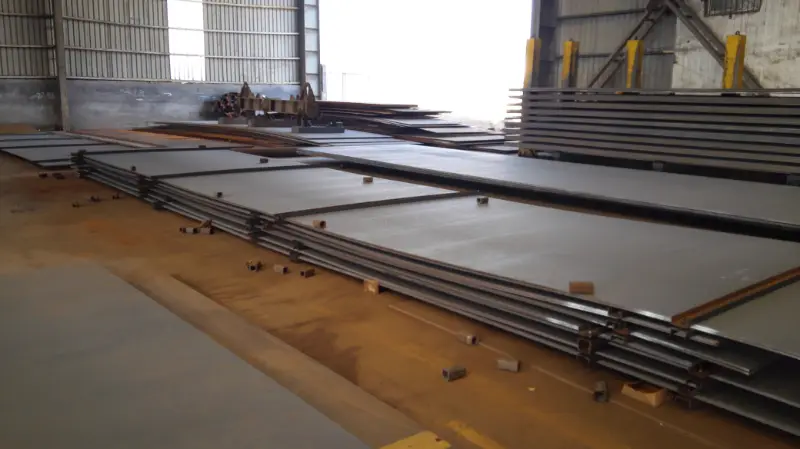
Q550D (GB/T 16270) High-Strength Quenched & Tempered Steel Plate
Q550D (GB/T 16270) High-Strength Quenched & Tempered Steel Plate - Properties, Equivalents and Applications
Comprehensive data sheet for Q550D steel plate under GB/T 16270: chemical composition, mechanical and physical properties, international equivalents, and typical applications in construction and machinery.
Cutting, welding, bending, cold forming (with precautions), machining
- Phone : +8618037372205
- Email : [email protected]
- WhatsApp: Contact via Whtsapp
- WeChat: +8618037372205
Q550D High-Strength Quenched & Tempered Steel Plate Introduction
Q550D is a carbon and low-alloy high-strength structural steel plate produced to GB/T 16270 in the quenched and tempered (Q&T) condition. It is classified as a 550 MPa minimum yield strength grade with enhanced low-temperature toughness (D-quality, impact tested at -20 °C).
The steel is designed for welded heavy-duty structures where weight savings, high strength, and good ductility are critical. Quenching and tempering provide an optimal balance of strength, toughness, and weldability.
Key characteristics include:
- Minimum yield strength of 550 MPa for thicknesses ≤50 mm, decreasing for thicker sections.
- Tensile strength in the range of 670–830 MPa.
- Excellent low-temperature impact energy (≥47 J at -20 °C).
- Good formability and weldability when proper procedures are followed.
Q550D High-Strength Quenched & Tempered Steel Plate Chemical Composition
The chemical composition of Q550D is defined in GB/T 16270. The steel is microalloyed with elements such as niobium, vanadium, and titanium to refine grain size and improve strength and toughness. Residual elements are strictly controlled to ensure low-temperature impact properties. The maximum carbon equivalent (CEV) is typically ≤0.50% to secure good weldability.
| Element | Standard Value (wt%) | Remarks |
|---|---|---|
| C | ≤ 0.18 | |
| Si | ≤ 0.50 | |
| Mn | ≤ 1.70 | |
| P | ≤ 0.020 | D-quality requires tighter control |
| S | ≤ 0.010 | |
| Cr | ≤ 1.50 | |
| Ni | ≤ 2.00 | |
| Mo | ≤ 0.60 | |
| Nb | ≤ 0.06 | |
| V | ≤ 0.12 | V+Nb+Ti ≤ 0.22% often applied |
| Ti | ≤ 0.05 | |
| B | ≤ 0.004 |
Q550D High-Strength Quenched & Tempered Steel Plate Physical and Thermal Properties
The following physical properties are typical for Q550D (quenched and tempered low-alloy high-strength steel) at room temperature unless otherwise stated. These values are not part of GB/T 16270 but are commonly observed for this type of material and can be used for design calculations. They vary slightly with heat treatment and exact chemical composition.
| Property | Typical Value | Unit | Test Condition |
|---|---|---|---|
| Density (ρ) | 7.85 | g/cm³ | 20 °C |
| Elastic modulus (E) | 205 – 210 | GPa | 20 °C |
| Shear modulus (G) | 80 | GPa | Estimated from E and ν |
| Poisson's ratio (ν) | 0.3 | 20 °C | |
| Thermal expansion coefficient (α) | 11.7 | ×10⁻⁶ /K | 20 – 100 °C |
| Thermal expansion coefficient (α) | 12.5 | ×10⁻⁶ /K | 20 – 200 °C |
| Thermal expansion coefficient (α) | 13.2 | ×10⁻⁶ /K | 20 – 300 °C |
| Thermal conductivity (λ) | 42 | W/(m·K) | 20 °C |
| Thermal conductivity (λ) | 40 | W/(m·K) | 200 °C |
| Specific heat capacity (Cp) | 460 | J/(kg·K) | 20 °C |
| Electrical resistivity (ρ_e) | 0.22 | μΩ·m | 20 °C |
Q550D High-Strength Quenched & Tempered Steel Plate Mechanical Properties
Mechanical properties are specified according to GB/T 16270 and depend on plate thickness. Testing is conducted on transverse specimens at room temperature (for tensile) and at -20 °C for impact toughness. The bending test is performed using a 180° bend with a specified former diameter. All values are minimum unless a range is indicated.
| Property | Standard Value | Unit | Test Condition / Thickness |
|---|---|---|---|
| Yield strength (ReH) | ≥ 550 | MPa | Thickness ≤ 50 mm |
| Yield strength (ReH) | ≥ 530 | MPa | 50 mm < thickness ≤ 100 mm |
| Yield strength (ReH) | ≥ 500 | MPa | 100 mm < thickness ≤ 150 mm |
| Tensile strength (Rm) | 670 – 830 | MPa | Thickness ≤ 50 mm |
| Tensile strength (Rm) | 650 – 830 | MPa | 50 mm < thickness ≤ 100 mm |
| Tensile strength (Rm) | 630 – 800 | MPa | 100 mm < thickness ≤ 150 mm |
| Elongation after fracture (A) | ≥ 14 | % | Thickness ≤ 50 mm, gauge L0=5.65√S0 |
| Elongation after fracture (A) | ≥ 13 | % | 50 mm < thickness ≤ 100 mm |
| Elongation after fracture (A) | ≥ 12 | % | 100 mm < thickness ≤ 150 mm |
| Impact energy (KV2) | ≥ 47 (longitudinal) | J | -20 °C, V-notch |
| Bend test (bend angle 180°) | D = 3a | Thickness ≤ 16 mm (a = specimen thickness) | |
| Bend test (bend angle 180°) | D = 4a | 16 mm < thickness ≤ 50 mm | |
| Bend test (bend angle 180°) | D = 5a | 50 mm < thickness ≤ 100 mm |
Q550D High-Strength Quenched & Tempered Steel Plate Fully Equivalent International Standards and Substitute Grades
| Country/Region | Standard | Grade | Remarks |
|---|---|---|---|
| Europe | EN 10025-6 | S550Q (1.8924) | Quenched and tempered, 550 MPa yield, impact at -20 °C (Q) |
| International (ISO) | ISO 4951-1 | E550DD | High yield strength steel bars and sections, similar chemical/mechanical concept |
Q550D High-Strength Quenched & Tempered Steel Plate Application Introduction
Q550D is engineered for structural applications demanding high strength, good toughness, and weldability. Its quenched and tempered condition provides predictable mechanical properties, making it ideal for heavy welded structures, mobile equipment, and offshore components. With careful fabrication, it can be used at temperatures as low as -20 °C.
Product Applications: Crane booms, lattice booms and chassis of mobile cranes, Excavator buckets, arms and booms, Heavy-duty truck frames and trailer components, Bridge girders and box sections, Offshore platform structural parts, Shot blasting and stamping press frames
Processed into products: Welded structural sections (cut, bent, and welded into shape), Boom sections and articulated joints for construction machinery, High-strength wear plates requiring combination of hardness and impact resistance, Flanges and webs for built-up beams in bridge construction, Machined pins, bushings, and bearing housings (when wear resistance is improved by surface treatment)
Application industries: Heavy machinery and earthmoving equipment, Bridge and structural engineering, Offshore and marine structures (e.g., jack-up legs), Mining and material handling, Pressure vessel and storage tank manufacturing, Wind turbine tower and foundation components
Q550D High-Strength Quenched & Tempered Steel Plate Similar or Comparable Steel Grades for Reference
| Country/Region | Standard | Grade | Remarks |
|---|---|---|---|
| China | GB/T 16270 | Q550E | Same strength, but impact test at -40 °C (E-quality) |
| China | GB/T 16270 | Q500D | Lower yield strength (500 MPa), similar toughness class |
| Europe | EN 10025-6 | S500Q | 500 MPa yield, quenched & tempered, similar application |
| Japan | JIS G3128 | SHY685 | Higher strength (685 MPa), quenched & tempered, but not a direct substitute |
| USA | ASTM A514/A517 | Grade B / H | 690 MPa yield, higher strength, requires careful evaluation for replacement |
Notes:
Welding: Preheating (typically 100–150 °C) and interpass temperature control are essential to avoid hydrogen-induced cracking. Low-hydrogen welding consumables are recommended. Post-weld heat treatment is generally not required for thicknesses below 50 mm, but stress relieving may be performed as per project specifications.
Forming: Cold forming is possible with large bending radii (≥ 4t). Hot forming above tempering temperature is not recommended without subsequent re-tempering.
Quality certification: Mill test certificates (MTC) according to EN 10204 3.1 or 3.2 are normally supplied, including chemical analysis, tensile, impact, and bend test results.
Surface condition: Supplied as-rolled, shot-blasted, or primed upon agreement.
- Share



