
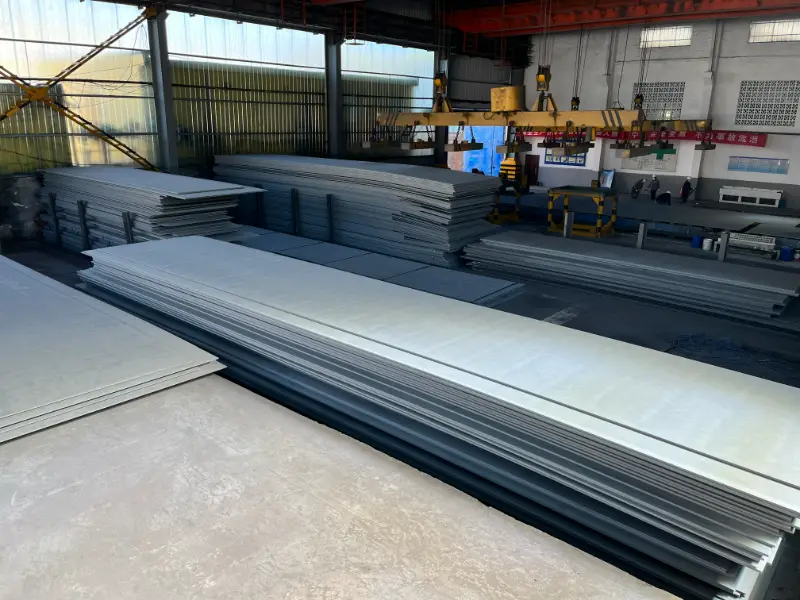
Q550C Carbon and Low-alloy High-strength Steel Plate
Q550C Carbon and Low-alloy High-strength Steel Plate - GB/T 16270 Analysis & Substitute
Detailed material data for Q550C steel plate defined in China GB/T 16270 standard: chemical composition, mechanical and thermal properties, international equivalents, and application insights for construction and machinery.
Quenching + Tempering (Q&T), welding, bending, plasma cutting, machining
- Phone : +8618037372205
- Email : [email protected]
- WhatsApp: Contact via Whtsapp
- WeChat: +8618037372205
Q550C Carbon and Low-alloy High-strength Steel Plate Introduction
Q550C is a high-strength low-alloy structural steel plate specified in China National Standard GB/T 16270. It is delivered in the quenched and tempered (Q+T) condition, offering a minimum yield strength of 550 MPa and good toughness at 0°C (C-grade impact requirement). The steel exhibits excellent weldability and moderate formability after tempering.
Typical applications include heavy-duty machinery, mining equipment, and bridge structures where a combination of high strength, corrosion resistance, and reliable low-temperature service performance is essential.
- Microalloyed with elements like Cr, Ni, Mo, V, Nb, Ti to achieve strength and grain refinement.
- Low carbon equivalent (CEV) ensures good weldability.
- Available in a wide range of plate thicknesses with consistent mechanical properties.
Q550C Carbon and Low-alloy High-strength Steel Plate Chemical Composition
Chemical limits for Q550C according to GB/T 16270. The alloying elements ensure deep hardenability and temper resistance while keeping carbon equivalent (CEV) within a weldable range. Residuals and gas contents are tightly controlled.
Note: Microalloying elements such as V, Nb, Ti may be added singly or in combination; B can be used for grain refinement.
| Element | Standard Value (max, unless range given) | Remarks |
|---|---|---|
| C | ≤ 0.18 | Carbon |
| Si | ≤ 0.60 | Silicon |
| Mn | ≤ 1.70 | Manganese |
| P | ≤ 0.020 | Phosphorus (max for quality C) |
| S | ≤ 0.010 | Sulfur (max for quality C) |
| Cr | ≤ 1.00 | Chromium |
| Ni | ≤ 1.00 | Nickel |
| Mo | ≤ 0.60 | Molybdenum |
| Cu | ≤ 0.50 | Copper (residual or added) |
| B | ≤ 0.004 | Boron (if used) |
| V | ≤ 0.08 | Vanadium |
| Nb | ≤ 0.06 | Niobium (Columbium) |
| Ti | ≤ 0.05 | Titanium |
Q550C Carbon and Low-alloy High-strength Steel Plate Thermal & Electrical Physical Properties
The following physical properties are typical for a quenched and tempered low-alloy steel similar to Q550C. They are provided for design and engineering calculations. Actual values may vary slightly depending on precise chemical composition and heat treatment conditions.
Data are representative for the temperature range 20–100°C unless otherwise noted.
| Property | Typical Value | Unit | Test Condition / Remarks |
|---|---|---|---|
| Density (ρ) | 7.85 | g/cm³ | At 20°C |
| Modulus of Elasticity (E) | 205 | GPa | Static, at room temperature |
| Shear Modulus (G) | 79.3 | GPa | Calculated from E and ν |
| Poisson's ratio (ν) | 0.30 | – | Elastic range |
| Thermal expansion coefficient (α) | 11.5 × 10⁻⁶ | 1/K | Between 20°C and 100°C |
| Thermal expansion coefficient (α) | 12.0 × 10⁻⁶ | 1/K | Between 20°C and 200°C |
| Thermal conductivity (λ) | 45 | W/(m·K) | At 20°C |
| Specific heat capacity (c) | 460 | J/(kg·K) | At 20°C |
| Electrical resistivity (ρ_e) | 0.20 × 10⁻⁶ | Ω·m | At 20°C |
Q550C Carbon and Low-alloy High-strength Steel Plate Mechanical Properties
Mechanical properties specified in GB/T 16270 for Q550C are based on transverse test pieces unless otherwise stated. Impact energy is guaranteed in the longitudinal direction. The plate thickness range influences strength and elongation. Bend tests require crack-free 180° bending with various mandrel diameters.
| Property | Standard Requirement | Unit | Test Condition / Thickness |
|---|---|---|---|
| Yield Strength (ReH/Rp0.2) | ≥ 550 | MPa | Plate thickness ≤ 50 mm |
| Yield Strength (ReH/Rp0.2) | ≥ 530 | MPa | Plate thickness > 50 mm ≤ 100 mm |
| Yield Strength (ReH/Rp0.2) | ≥ 510 | MPa | Plate thickness > 100 mm ≤ 150 mm |
| Tensile Strength (Rm) | 640 ~ 820 | MPa | Plate thickness ≤ 50 mm |
| Tensile Strength (Rm) | 620 ~ 800 | MPa | Plate thickness > 50 mm ≤ 100 mm |
| Tensile Strength (Rm) | 600 ~ 800 | MPa | Plate thickness > 100 mm ≤ 150 mm |
| Elongation after fracture (A) | ≥ 16 | % | Plate thickness ≤ 50 mm, gauge L₀=50 mm |
| Elongation after fracture (A) | ≥ 16 | % | Plate thickness > 50 mm ≤ 100 mm |
| Elongation after fracture (A) | ≥ 16 | % | Plate thickness > 100 mm ≤ 150 mm |
| Bending test (d = bend diameter, a = thickness) | d = 3a, 180° no cracks | Plate thickness ≤ 50 mm, transverse sample | |
| Bending test | d = 4a, 180° no cracks | Plate thickness > 50 mm ≤ 100 mm | |
| Bending test | d = 5a, 180° no cracks | Plate thickness > 100 mm ≤ 150 mm | |
| Impact energy (KV₂, longitudinal) | ≥ 47 | J | Test temperature 0°C (for grade C) |
Q550C Carbon and Low-alloy High-strength Steel Plate Fully Equivalent Material Standards & Substitutable Grades
The table below lists standards and grades that are technically equivalent to Q550C in terms of quenched & tempered delivery condition, minimum yield strength ≥550 MPa, and 0°C impact toughness. These can be used as direct substitutes in design and procurement.
| Country/Region | Standard | Grade/Designation | Remarks |
|---|---|---|---|
| China | GB/T 16270 | Q550C | Original grade, quenched and tempered |
| Europe | EN 10025-6 | S550Q | +Q (quenched and tempered), quality grade comparable when Charpy test at 0°C specified |
| International | ISO 4950-2 | E550DD | DD quality ensures energy ≥ 47 J at 0°C (longitudinal) |
| Germany | DIN EN 10025-6 | S550Q | Identical to EN 10025-6 |
| UK | BS EN 10025-6 | S550Q | Adopted EN standard |
Q550C Carbon and Low-alloy High-strength Steel Plate Application Introduction
Q550C is engineered for heavy structural applications where weight savings and high load capacity are critical. Its balanced combination of strength, toughness, and weldability makes it a first choice for mobile equipment and dynamic structures. Components are typically flame-cut or plasma-cut, bent, and welded.
Use recommendations:
- Preheat before welding according to carbon equivalent and thickness.
- Low-hydrogen welding consumables are mandatory.
- Post-weld heat treatment is generally not required for Q550C but may be applied after evaluating stress relief.
Product Applications: Excavator boom and arm plates, Crane main chords and outrigger frames, Mining dump truck body liners and frames, Bulldozer push arms and ripper shanks, Girder flanges and web plates in steel bridges
Processed into products: Welded structural beams and columns, Flame-cut brackets and gussets, Bent forming parts like J-hooks and lifting lugs, High-wear pads and reinforcing plates, Machined pin joints and connector plates (after cutting)
Application industries: Construction machinery (excavators, bulldozers, loaders), Mining and quarrying equipment (crushers, screeners, dumpers), Crane and heavy transport industry (mobile crane booms, chassis), Bridge and structural engineering (box girders, diaphragms), Offshore platforms (deck beams, stiffeners)
Q550C Carbon and Low-alloy High-strength Steel Plate Similar / Alternative Material Recommendations
These grades offer comparable yield strength levels (around 550 MPa) and are often considered as alternatives, though processing routes or toughness requirements may differ. Adaptations in welding and forming procedures may be needed.
| Country/Region | Standard | Grade | Remarks |
|---|---|---|---|
| China | GB/T 1591 | Q550C | Hot-rolled or normalized; yields 550 MPa but less uniform through-thickness properties. Impact test at 0°C (C grade). |
| China | GB/T 16270 | Q550D | Same strength, impact at -20°C; suitable for colder service. |
| Europe | EN 10025-3 | S550M | Thermo-mechanically rolled (M), yield ~550 MPa, better weldability but less heat-treated strength. |
| Japan | JIS G3128 | SQV2A | Pressure vessel quenched steel, yield ≥500 MPa, toughness characteristic equivalent to 0°C (approximate substitution). |
Notes:
Additional information:
- Q550C plates are available in thicknesses from 6 mm to 150 mm (thicker on agreement).
- Carbon equivalent (CEV) typically ≤ 0.47% for weldability class A; check producer certificates.
- Ultrasonic testing per GB/T 2970 is often required for critical members.
- For sour service or harsh environments, supplementary requirements for HIC/SSC resistance must be specified separately.
- Share



