
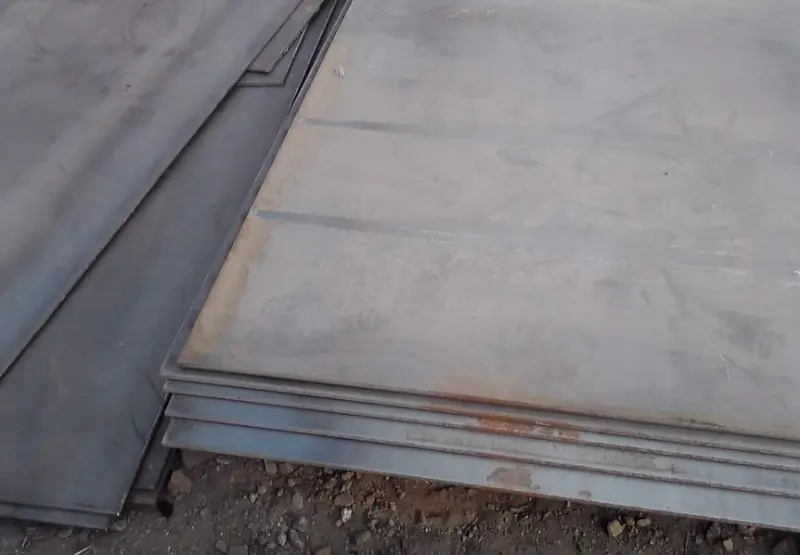
Q500F Quenched and Tempered High-Strength Steel Plate
Q500F Quenched and Tempered High-Strength Steel Plate - GB/T 16270 Properties and Equivalents
Comprehensive material data for Q500F carbon and low-alloy high-strength structural steel plate according to Chinese standard GB/T 16270, covering chemical composition, mechanical and physical properties, international equivalents, and application guidance.
Hot rolling followed by quenching and tempering (Q&T); suitable for welding, cutting, cold forming, and machining
- Phone : +8618037372205
- Email : [email protected]
- WhatsApp: Contact via Whtsapp
- WeChat: +8618037372205
Q500F Quenched and Tempered High-Strength Steel Plate Introduction
Q500F is a carbon and low-alloy high-strength structural steel grade specified in Chinese standard GB/T 16270. It belongs to the quenched and tempered (Q&T) delivery condition, providing a minimum yield strength of 500 MPa combined with excellent low-temperature toughness down to -60°C (Charpy V-notch impact energy ≥ 27 J). The steel is characterized by fine grain microstructure, good weldability, and balanced mechanical properties. Typical thickness range is up to 150 mm. Q500F is widely used in heavy-duty welded structures such as bridges, offshore platforms, construction machinery, and high-rise buildings where high strength-to-weight ratio and resistance to brittle fracture at very low temperatures are required. The grade offers good formability and is supplied in normalized or quenched and tempered condition according to customer requirements.
Q500F Quenched and Tempered High-Strength Steel Plate Chemical Composition
The chemical composition of Q500F steel according to GB/T 16270 is designed to achieve high strength and good low-temperature toughness through controlled microalloying and low impurity levels. Maximum limits for carbon and alloying elements ensure good weldability, while additions of Nb, V, Ti, and Al provide fine grain refinement. The carbon equivalent (CEV) is typically restricted to ≤ 0.47-0.52 depending on thickness, ensuring hydrogen-induced cracking resistance. Actual values may be tightened by additional agreements.
| Element | Content (%) | Remarks |
|---|---|---|
| Carbon (C) | ≤0.18 | Maximum |
| Silicon (Si) | ≤0.55 | Maximum |
| Manganese (Mn) | ≤1.70 | Maximum |
| Phosphorus (P) | ≤0.020 | Maximum |
| Sulfur (S) | ≤0.010 | Maximum |
| Chromium (Cr) | ≤0.80 | Maximum |
| Nickel (Ni) | ≤1.00 | Maximum |
| Molybdenum (Mo) | ≤0.50 | Maximum |
| Copper (Cu) | ≤0.50 | Maximum (if specified) |
| Boron (B) | ≤0.005 | Maximum |
| Nitrogen (N) | ≤0.020 | Maximum |
| Niobium (Nb) | ≤0.06 | Maximum |
| Vanadium (V) | ≤0.10 | Maximum |
| Titanium (Ti) | ≤0.05 | Maximum |
| Aluminum (Al total) | ≥0.015 | Minimum for grain refinement |
| Carbon Equivalent (CEV) | ≤0.47 (typical) | Calculated; may vary with thickness per standard |
Q500F Quenched and Tempered High-Strength Steel Plate Thermal and Electrical Physical Properties
The values below represent typical physical properties of quenched and tempered low-alloy high-strength steels similar to Q500F. They are not specified in GB/T 16270 and are provided for engineering reference only. Actual values may vary depending on exact chemical composition, heat treatment, and processing history.
| Property | Typical Value | Unit | Conditions / Remarks |
|---|---|---|---|
| Density (ρ) | 7.85 | g/cm³ | At 20°C |
| Modulus of elasticity (E) | 205–210 | GPa | At room temperature |
| Shear modulus (G) | 80 | GPa | At room temperature |
| Poisson's ratio (ν) | 0.28–0.30 | - | Typical for steels |
| Thermal expansion coefficient (α) | 11.5–12.5 | 10⁻⁶/K | Between 20°C and 100°C |
| Thermal conductivity (λ) | ~42 | W/(m·K) | At 50°C |
| Specific heat capacity (cp) | ~460 | J/(kg·K) | At 50°C |
| Electrical resistivity (ρe) | ~0.18–0.25 | 10⁻⁶ Ω·m | At 20°C |
Q500F Quenched and Tempered High-Strength Steel Plate Mechanical Properties
The mechanical properties of Q500F steel are guaranteed for quenched and tempered condition. Yield and tensile strength values depend on plate thickness. Impact toughness is verified by Charpy V-notch tests at -60°C. Bending test requirements are also defined. All tests are carried out on specimens oriented in the transverse direction unless otherwise agreed. Note: For thicknesses above 150 mm, properties shall be agreed upon.
| Property | Value | Unit | Test Conditions / Remarks |
|---|---|---|---|
| Yield strength (ReH) | ≥500 | MPa | Thickness ≤ 50 mm |
| Yield strength (ReH) | ≥480 | MPa | Thickness >50 mm to ≤100 mm |
| Yield strength (ReH) | ≥440 | MPa | Thickness >100 mm to ≤150 mm |
| Tensile strength (Rm) | 610–770 | MPa | Thickness ≤ 50 mm |
| Tensile strength (Rm) | 590–750 | MPa | Thickness >50 mm to ≤100 mm |
| Tensile strength (Rm) | 540–720 | MPa | Thickness >100 mm to ≤150 mm |
| Elongation (A) | ≥17 | % | Thickness ≤ 50 mm, gauge length 5.65√So |
| Elongation (A) | ≥17 | % | Thickness >50 mm to ≤150 mm |
| Bending test (bend angle 180°) | d=3a | - | Thickness ≤ 16 mm (a = specimen thickness) |
| Bending test (180°) | d=4a | - | Thickness >16 up to 40 mm |
| Bending test (180°) | d=5a | - | Thickness >40 up to 63 mm |
| Bending test (180°) | d=6a | - | Thickness >63 up to 80 mm |
| Charpy V-notch impact energy (KV₂) | ≥27 (average) | J | At -60°C, longitudinal specimens |
| Charpy V-notch impact energy (KV₂) | ≥19 (single min.) | J | At -60°C, longitudinal specimens |
Q500F Quenched and Tempered High-Strength Steel Plate Fully Equivalent Material Standards and Replacement Grades
| Country / Region | Standard | Grade | Remarks |
|---|---|---|---|
| China | GB/T 16270 | Q500F | Original grade |
| Europe | EN 10025-6 | S500QL1 | Closest European grade; quenched and tempered, minimum yield 500 MPa, impact tested at -40°C (Q500F requires -60°C). Chemical composition may slightly differ. |
| – | – | – | No direct equivalent in ASTM, JIS, or other international standards for a 500 MPa Q&T plate with -60°C impact requirement. |
Q500F Quenched and Tempered High-Strength Steel Plate Application Introduction
Q500F is a versatile high-strength steel that can be used in a wide range of heavy engineering applications. Its combination of 500 MPa yield strength and -60°C guaranteed toughness makes it especially suitable for constructions exposed to extreme weather and dynamic loads.
- Welding: Suitable for all common arc welding processes with low-hydrogen consumables and proper preheat/interpass control.
- Forming: Can be cold bent and formed, but greater springback than mild steel; hot forming may be used.
- Machining: Good machinability in quenched and tempered condition; use carbide tools.
- Fatigue: Designed for structures subjected to cyclic loading; follow design codes to utilize high fatigue strength.
Product Applications: Steel plates and flats for welded structures, Cut-to-length plates for fabrication, Submerged arc welded pipes (when further processed into tubular components), Prefabricated bridge girders and sections, Offshore platform nodes and members
Processed into products: Main longitudinal girders of bridges, Bearing plates and bolted joints, Articulated crane boom sections, Offshore jacket leg chords and braces, Wind turbine tower base plates, Heavy-duty excavator buckets and arms, Pressure vessel shells (requires supplementary certification)
Application industries: Bridge engineering (highway and railway bridges), Offshore oil & gas platforms (jacket legs, topside modules), Construction machinery (crane booms, excavator arms, bulldozer frames), Wind power (turbine tower sections, transition pieces), Shipbuilding (hull reinforcements, icebreakers), Mining & mineral processing (dump truck bodies, crusher frames), High-rise building structures (columns, trusses)
Q500F Quenched and Tempered High-Strength Steel Plate Similar or Alternative Materials with Comparable Performance
| Country / Region | Standard | Grade | Remarks |
|---|---|---|---|
| China | GB/T 16270 | Q500D | Same strength and chemical composition but impact at -20°C; suitable for less severe low-temperature service. |
| China | GB/T 16270 | Q500E | Impact at -40°C; intermediate toughness between Q500D and Q500F. |
| Europe | EN 10025-6 | S500Q | Quenched and tempered, impact at 0°C; lower toughness requirement. |
| Europe | EN 10025-6 | S500QL | Quenched and tempered, impact at -20°C. |
| Europe | EN 10025-6 | S500QL1 | Quenched and tempered, impact at -40°C; closest European alternative. |
| Japan | JIS G 3128 | SHY 685 | Higher strength (685 MPa yield) and may require careful welding procedure; can be considered for some applications with redesign. |
| USA | ASTM A514/A514M | Grade B, H, F, Q | Yield strength 690 MPa, higher than Q500F; suitable for ultra-high strength but with different toughness and weldability characteristics. |
Notes:
Delivery condition is quenched and tempered (symbol Q). For thicknesses above 80 mm, supplementary requirements such as ultrasonic testing (e.g., according to GB/T 2970) are commonly specified. The steel may be supplied with improved notch toughness or through-thickness properties (Z-quality) upon agreement. When procuring, attention must be given to the actual carbon equivalent value and welding procedure specification to avoid cold cracking. Maximum hardness values in heat-affected zones are typically controlled by limiting chemical composition and using appropriate welding heat input.
- Share



