
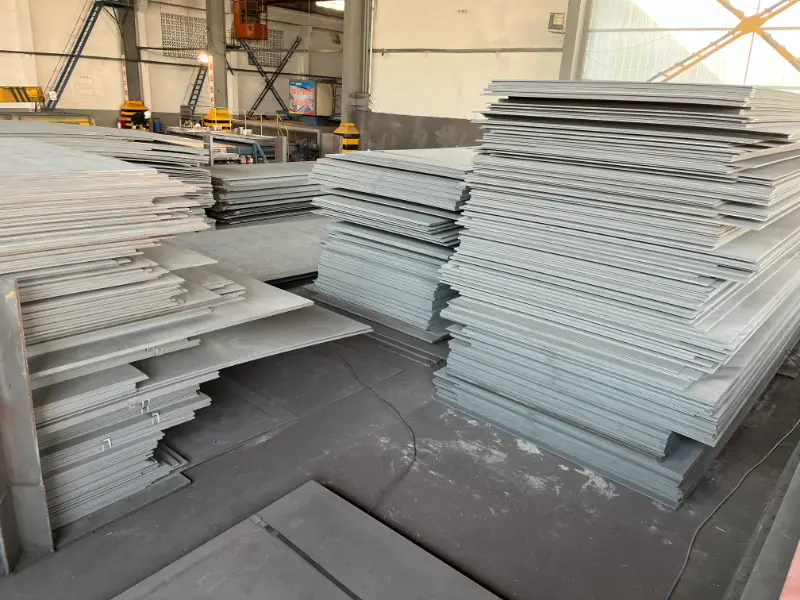
Q550E High-Strength Steel Plate
Q550E High-Strength Steel Plate: GB/T16270 Standard, Quenched & Tempered Low-Alloy for Welded Structures
Q550E is a Chinese high-strength low-alloy quenched and tempered steel plate with minimum yield strength 550 MPa, excellent low-temperature toughness (E-class, -40°C), and good weldability. Conforming to GB/T 16270, it is widely used in heavy welded structures such as bridges, pressure vessels, and machinery.
Hot rolling followed by quenching and tempering; suitable further processes include cutting (flame, plasma, laser), welding (SMAW, SAW, GMAW), bending, and machining.
- Phone : +8618037372205
- Email : [email protected]
- WhatsApp: Contact via Whtsapp
- WeChat: +8618037372205
Q550E High-Strength Steel Plate Introduction
Q550E is a high-strength low-alloy structural steel plate defined by the Chinese standard GB/T 16270. It is supplied in the quenched and tempered (Q+T) condition, offering a minimum yield strength of 550 MPa and excellent impact toughness down to -40°C (Grade E). The steel combines good weldability with high resistance to brittle fracture, making it suitable for heavy-duty welded structures subject to dynamic loads and low temperatures. Key features include:
- High strength-to-weight ratio, enabling lighter designs
- Superior notch toughness at sub-zero temperatures
- Controlled chemistry with microalloying elements (Nb, V, Ti, B) for fine grain strengthening
- Good cold forming and welding properties when proper procedures are followed
Typical applications span construction, bridge building, offshore engineering, pressure vessels, heavy machinery, and vehicle manufacturing.
Q550E High-Strength Steel Plate Chemical Composition
Chemical composition limits according to GB/T 16270-2009 for grade Q550E (heat analysis). All values are maximum unless a range is specified. Microalloying elements like Nb, V, Ti, and B are added for grain refinement and precipitation hardening. The carbon equivalent (CEV) is also controlled to ensure good weldability.
- CEV = C + Mn/6 + (Cr + Mo + V)/5 + (Ni + Cu)/15
- Low sulphur and phosphorus contents enhance toughness and resistance to lamellar tearing.
| Element | Content (wt%) | Remarks |
|---|---|---|
| C | ≤ 0.18 | Main hardening element |
| Si | ≤ 0.60 | Deoxidizer, strength contributor |
| Mn | ≤ 1.80 | Grain refiner, strength and toughness |
| P | ≤ 0.025 | Impurity, minimized for toughness |
| S | ≤ 0.015 | Impurity, low for weldability |
| Cr | ≤ 0.80 | Hardenability element |
| Ni | ≤ 0.80 | Toughness and hardenability |
| Mo | ≤ 0.30 | Hardenability and temper resistance |
| V | ≤ 0.10 | Microalloying for precipitation strengthening |
| Nb | ≤ 0.06 | Grain refinement and precipitation |
| Ti | ≤ 0.05 | Grain refinement, nitrogen fixation |
| B | ≤ 0.004 | Hardenability enhancer |
| Cu | ≤ 0.50 | Residual element, may improve corrosion resistance |
| CEV | Typically ≤ 0.50 | Carbon equivalent, for weldability assessment |
Q550E High-Strength Steel Plate Thermal and Electrical Physical Properties
Physical properties are typical for low-alloy high-strength quenched and tempered steel plates of similar composition. These values are not mandatory in the delivery standard but serve as engineering reference data.
- Properties vary slightly with temperature and heat treatment condition.
- Electrical resistivity and thermal conductivity are influenced by alloy content and microstructure.
| Property | Standard Requirement | Unit | Test Condition |
|---|---|---|---|
| Density (ρ) | approx. 7.85 | g/cm³ | At 20 °C |
| Modulus of elasticity (E) | approx. 210 | GPa | At room temperature |
| Shear modulus (G) | approx. 81 | GPa | At room temperature |
| Poisson's ratio (ν) | approx. 0.30 | — | At room temperature |
| Thermal expansion coefficient (α, 20–100 °C) | approx. 12.0 | 10⁻⁶/K | Mean coefficient between 20 °C and 100 °C |
| Thermal conductivity (λ) | approx. 45 | W/(m·K) | At 100 °C |
| Specific heat capacity (cp) | approx. 480 | J/(kg·K) | At 20 °C |
| Electrical resistivity (ρe) | approx. 0.20 | 10⁻⁶ Ω·m | At 20 °C |
Q550E High-Strength Steel Plate Mechanical Properties
Mechanical properties specified in GB/T 16270-2009 for Q550E in quenched and tempered condition. Testing is carried out on longitudinal specimens unless otherwise noted. Yield and tensile strengths apply to as-supplied plate; impact energy is for standard Charpy V-notch specimens at -40 °C.
- Properties are thickness dependent; values for thickness >16 mm are for the core region.
- Bending tests are performed with the bend axis perpendicular to the rolling direction.
| Property | Standard Requirement | Unit | Test Condition |
|---|---|---|---|
| Yield strength (ReH) | ≥ 550 | MPa | Plate thickness ≤ 50 mm |
| Yield strength (ReH) | ≥ 530 | MPa | Plate thickness > 50–100 mm |
| Yield strength (ReH) | ≥ 510 | MPa | Plate thickness > 100–150 mm |
| Tensile strength (Rm) | 670 – 830 | MPa | All thickness ranges |
| Elongation after fracture (A) | ≥ 16 | % | Thickness ≤ 100 mm, longitudinal, L0 = 5.65√S0 |
| Elongation after fracture (A) | ≥ 15 | % | Thickness > 100–150 mm, longitudinal |
| Charpy V-notch impact energy (KV2) | ≥ 34 | J | At -40 °C, longitudinal, thickness > 16 mm |
| Bend test (180°) | d = 3a (no cracks) | — | Thickness ≤ 16 mm, bend axis perpendicular to rolling direction |
| Bend test (180°) | d = 4a (no cracks) | — | Thickness > 16 mm, bend axis perpendicular to rolling direction |
Q550E High-Strength Steel Plate Fully Equivalent Material Standards and Substitute Grades
| Country/Region | Standard | Grade | Remarks |
|---|---|---|---|
| China | GB/T 16270 | Q550E | Original standard; quenched and tempered, -40°C impact ≥34 J |
| European Union | EN 10025-6 | S550QL | Quenched and tempered, -40°C impact; similar chemical and mechanical requirements |
| International | ISO 4950-2 | S550QL | Same as EN 10025-6 S550QL, globally recognized |
Q550E High-Strength Steel Plate Application Introduction
Q550E steel is engineered for heavy welded structures that demand high strength and reliable low-temperature service. Its quenched and tempered condition provides an optimum balance of strength and toughness, enabling weight reduction without compromising safety. Typical applications include:
- Bridge construction: main girders, cross beams, and orthotropic deck plates where fatigue and brittle fracture resistance are critical.
- Pressure vessels and storage tanks: shells and heads subjected to moderate pressures and low-temperature environments.
- Offshore and marine structures: platform legs, nodes, and heavy-lift crane pedestals exposed to severe weather.
- Heavy-duty machinery: frames, booms, and chassis of mobile cranes, excavators, and mining trucks.
- Wind energy: tubular towers and transition pieces for onshore and offshore wind turbines.
When used in welded assemblies, preheating and strict heat input control are recommended to avoid cold cracking and to preserve the heat-affected zone toughness.
Product Applications: Bridge main girder plates, Pressure vessel shells, Offshore platform structural nodes, Crane boom segments, Wind turbine tower sections, Heavy-duty truck chassis
Processed into products: Welded box girders, Flanges and webs for fabricated beams, Load-bearing brackets, Crane outriggers, Boom and arm assemblies, Structural reinforcement plates
Application industries: Bridge and infrastructure, Heavy machinery manufacturing, Pressure vessel and boiler, Offshore and marine engineering, Wind energy, Transport and lifting equipment
Q550E High-Strength Steel Plate Similar and Alternative Materials for Reference
| Country/Region | Standard | Grade | Remarks |
|---|---|---|---|
| China | GB/T 16270 | Q550D | Same strength class, impact requirement only at -20°C; less demanding toughness |
| China | GB/T 16270 | Q500E | Lower minimum yield strength (500 MPa), same toughness class; lighter gauge applications |
| China | GB/T 16270 | Q620E | Higher yield strength (620 MPa), similar toughness; where higher static strength is needed |
| European Union | EN 10025-6 | S500QL | Yield 500 MPa, toughness -40°C; slightly lower strength alternative |
| European Union | EN 10025-6 | S460QL | Yield 460 MPa, toughness -40°C; more common for general high-strength structures |
| United States | ASTM A514 / A517 | Grade B, H, F, etc. | Yield 690 MPa, higher strength; requires careful welding procedures, differ in toughness classes |
Notes:
Welding recommendations: Use low-hydrogen processes (SMAW with basic electrodes, SAW, GMAW) and dry electrodes/fluxes. Preheat to 100–200°C depending on thickness and carbon equivalent. Interpass temperature should not exceed 250°C. Post-weld heat treatment (PWHT) is generally not required for thicknesses below 50 mm, but stress relieving at 550–600°C may be applied for thick components to reduce residual stresses.
Forming: Cold bending radii should follow the recommended d=3a or d=4a to avoid cracking. Hot forming should be done at temperatures above the tempering temperature, followed by re-tempering if necessary.
Surface quality: Plates are ultrasonically tested per GB/T 2970 or agreed standard to ensure internal soundness. Additional requirements (e.g., Z-direction properties, CTOD testing) can be ordered for critical applications.
Health and safety: During welding and cutting, proper ventilation and protective equipment are required due to fumes and UV radiation.
- Share



